As I mentioned earlier, last week was a busy one in part because I was busy presenting at the Minnesota Library Association’s annual conference last week. It was a blast! The audiences were participatory and I learned a lot from my co-presenters in each presentation. What fun.
“The ACRL Framework for Information Literacy: What does it mean for instruction librarians?”
Presented by Iris Jastram (Carleton), Jason Paul (St. Olaf), and Rachel Weiss (Augustana), this presentation updated instruction librarians on the new (draft) Framework for Information Literacy from ACRL.
“Studying the Second Year: College Sophomores, Research Behavior, and Information Communication.”
Presented by Anna Hulseberg (Gustavus), Iris Jastram (Carleton), Heather Tompkins (Carleton), and Michelle Twait (Gustavus). this presentation combined Carleton’s Information Literacy in Student Writing project with Gustavus’ mixed methods study of sophomore research practices.
As it turns out, I’ll be presenting at MLA not once but twice this week, so if you’re headed there be sure to stop by and say hi!
First I’ll be part of a panel with Jason Paul of St. Olaf and Rachel Weiss of Augustana entitled “The ACRL Framework for Information Literacy: What Does It Mean for Instruction Librarians?” We’ll talk about weaving together your institution’s mission and the new (still draft) Framework for Information Literacy to create elements in your library sessions that move students toward greater competence with the core concepts of the Framework.
Then I’ll do a quick change and present with my colleague Heather Tompkins and with two colleagues from Gustavus, Anna Hulseberg and Michelle Twait, on a session entitled “Studying the Second Year: College Sophomores, Research Behavior, and Information Communication.” The Gustavus librarians have done some fascinating research into the behaviors of sophomores who are preparing research projects, and Heather and I have been part of our library’s Information Literacy in Student Writing (based off of sophomore writing). Put the two together and we suddenly know quite a lot about sophomore skills and habits when it comes to research.
Last week was Chronic Illnesses week. Last week was also the first week of classes at my institution, so time and energy for reflective blogging was at a pretty low ebb. But perhaps it’s in keeping with the theme of that week that posts like this happen when the poster is able rather than by some goal written on a calendar.
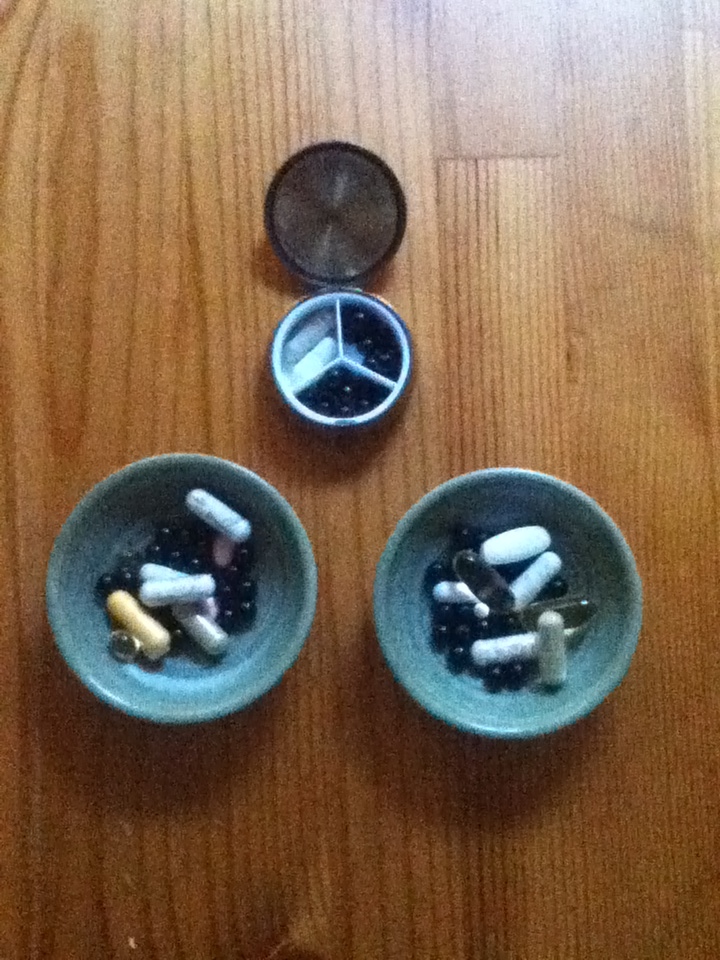
Morning, noon, and night. I can swallow each set in a single gulp! How’s THAT for a super power.
Like many people I know, I live and work while dealing with a chronic illness. These illnesses come in many flavors — mine happens to be Chronic Fatigue Syndrome. A few years ago, my CFS was so debilitating that I seriously contemplated quitting my job and moving in with my parents to be an invalid on their couch for the remainder of my days, and I honestly hoped that those days would be few in number. I had no realistic hope for improvement and no energy to live. Basic things like chewing were often too tiring to contemplate. Breathing was a chore. Work? I was doing my best, but students were beginning to comment that I looked mostly dead, my supervisor kindly removed me from every project and committee I was on in one fell swoop, and my poor colleagues took up more of my slack than was fair (and did so without complaint, for which I will be forever grateful).
Thankfully, things have improved since then. I can’t work the 60- and 70-hour weeks I worked years ago, but I can put in a full, enthusiastic day at work as long as I don’t do anything else that day. I can’t keep a spotless house, but I can keep a functional one if I work carefully and efficiently. I can’t do a lot of galavanting with friends, but I can make some plans and even keep most of them. And for the first time in 7 years, I have hope that I’ll be able to keep up with life and with work.
Because of the amazing support I’ve received from family, friends, and colleagues, and because of the creativity of my medical team (which includes my unbelievably helpful mom), I’m doing ok.
It’s almost guaranteed that you have someone you work with who is living with a chronic illness of some kind or another, and many of these illnesses are invisible to the casual observer. It’s likely that this person is at the end of his or her rope most of the time, desperately hanging on to some semblance of normalcy. It’s likely that this person is scared and feels like a failure a lot of the time, simultaneously worried about receiving accommodations and about not receiving them, constantly rewriting their sense of self.
You really can make a difference in that person’s life just by being patient, gentle, and kind. I don’t have words to thank the many people in my life who have been and continue to be vital supports for my fragile body and battered psyche. Thank you, from the bottom of my heart. You have made my life possible in the most real sense imaginable.
Abstract: This article reports on a pilot study to examine undergraduate students’ help-seeking behavior when undertaking library research in online courses. A novel methodology incorporating elements of ethnographic research resulted in a small, but rich and detailed, collection of qualitative data. The data suggest that the methodology has promise for future, larger studies on students in online learning environments. The article includes a detailed discussion of the methodology’s strengths and weaknesses, and offers recommendations for modifications that will improve the research design.
I should note that I’m the first author only by virtue of the alphabet. This was truly a group effort.
Please note: all figures are out of place by one position.