
Skip to content

Category: Random Thoughts

sticky clients… no, not those clients

wifiI’m talking about computers, not people, and especially about getting wifi on those computers. Like lots of large places built in a pre-networked era, our building presents special challenges for our poor network staff. IT has worked long and hard configuring and reconfiguring, and yet we keep having trouble getting reliable connectivity. And now I know way more about wifi connectivity than I ever expected to.

So in case your library is having a similar experience, here are the three factors that seem to be/have been causing our dropped connections.

First, networks were not invented with the idea that a single person is likely to have at least two devices pinging the network all the time — a phone plus the laptop, plus maybe a tablet or an ipod or who knows what other wifi-enabled device. IT here added a bunch of capacity for this and so it seems no longer to be an issue for us. Thank goodness.

Second, unless you get dual-band radios for your signal, the radio has to go with the lowest common denominator for signal type: a, b, or g. So if one person with an older laptop comes in needing an “a” signal, the whole area bumps down to “a” signal. So our IT department got us lovely new radios so everyone could be happier in the same space. Thank goodness.

Third, and this is the kicker, it turns out that there’s a sticky client issue built into the very foundation of networking. The way it was explained to me is that back in the day when they were first inventing wifi, they couldn’t conceive of people moving around while also needing wifi. They could only conceive of local networks among stationary computing stations. Flash forward to today, and you have computers who basically mate with their favorite wifi radio and will desperately hang onto that signal however weak and far away, meanwhile completely ignoring the beautiful strong signal of a nearer radio. There’s even a whole paper about it and how people are trying to solve it. So our IT department is working on this fix in hopes that it will make everything work a lot more smoothly.

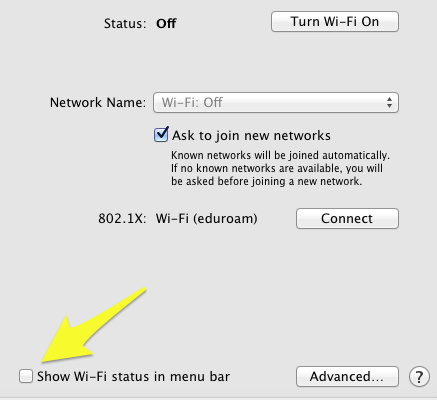
Oh, and if you’re on a Mac, you’re a particularly sticky client. Also the little wifi signal strength indicator could be interfering with your actual signal (headdesk) so I’ve disabled mine. Kind of a pain, but I drop signal a whole lot less frequently.
Network-2

Comments closed

Prioritize or fail

thinkingGreg McKeown was recently on NPR talking about the importance of prioritizing in leadership. He’s been obsessed with the question of why capable people plateau in their fields, and he’s decided that the answer is: success. Success leads to increased opportunity. Increased opportunities lead to diluted focus. Ultimately, he says, “Success can become a catalyst for failure because it leads to the undisciplined pursuit of more.”

After spending a couple of months helping to draft our strategic plan, spending a summer helping to update our mission, vision, and values, and having ongoing conversations about sustainability within my department, McKeown’s ideas seem at once brilliant and impossible.

The fact is, we have been successful, and this has lead to increased opportunities. And personally, my work has broadened in focus from direct reference and instruction about library resources to a myriad of activities aimed at improving teaching and learning on campus as it relates to information literacy. What’s more, I think this broader focus is far healthier and more realistic if my goal is to play a role in graduating information literate seniors (I only ever get to teach a tiny percentage of students, so more systemic information literacy infusions are necessary to my goal). But depending on how I look at it, perhaps I do have a pretty singular goal (graduating information literate seniors), or perhaps I have a plethora of great opportunities that dilute my focus. Where up the hierarchy from the very granular to the very high-level should these focused goals exist?

Comments closed

Being Negative is Safe

It struck me recently that those people who fixate on the flaws in every plan are in safe territory all the time. There are no perfect plans. There are no perfect interfaces. So these people will be right every single time — there are ALWAYS flaws.

But you can’t actually live like that, getting bogged down under the weight of life’s many flaws. And you certainly can’t provide a service or run a business like that. At some point you have to choose a direction and move forward, imperfections and all. This choice to move forward isn’t naiveté, it’s life.

9 Comments

Judging a book by its cover

booksSo here’s a question: If you make your digital humanities project so that the product is a gorgeous website with swoopy interactive capabilities and lush soundscapes, will people engage with it on a deep scholarly level, or will they get stuck in the flash and glam?
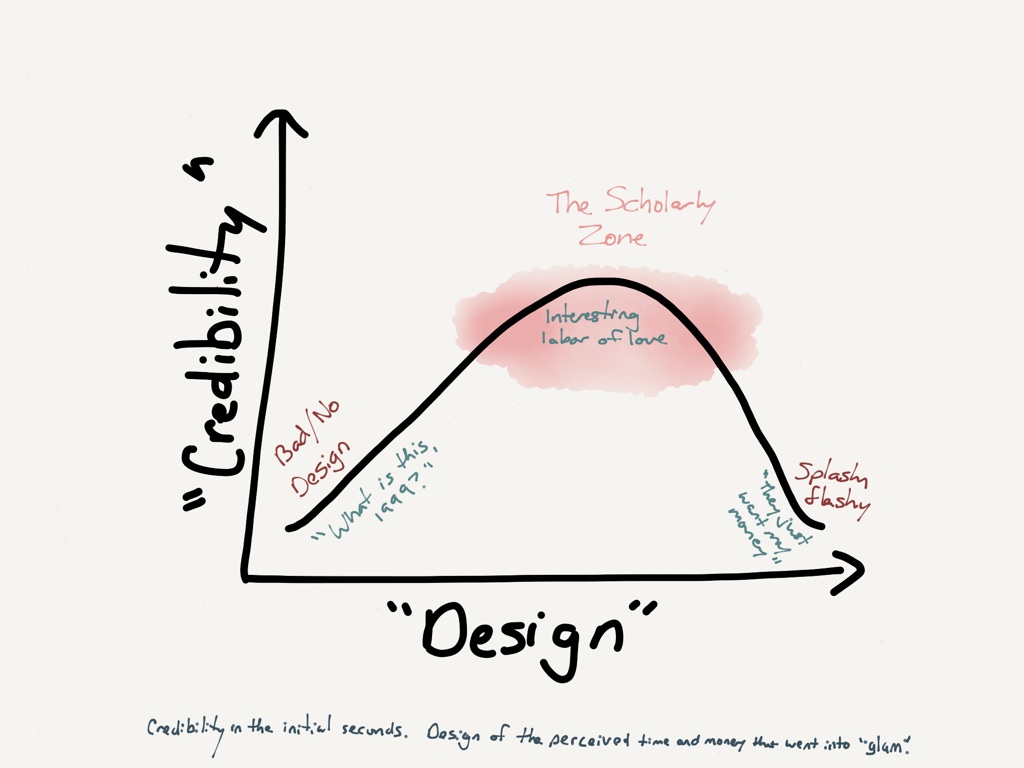
This was a question that came up today at a DH workshop on campus, and it got me to thinking about a similar question that had come up at THATcamp in Denver last year — how much web design do you need before people will pay any attention to your site?

People make snap decisions about website credibility, and they do so largely unconsciously, so research suggests that if you make your site look nice, people will stay on it rather than move on to look for something “better.” This is what people at THATcamp were talking about last year — the need to have enough web design built into their DH projects that their projects will be taken seriously.

On the other end of the spectrum, if a site is TOO beautiful, I start thinking it’s likely to be trying to get money from me. All the money for the custom designing and maintenance has to come from somewhere, right? Likewise, I’m not at all used to seeing scholarly books come out with incredibly designed covers, glossy pages, and custom illustrations.

So maybe there’s some spot part way between “grungy” and “flashy” that would appear the most credible for scholarly DH work. The question is, where along that continuum is the sweet spot?

thoughtgraph

11 Comments