Carleton doesn’t have semesters or even quarters, we have terms. Each term is 10 weeks long, and there’s Fall, Winter, and Spring term. The week numbers of each term matter so much that at the end of every spring term I look ahead to the next year and enter “Week 1, week 2, week 3…” as events on the Monday of each week for the next year’s terms. Week numbers matter more than months or dates or days of the week. Classes start on the Monday of Week 1 and end on the Wednesday of Week 9. Then there are two Reading Days, and then finals run on Saturday, Sunday, and Monday.
Right now we’re at the beginning of 7th week of Spring Term, and it feels like we’ll never survive through to graduation next month. On top of that, it’s been a crazy intense year+ that’s left me burned out and used up. Apparently powering through Chronic Fatigue Syndrome while juggling a ton of extra work, a few massive transitions, plus all the normal intensity of this job only works for so long. The fallout is starting to show up in medical bills and mental anguish.
So how do I turn it around? I like my coworkers and don’t want to let them down. And I’m pretty sure that when I step out of my own head I actually still believe that the work matters. And then there’s the mortgage, which probably won’t pay itself. I want to get back to liking my job. I want to get back to liking me in my job.
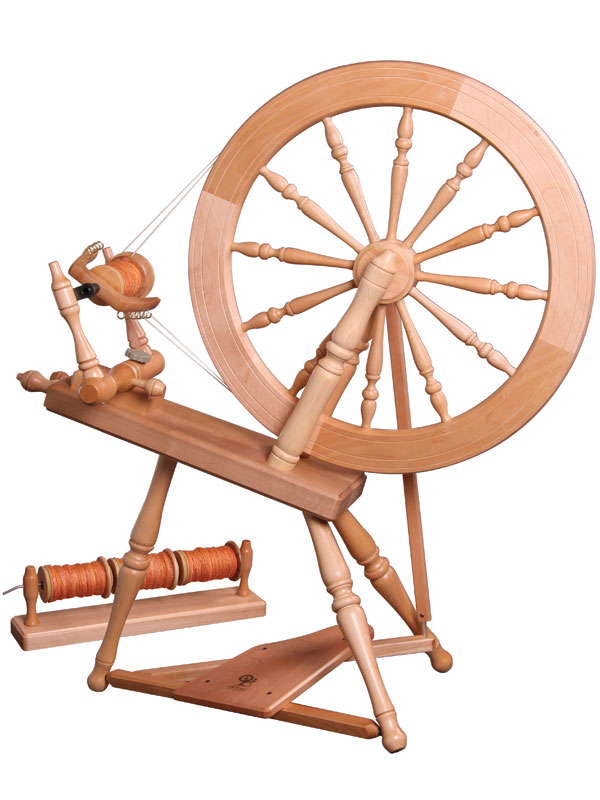
This is my wheel, plus the “lazy kate” to hold the bobbins for plying.
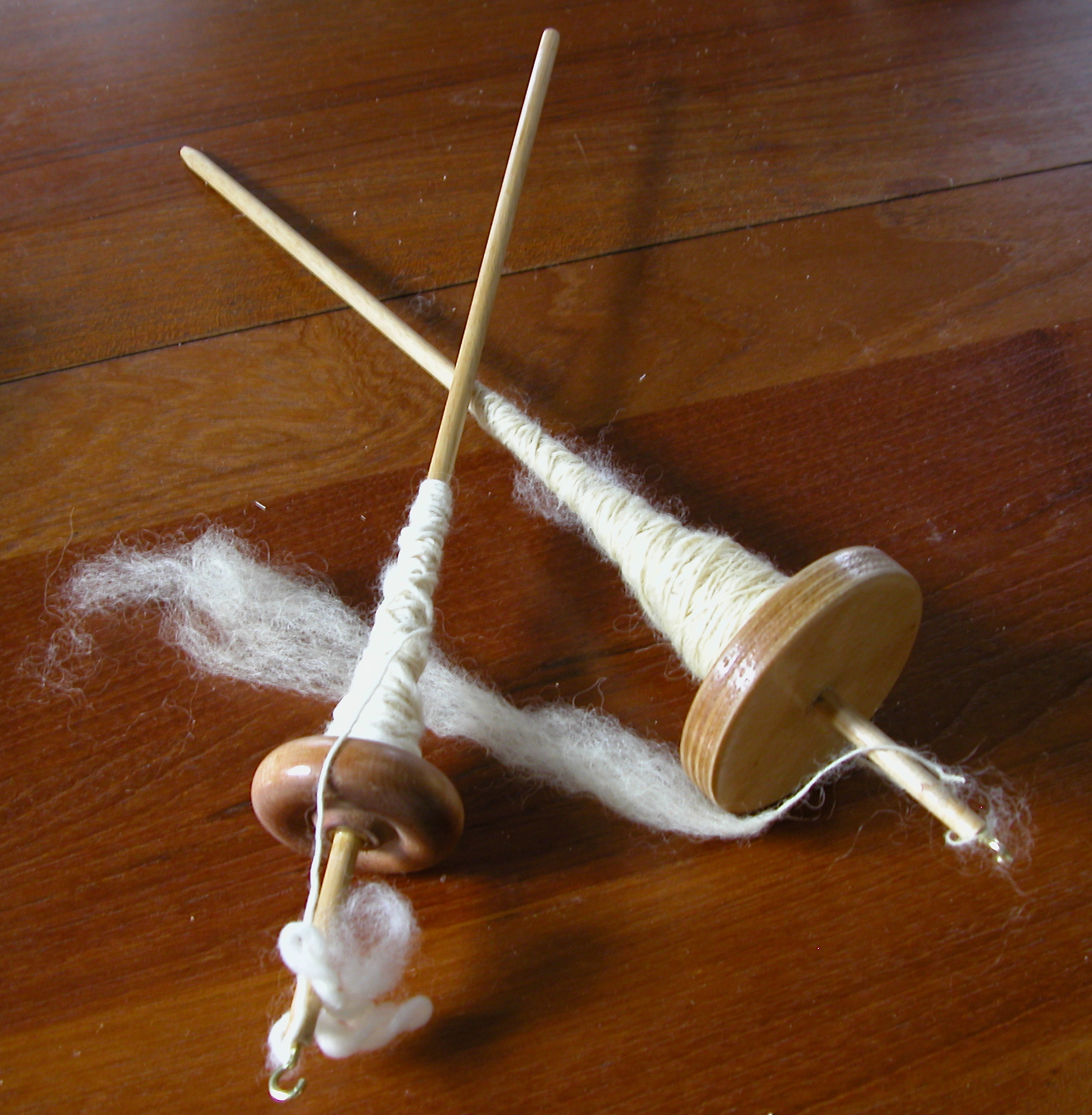
Last week and this week I got to expand my repertoire of class sessions into very new territory. I got invited to a class on early Anglo-Saxon material culture to demonstrate making yarn using a drop spindle and to talk about using that homespun yarn for weaving. And later I got invited to another class studying 18th Century English Workhouses (where the residents did a lot of spinning), to demonstrate making yarn with a treadle spinning wheel and then talk about knitting and weaving with that yarn.
Such fun! I got to use words I’ve never used at work before, like “lazy kate” and “niddy noddy.” Students got to try their hands at spinning with the wheel and the drop spindle. And the one down-side was that I hadn’t oiled my fly wheel recently so there was an annoying squeak. Oh, and that my nephew has hidden my orifice hook, so I had to use a crochet hook to thread the wheel. (Somebody needs to think of a better name for the orifice hook.)
I also got to tell them about sitting with an angora rabbit on my lap and spinning directly from his coat. (And also the other rabbit that hated me and would NEVER sit still for such a thing.) Such a different set of things from the things I normally tell students, and they were soooo much more interested in what I had to say. Database searching is never this fun!
One student in the Workhouses class is building a game scenario in which the gamer “spins” using the space bar as a treadle and some other keys as the hands working with the wool. He needed to know about treadle technique and timing, and he also timed me spinning so that he knew how many inches of yard I can produce per minute.
Next week I’ll rejoin the Anglo-Saxon class to do my demonstrations as part of their end-of-term project: a sort of pre-renaissance fair with demonstrations of all kinds of early Anglo-Saxon material culture. I might even get my very own apprentice.
Example of drop spindles
There was a lot to love about being involved in these classes, but one of my favorite things was that these were heavily digital classes, working with 3D modeling and game design, and here I was doing the farthest thing from digital work I can imagine — making yarn from sheep’s wool. The juxtaposition was delicious.
Back in the ancient days of social networking, all the way back in 2007, my friend and former classmate Josh Neff posted a tweet that rocked the library world, we just didn’t know it yet. He declared that there would be a library society that didn’t charge dues, and that this society would be called the Library Society of the World. My friend Steve Lawson took up the call, and I signed on as a “founding member” along with several others. We gave each other goofy titles and made up goofy bylaws (my contribution was that we would always be one short of a quarum). After a while we set up a chat room on Meebo (remember Meebo??), and a while after that we took up residence on FriendFeed. And little by little it dawned on us that we weren’t joking any more. We were a real library society comprised of library folk from around the world.
In the 7 years we lived together on Friendfeed, membership grew to the thousands depending on where you counted, friendships blossomed and drama came to visit from time to time. Some people left the profession, and new librarians were born. FriendFeed got bought by Facebook (and donated likes and threaded comments to the Facebook interface). And finally Facebook pulled the plug on us in April of 2015.
For nearly a year we’ve been in diaspora. Some went to Facebook, some went to Slack, others went back to Twitter. We tried message boards and Frenf.it. Nothing felt like home.
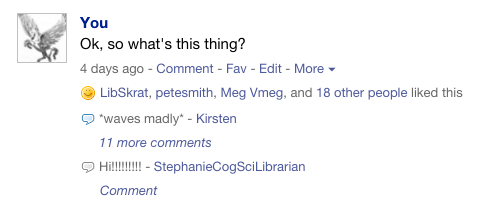
Then mokum.place appeared. And now I’m mounting the call: it’s time to come home! LSWians Unite! And if you aren’t sure just how much like home it will feel, here’s a screenshot for you. Look familiar?
Here at Carleton I’ve been tasked with helping to draft a proposal for a campus-wide digital humanities initiative and infrastructure. Being the librarian that I am, I’ve been spending a good deal of time reading the literature of the field in addition to investigating potential model programs at other institutions and pulling together what amounts to a SWAT analysis about our own institution. And one of the really interesting things in the literature of the field is how librarians are thought of (and think of themselves) in relationship to DH work.
There’s a sizable camp of vocal “librarians should be full partners in the research” proponents. There are quite a few “provide good, quiet service and provide it well” advisers. There’s the “this is a new thing for librarians so we really need to figure out what we can do” camp. And there’s the “there’s nothing new under the sun for librarians so just do this” camp.
I fall somewhere in the middle of all this. There aren’t well-oiled mechanisms here or at many other institutions for humanists (as opposed to scientists) who want to do digitally inflected research, and yet this research is becoming more and more of an expectation in humanities fields. So in that sense there’s an awful lot to figure out, cobble together, and invent when it comes to supporting this research.
On the other hand, librarians have always studied and supported information use and dissemination, research methods, and scholarly communication cultures. We have always fought to make sure that intellectual freedom is a reality and that everyone has a chance to create new knowledge from the record of human thought. These things sit at the core of our profession — the core of our guiding documents and professional ethics.
A few years ago the humanities departments I serve became much more dependent on data and statistics as they engaged in scholarship, so I learned what I needed to know about finding, understanding, and using numerical information. Right now it’s becoming clear to me that the humanities research in my departments has taken on a decidedly spacial flavor, so it’s time for me to learn enough about spacial analysis and GIS to be conversant with the information and methods of the scholarship in my areas. And while I will never be a GIS specialist, basic familiarity is no more outside of my professional scope than leaning database searching was for the librarians who trained me. The stuff of scholarship changes, but our professional expertise lies first in understanding and facilitating how information flows and functions within scholarship, and it lies second in understanding the mechanics of locating the particular kinds of information that happen to be in use at the moment.
On top of all of this, the information that makes up the bulk of the data for humanities scholarship resides in various kinds of libraries, the “labs of the humanities.” The ties between librarian and scholar have always been particularly strong in the humanities. We geek out together over dusty codexes and digitized primary source collections, monograph browsing and frustratingly jargonless full-text article searching, bulky archival boxes and streaming video collections. Humanities scholarship has never been the solo enterprise that has gotten so much air time lately. Librarians and scholars have been there for each other through the ages, though the librarians’ role is often invisible to the broader community. The librarians aren’t listed as co-authors (and shouldn’t be!), but they do participate in very real ways in humanities scholarship’s inception, feasibility, creation, dissemination, and use.
So I think librarians and scholars function best when they are full partners with each other, and I think that “full partnership” often means playing a pretty invisible role.* I think that there is a lot that’s new that needs to be figured out, and I think there’s nothing new under the sun. But most of all I think that this is our world and our reality, and I think that we are equipped to tackle it, messiness and unanswered questions and all.
* There are some problems with invisibility, including things like being underpaid, over worked, etc. But that’s a topic for another post.
Here’s a bibliography of things that contributed to me thinking these thoughts.
Aarsvold, Nancy, Kasia Gonnerman, and Jason N. Paul. “Shaping the Roles of Academic Librarians to Meet Emerging Demands of DH Scholarship.” In Supporting Digital Humanities for Knowledge Acquisition in Modern Libraries, 44–65. Hershey, PA: Information Science Reference, 2015.
Schell, Justin, Jennie M. Burroughs, Deborah Boudewyns, and Cecily Marcus. “From Digital Arts and Humanities to DASH.” In Supporting Digital Humanities for Knowledge Acquisition in Modern Libraries, edited by Kathleen L Sacco, Scott S. Richmond, Sara Parme, and Kerrie Fergen Wilkes, 234–252. Hershey, PA: Information Science Reference, 2015.