Finally, someone with a crystal ball that’s actually working. Tim Spalding of Library Thing writes:
Comments closedI have seen the future of libraries: It is to spend the future discussing the future of libraries.
Finally, someone with a crystal ball that’s actually working. Tim Spalding of Library Thing writes:
Comments closedI have seen the future of libraries: It is to spend the future discussing the future of libraries.
Every summer a group of high school students, gleaned from high schools all over the United States, comes to campus for a week-long program called CLAE (the Carleton Liberal Arts Experience). There are various courses they can take (everything from “how to apply to college” to “the Harlem Renaissance”) with the dual purpose of introducing them to the idea of a liberal arts college and giving them a little bit of experience living and studying on a college campus. The emphasis is really on empowering them to think that college is possible, doable, interesting, intense, and fun.
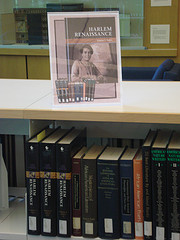
And every year, one of the classes brings all the kids to the library. For the past three summers I’ve worked with the history librarian to prepare the students to engage in a modernized Washington/Du Bois debate. But this year the class and professor changed, so the history librarian and I started from scratch to build a class for students studying the Harlem Renaissance.
My part of the class preparations was to develop an exercise that would introduce the students to the 5 reference sets they’d need to navigate as they prepared for their final presentations. But the big question was how to make it easy for them to pick their sets out from the shelves and shelves of unfamiliar reference books, while still letting them see the sets in context rather than pulled out and put on a cart just for this assignment. Well, to ease this particular rub, I made signs for each set that had a full scan of the cover of the one of the set’s volumes, and then a cut-out image of the set’s place on the shelf.
Then I put these signs up on the shelves above each reference set.

That way, when the students came back to do their research after all of the librarians had gone home for the night, they’d be able to go back to the sets we’d shown them in class. I hope it worked for them.
Oh, and the exercise itself sounded great on paper, but would need more clarification next year. I still like the idea of it, but there were some recurring questions I should have anticipated.
Comments closedWe’re having our mid-meeting break at the moment (all-staff meeting from 9 to noon, followed by lunch and a photo). But I wanted to share my favorite quote of the day. It came from a co-worker, who quoted a speaker he’d heard at the Frye Institute.
2 CommentsThe library is pregnant with change. In fact, it’s nine month’s pregnant, and it’s in the delivery room. And the library has just decided it’s time to go out and buy a pregnancy test.
I attended a cook-out this past weekend and had a wonderful time sitting around in lawn chairs talking, listening to others talk, or listening to the breeze whenever we all fell silent. The gathered group was actually comprised of two sub-groups: people who work at Carleton with one of the hosts and people who don’t work at Carleton but are cool and interesting anyway. By chance, I ended up spending most of my time sitting with the latter subgroup, and twice the Dreaded Question came up.
The DQ, as I like to call it (since I am a librarian and am thus compelled to make acronyms out of any phrase of two or more words), is only slightly less difficult for me to answer than that ubiquitous question: “So… where are you from?” Every time that omni-present conversation opener rears it’s ugly head I have to quickly assess whether the person wants to know where I was born, where I spent my early years, where I spent mostly of my time, where I’m mostly recently from before moving here, or if they just want to know where around here I live. The only thing I know they don’t want to know is everywhere I’m from. It’s very complicated.
But I digress. The DQ, as I’m sure you’ve guessed from the title of this post, comes just slightly after “Where are you from?” and it’s inevitable follow-up, “What do you do?” It’s the thing that comes after you say, “I’m a librarian.”
First there’s the instant smile and the comfortable “oh, that’s nice.”
Then there’s a pause.
And then comes the kicker: “So… what do you do, exactly?”
Long days at the office, dashes across campus to help professors conquer research emergencies, days spent agonizing over classes and preparing for student appointments, weekends spent “catching up,” and hours at the reference desk all flash through my head. But there’s not much that’s coherent, not much that I can latch onto and say “This. This is what I do.” So I rambled both times about working through research processes, sources, and analysis with students and faculty, teaching classes of students before they start out on research assignments, working with intellectual property policy on campus, and sitting at the reference desk several hours a week. We got into how the internet has changed this job in recent years and explanations about why people need a degree to do this job. And then people moved on to talk about a bar somebody liked, the neighbor’s dog, and how much money farmers can make from growing mint.
And maybe that’s ok. I have very little concept of what the woman next to me does all day even though she explained it, and her fiance told me the job is eating her live. Maybe there really are only a handful of jobs in the world that we all know and understand well enough that we don’t have to walk away from newly met people and wonder how they fill their time. Besides, maybe it’s more interesting to work in a job that has so many disparate parts to it, each one with it’s own challenges and rewards.
It’s also gratifying that people actually ask what I do rather than jump to the conclusion that I must shelve books all day. I never ask a lawyer what he or she does all day because I think I know. But I don’t, actually. And it’s only since my cousin became a lawyer that I bothered to find out that there are many branches and specialties in that field. Maybe having people assume our jobs have been usurped by Google is the best thing that’s happened for this profession in a while. Maybe now they’re curious about what happens when we aren’t sitting at the reference desk.
So as much as the DQ is frustrating and unsettling, maybe it doesn’t need to bother me any more. Maybe I can learn to love it as much as I love having people ask me what kind of dog my family’s mutt is, or what ingredients go into my soups.
3 Comments