Skip to content

Category: In My Classroom

Library instruction for undergraduate thesis writers

A librarian emailed me to ask what I teach when I teach seniors who are starting to write their senior theses. I realized that I haven’t written some of this here, yet, so here’s my answer to that librarian only slightly edited.

The pre-thesis session changes a bit every time because I start it with time to go around the table, have each student tell me and the group their thesis topic, and also tell us at least one thing about the research process that they’re concerned about. (This wouldn’t work for majors in departments with departmental cultures that prevent revealing weaknesses, but it works quite well for my English and American Studies and Language students.) For American Studies students I also ask them what they remember from our session the previous spring, since I get to see them at the end of their Junior year and the beginning of their Senior year. If they look at me blankly, I’ll cover that stuff again only more quickly, and if they remember a lot, I’ll add in some razzle dazzle advanced resource that will be new to them.

Basically, based on that conversation, I prioritize the rest of the hour.

There are always a few things I want to get to, of course, but luckily the students nearly always bring these things up, so the whole session usually feels like their idea even though I can usually predict at least 75% of the content.

So, what are some of these things? Many of them are covered in this old blog post of mine: http://pegasuslibrarian.com/2012/12/what-do-i-teach-anyway.html The Circular Research Process is particularly important for research at this level, as is Instrumental Reading. In addition, I nearly always talk about managing your research riffing off of the “Keeping Track” tab of their subject research guides for each major http://gouldguides.carleton.edu/content.php?pid=58440&sid=3083204

I also make sure that they either hear or remember conversations we’ve had about how bibliography is not just an alphabetical list. Instead, it’s a mind map of the scholarly conversation that the author was joining. They should get used to looking for clues about major players and how claims can be built and what counts as evidence in this conversation, etc.

Two things that come up a lot are appropriate topic scope and how to know when you’re done researching. For the first I often use the analogy of a cropped photograph for a good topic: focused in on the important parts and only gesturing toward the rest of the things that you mentally know are part of the original scene but are cut out of the cropped image. We’ll also talk about how to combine related bodies of scholarship into your new, combined topic (students often aren’t very good at thinking about related research as useful to their new claims). And as far as when you know you’re done? Being true to your cropped image and then running continually into bibliographies that list people you’ve already read.

I will always take them through the advanced research features and search strategies of the one or two databases most likely to be core to their disciplinary work. If there’s time, I’ll show them how to do cited reference searching using both Web of Science and Google Scholar. Depending on the group I’ll also do a more in-depth look at either Zotero or Mendeley, whichever the group votes up.

I also give them a “Subversive Handout” which lists questions they can come talk to me about later, and I take them through scheduling an appointment with me and give them some hints about what might be good points in the research process to sit down with me (i.e. when they’re testing topic feasibility, when their just starting to explore, just before their proposals are due, and any time they feel stuck).

Clearly, I don’t to every piece of this! But these are the things that I’m prepared to do and that I choose from during that initial conversation with the group.
4 Comments

Doing it Wrong?

Two students have come to me in the last week saying that they listened and understood while taught how to navigate the MLA International Bibliography, but then when they tried it themselves, nothing seemed to work.

This tells me two things. First, MLA is hard. Second, I’m teaching it wrong.

There are caveats, of course. One of them being that my “research for compsing seniors” instruction session is rapid-fire review of things they’ve hopefully learned in lower level courses, plus advanced techniques they’ll need now more than every before. This is the one class where covering a bunch of stuff quickly matters to me (rather than experimenting and playing with a thing or two in class).

On the one hand, perhaps these and similar caveats really do mean that I should be doing lecture/demo, having them do the “workshop” portion of a hands-on class outside of class, and then wrap up with me one-on-one, just as they’re doing. On the other hand, maybe I’m using this as permission to rely on the less difficult instruction format of lecture/demo when really I should be working at finding an efficient hands-on approach to that session. Or maybe I need to rethink the approach of my lecture/demo.

So many options, so little clarity. All I know is that these students didn’t learn what I wanted them to learn, and that’s got to be at least partly my fault.

Comments closed

Heartfelt Questions

At the end of most of my instruction sessions now I ask students to do a combination Metacognitive Exercise and assessment form that consists of three questions: What is one thing you learned that was new and/or helpful? What is one thing that is still confusing or that you would still like to know about? Overall, how satisfied were you with the instruction session (scale of 1-5)?

For my last instruction session I got this response in the “What is one thing you would still like to know” category:

Does researching get easier over time? With practice? Depending on the subject?

What would you tell this student?

4 Comments

Morning of Nerddom: appointment schedulers and feedback forms

First of all, I’m back! I’ve been devoting any writing energy to some article revisions, but now those are all submitted and I don’t have to feel guilty about cheating on my article with my blog. What a relief.

Anyway, this morning I spent nearly all of my time shirking other responsibilities in order to set up an appointment scheduler and some feedback forms. A couple of my colleagues use and love schedulers, so I thought I’d give it a try, and I’ve been hearing non-stop lately about the value of very very brief assessment, so I thought I’d try that in a more formalized way, too.

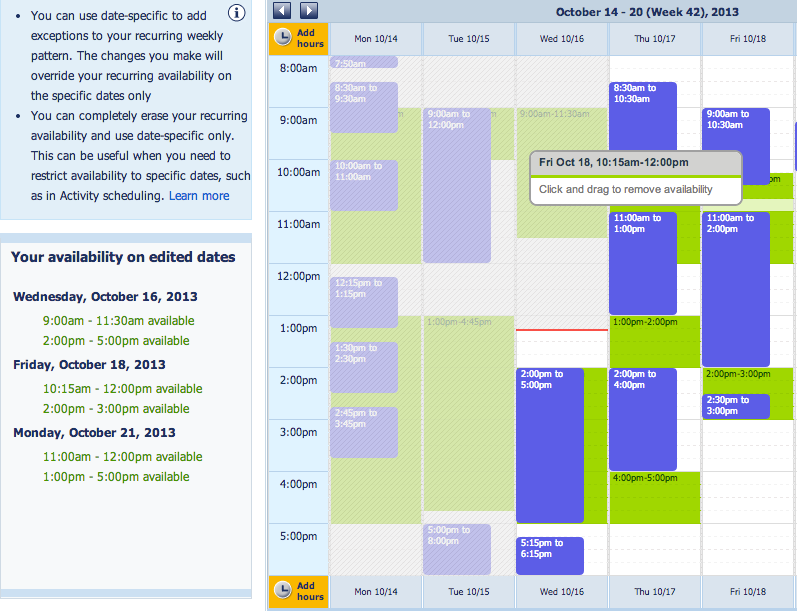
How my calendar looks to the scheduler
How my calendar looks to the scheduler. Blue is “busy” time from Zimbra via Gcal (this trumps available time). Green is available time that I can add to or erase by clicking and dragging.

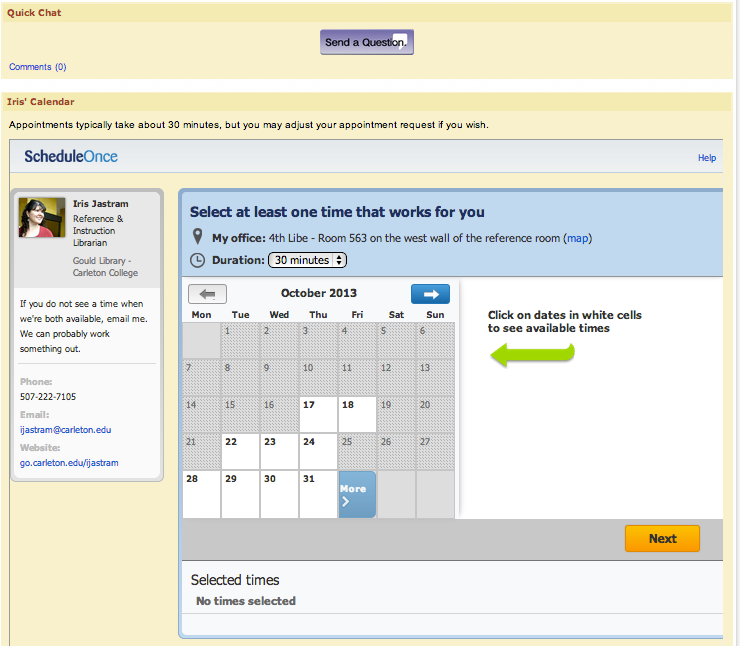
I heard about ScheduleOnce on a recent friendfeed thread and made an account almost on a whim. “I’ll poke around and maybe set it up later.” Famous last words. It’s pretty nifty and lets me do pretty much all of the things I want, and some things I didn’t know I wanted. For example, I could set it up to send a reminder email to the student (maybe fewer no-shows?), and tell it how soon before the desired appointment time a student can book me. The one catch is that it’s made to work with Google Calendar, and my school uses Zimbra, so I had to import my Zimbra calendar into a google calendar (there are some limitations with this, but it’s better than nothing) and then tell ScheduleOne to look at the imported calendar for busy times (which required an upgrade to the $5/month plan). But if it works, it’s totally worth it to me.

What my students see

After a couple hours of tinkering and testing and tinkering and importing and syncing and cursing Zimbra/Gcal quite contentedly, I embedded the scheduler page in my liaison page and thought I was done.

Then I remembered the “follow-up email” option in the scheduler that I had turned off. Who needs more email, right? Well, maybe people will give me some basic feedback if I ask nicely. So I hopped over to Google Docs and made a feedback form that basically asks two questions: “how satisfied are you” and “do you have follow up questions” (if yes, email me, because this form doesn’t collect any identifying information. Then I leave the traditional optional space to tell me more. Done. I added the link to a follow-up email thanking the student for the research meeting and telling them to email me if they have further questions, and I figured I was done.

But no. This made me think of the people talking about having students fill out forms embedded in libguides at the end of instruction sessions. I’ve done the “on the front of the notecard write something that was new and/or helpful; on the back write something that is still confusing or you’d like to know more about” kinds of exercises on occasion, and I’d love to do more of them, but I often don’t have notecards at the last minute. So I basically made that into a Google Form, embedded it in a page on libguides, and now I’m set to copy that page to any other guides I make. Tada!

And thus ends my morning of nerddom.

Update: 10/31/2013

This is going exceptionally well so far. I’ve done a few user error things along the way, but over all it has been such a help. Almost no futzing with calendars every day, and almost no back-and-forth emails with students about meeting times. I’m in love!

3 Comments