It struck me recently that those people who fixate on the flaws in every plan are in safe territory all the time. There are no perfect plans. There are no perfect interfaces. So these people will be right every single time — there are ALWAYS flaws.
But you can’t actually live like that, getting bogged down under the weight of life’s many flaws. And you certainly can’t provide a service or run a business like that. At some point you have to choose a direction and move forward, imperfections and all. This choice to move forward isn’t naiveté, it’s life.
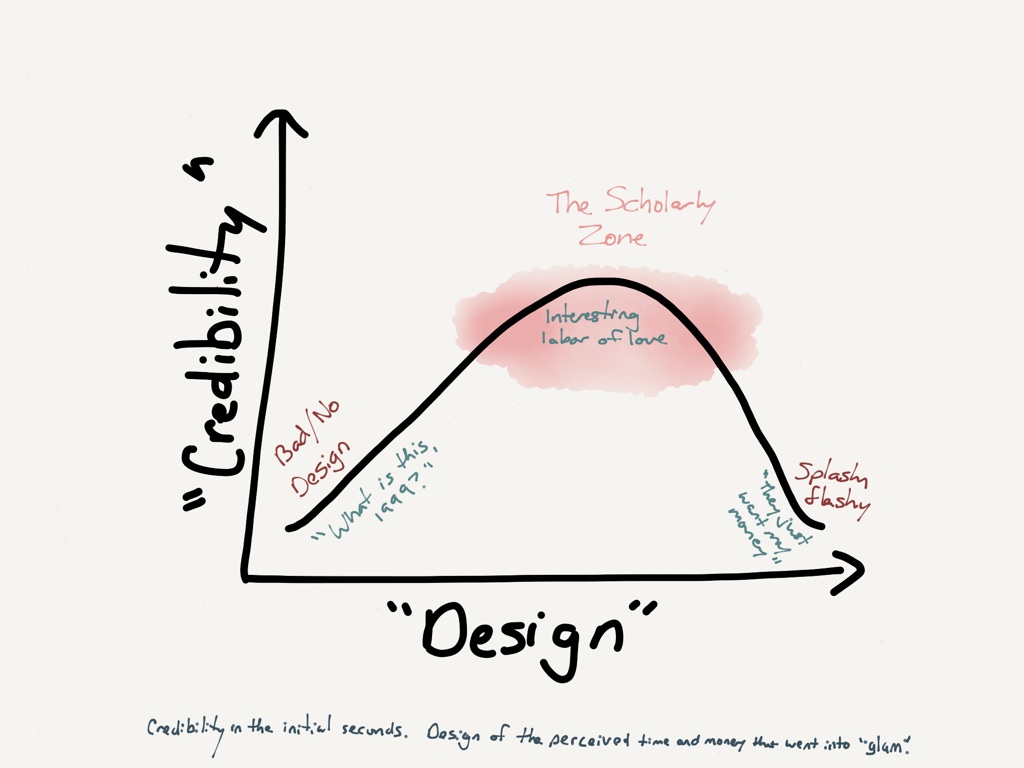
So here’s a question: If you make your digital humanities project so that the product is a gorgeous website with swoopy interactive capabilities and lush soundscapes, will people engage with it on a deep scholarly level, or will they get stuck in the flash and glam?
This was a question that came up today at a DH workshop on campus, and it got me to thinking about a similar question that had come up at THATcamp in Denver last year — how much web design do you need before people will pay any attention to your site?
People make snap decisions about website credibility, and they do so largely unconsciously, so research suggests that if you make your site look nice, people will stay on it rather than move on to look for something “better.” This is what people at THATcamp were talking about last year — the need to have enough web design built into their DH projects that their projects will be taken seriously.
On the other end of the spectrum, if a site is TOO beautiful, I start thinking it’s likely to be trying to get money from me. All the money for the custom designing and maintenance has to come from somewhere, right? Likewise, I’m not at all used to seeing scholarly books come out with incredibly designed covers, glossy pages, and custom illustrations.
So maybe there’s some spot part way between “grungy” and “flashy” that would appear the most credible for scholarly DH work. The question is, where along that continuum is the sweet spot?
Most of my seniors are in the midst of writing their senior theses at the moment. For some, this is their first time doing any major library research (no kidding). For most, if not all of them, this is the biggest, longest, scariest paper they’ve ever had to write, and they can’t graduate until they’ve successfully completed it.
For students going on to graduate school, this is fantastic practice for their futures as scholars. For everyone else, it’s a really really big paper. And yet everyone is expected to produce work that demonstrates the student’s ability to behave like a young scholar — an almost-expert insider in the community of inquiry that is their major field.
This business of becoming an expert inside in a field is hard enough if you’re aware that that’s your task — it’s harder still if nobody has explained that this is what they want of you. And in my world of information literacy, it’s probably the single most important concept to get across. No evidence that they examine is intrinsically “good” or “bad” evidence. The question is, good or bad for what and for whom and in what context?
“To become an insider requires access to information that is valued and sanctioned with that [conversation] space…. This requires knowing about the sources of information that will inform practice, why they are valued and sanctioned by the community, how they are nuanced and the ways in which they can be accessed” (Lloyd 2010, 10).
I can teach advanced searching of the MLA International Bibliography until I’m blue in the face, but if my students don’t realize they they must first become aware of the norms and conventions of the conversation they’re entering, they have no functional way of selecting appropriate evidence, asking questions of it that are valued within the community, and asserting credible claims for their community.
In essence, I’m teaching these students, many of whom will not become PhDs in their chosen fields, to be method actors. See the scholar; be the scholar. Take on the tweed coat, revel in it, and take on the values, characteristics, and moods of that scholar as if they were your own. Only then will they be able to find, select, interrogate, and make appropriate use of the information that surrounds them.
——–
Lloyd, Annemaree. 2010. Information Literacy Landscapes: Information Literacy in Education, Workplace, and Everyday Contexts. Oxford: Chandos Publishing.
And now, back to your irregularly scheduled librarian mundanity…
The last finals have be given, so Fall term is officially over. Fall terms are always intense, and this one was no exception. The difference this time is that I now have a couple of years of data all in LibAnalytics to look at. Turns out, I do over a third of all my teaching for the whole year in a two-week period in October. Yeow.
This year was also the year of “I wrote the paper, so now I just need some sources,” which is wrenching for both me and the student (particularly because the answer is often “there is no source that says that, so you’ll have to re-write your paper).
I’m also branching out in my projects, helping to run the new Emergency Planning task force. That probably deserves its own post at some point — it’s been a wild ride so far and I now know more than I thought I ever would about our electrical system and the Clery Act.
I ran through my limited energy a couple of weeks ago, so I’m really looking forward to the long weekend this week and the Christmas holidays coming up. I need some quality couch time!
Happy Thanksgiving, everyone. See you in December, most likely.
 So here’s a question: If you make your digital humanities project so that the product is a gorgeous website with swoopy interactive capabilities and lush soundscapes, will people engage with it on a deep scholarly level, or will they get stuck in the flash and glam?