Skip to content

Month: September 2008

Rethinking Instruction … Again

One of my favorite things about teaching is that I never feel like I’ve figured out how to do it well. There’s always something new to try, or something old to tweak, or something tried and true to throw out because as it turns out, the students don’t need it any more. All of this means that I’m never bored, and that I’ve never taught the same session twice.

Of course, this also means that I’m always a little uncertain about what I’m doing, how effective it was, and how meaningful it was. So far, no assessment I’ve done has completely set these nagging uncertainties to rest.

But uncertainties notwithstanding, I’m going to try something new this fall. When and where appropriate, I’m going to combine the idea of the Knowledge Survey* with classroom clickers.

I’ve been hearing about clickers for years and have experience their effectiveness myself. Quite against my own will, and in spite of feeling that I was participating in something as corny as any of those team building exercises I always hated (like falling backwards and getting caught), I found myself being sucked in and engaged in the activity at hand. If that could happen to me against my will, maybe I can use it to sucker some nearly sleeping freshmen into my sessions with a couple of well-placed participatory activities.

Still, my innate aversion to gimmicky things kept me from getting too excited until after I heard about Knowledge Surveys. Those things are amazing! Students get an accurate assessment of their own abilities (the Macalester Geology department has found incredibly high correlations between the responses on knowledge surveys and the students’ actual abilities), but I get a quick way to assess students, and I get a less-gimmicky way of encouraging participation and curiosity.

Now, if I could only get the stupid clickers to work, that’d be a great first step. So far, they hang at the “sending” notification whenever I test them, and never make it through to the actual recording of a response. I’ll have to get someone to help me figure out if they’re actually not working or if I’ve set something up wrong.

* I’ve heard Karl Wirth speak about these surveys three times, now, and ever time I came away thinking that there’s got to be a way to incorporate these things into my teaching somehow. Here’s a paper he and Dexter Perkins wrote on the topic.

Comments closed
Shifting Patterns

I realized this evening, as I checked my mailbox on the way back home, that communication patterns have really shifted. At least, they have for me. There was a time when I’d open mail addressed to me as soon as it was delivered, but I’d only check email once or twice a week. Now I check email multiple times per day, but I only open my accumulated snail mail about once a week.

2 Comments

Why I’ll be Wearing Comfy Shoes Tomorrow

New students arrived this week. Yesterday there were new student week leaders dancing on our welcome sign all morning. (That’s quite a reception as you’re going to work!) Tomorrow I’ll be staffing the library table at the academic fair, leaving that a little early so that I can help host the library’s annual picnic for faculty and academic staff, working frantically on a couple dozen last-minute projects, and then helping out with the library’s annual murder mystery event (which gets started at 9pm).

I’m simultaneously looking forward to it and dreading it. Each of these things sounds like a whole lot of fun. The whole, though, sounds like it’ll much more tiring than the sum of it’s parts. I will therefore be wearing distinctly unfashionable, comfy shoes. Stereotype, here I come! Too bad I just got my hair cut today and can’t make a bun anymore.

3 Comments

Mission: LSSP

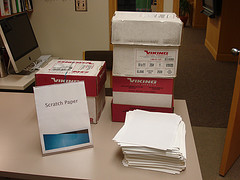
This is how I ended up with 5 feet of scratch paper, no real idea of where to store it all, and the warm fuzzies for all my co-workers who instantly donated more paper than I thought we’d collect in a year.

Hello All,

As you probably know, the introduction of print management last year brought about a huge reduction in paper use here in the library (to the tune of about 17% less paper used!). With fewer duplicate print jobs being sent to multiple printers, fewer accidental print-outs, and more attention being paid to what and how much was being printed, we saw the massive piles of unclaimed printouts dwindle down to a few sheets here and there. And there was much rejoicing in the land.

Much rejoicing until students wanted scratch paper to write on, that is. Having grown accustomed to a Limitless Supply of Scratch Paper (hereafter called the LSSP) near the printers, students took to opening the printers and removing sheets of paper from the printer trays. Not only is this poor use of ITS supplies (they do not exist to underwrite students’ scratch paper needs), but the opening and closing of the printer trays seems to have caused a sharp increase in the rate at which those trays go out of alignment and need repairs. Clearly, something needs to change, and asking students to buy notebooks would probably be met with blank stares.

What we need is a good old bait and switch. To this end, the printer area will serve as bait (so much paper, so much history of free paper, so much traffic in general), but when the students arrive at the printers we will dazzle them with big, beautiful stacks of scratch paper which will mimic the LSSP. Not only will this fill a clear public service and save ITS many printer-tray-related headaches, but it will also be a good use of paper that would otherwise be recycled only partially-used.

Your mission, should you choose to accept it, is to help us collect this precious scratch paper. On the middle shelf of the cart near the main black and white printer in the TS area you will find a double-decker Paper Collection Device (PCD). The top level of this PCD, the one marked “Scratch Paper,” is for paper that has been printed on one side and that contains no sensitive information (remember, this will end up in the hands of students) or even paper that is blank on both sides but is no longer fit for the printer. The lower level of the PCD is for anything else (colored paper seems to inhabit it now). The SCIC students [explanation of these students] and the reference librarians will use the paper from this PCD to attempt to keep a pile of scratch paper by the printers dazzling, big, and beautiful in order to mimic the LSSP as closely as possible.

I know what you’re thinking, but don’t worry, this message will not self-destruct.

Best,
Iris

4 Comments