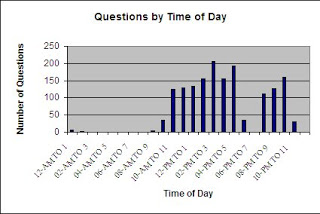

Like most libraries, we keep reference desk stats. These are more or less unenlightening. Numbers of transactions… sortable by date and time, length of transaction, type of question (reference, directional, technical), type of patron (student, faculty, staff, community), how the question came to us (at the desk, by phone, by IM, etc), and even who answered the question. We even go that extra mile and type in the question and a sketch of our answer. …Still mostly unenlightening for most purposes.
The way I see it, we’re driven by a quadruple motivation: we’re used collecting statistics, our administrations want statistics that’ll help them justify the money it takes to run a library, and we want to figure out what we do all day, and we want to figure out what our users need.
And before you discount the first motivation, consider some of the statistics you keep. Are these useful? Be honest.
And not so sure that a primary motivation is to figure out what we do? Maybe this isn’t a ubiquitous motivation, but I know that I have a really hard time articulating what it is to be a librarian. It’s not just about the number of people that ask me questions. In fact, I’d go so far as to say that the number of questions is somewhat incidental, kind of like the fact that the number of flowers in a garden has little direct correlation to the quality of the garden. Still, when I lack any other explanation for why I put in extra hours of work last week, or why I have to be selective about the new tools I’d like to play with, or the new initiatives I’d like to be a part of, I grasp at these statistics as a concrete way of quantifying my workload.
Unfortunately, this usually leaves me even more confused about how I spent my time. Yesterday night, as I tried to figure out why I’d run completely dry of imagination and energy in the last couple of weeks, my stats weren’t very enlightening, so I looked even farther back. Since September 12th (so, in exactly 5 months) I’ve answered 383 reference questions and conducted 109 individual consultations. Add to this the two library committees and the campus committee I’m on, and even the special projects I’ve been a part of… and I still don’t know what I’ve been doing. (Along the way I noticed that I had reference consultations with many freshmen and only 5 seniors in fall term, and with many seniors and so far only 1 freshman in winter term… interesting.)
So here’s the problem as I see it. We’re collecting a lot of numbers in a desperate attempt to tell a story about what we’re doing. That story may be something like “Look at the benefits your money has allowed,” or it may be “look at what our users are doing, now what more can we do to support that?” But what’s harder to do is to come up with the stories we think will best capture what we do and how we support our users, and then collecting stats that will help us tell those stories.
I’m not saying we need to predefine the stories. I’m saying that maybe gate counts and reference stats, as we keep them now, may not actually give an accurate picture of the services we provide, and I wish it were easier to come up with stats to keep that would more accurately reflect the stories we see around us every day. And I also think that the stats that help us coordinate our services may not be the same stats that we use to communicate with people outside the library.
We’ve begun to make a stab at it at my library, but I’m sure that as soon as we’ve got some time to devote to it we’ll want to continue rethinking what we collect and how we collect it. So far we’ve discovered that it would be nice to flag reference questions so that we can get a count of how many of them are complex research issues compared to the number that are fundamentally skill-based (“how do I find this call number,” “how do I find the text that goes with this citation,” etc). This will help us talk to faculty members who have a hard time comprehending both how lost their students can be in an academic library, and the exciting stuff we can do with students who have really complex research needs.
We’ve also been collecting information about where students hang out in the reference area, where they do their group work, where they work alone, and where they use their laptops. It would a lot of fun to map these activities using GIS or something (…says I, who have no idea how GIS works…), or use this information to inform later reorganization of other spaces in our library.
But I’m still frustrated with two things: how difficult it is to capture the story of the library (especially if you’re collecting numbers without planning the type of stories that would be meaningful to our audiences and ourselves), and how dependent I am on these types of numbers to define what I do. Why am I so unsure about my purpose on campus that I resort to counting the number of times people come to my office or the desk? Why is the campus so unsure of our value that they ask for these numbers, or do we give them the numbers because we can’t think of anything else to give? Is there a more meaningful way to tell our story? And would administration buy into a new narrative structure now that we’ve made them so accustomed to gate counts? What would the new narrative even look like?
4 Comments