Skip to content

Pegasus Librarian Posts

Back Online

This is just a note to say I’m back.

My blogging vacation was great. I sat on the porch, read Harry Potter, read a few New Yorkers (now I’m only behind by 3 weeks!), watched the grass grow, and generally took a true and thorough vacation. I’ve got a hefty to-do list here at work, including slogging through email and attending triply my normal load of meetings, but even so I’m not dreading the day, so I guess the vacation worked it’s magic (though I wouldn’t say no to about 3 or 4 more months of it).

Comments closed

Blogging Vacation

You may have noticed that blogging around these parts has slowed to trickles and little spurts lately. And strangely enough, this isn’t for lack of topics. Seriously. I’ve never been one for keeping lists of posts I want to write, but lately I’ve developed a ridiculously long list of topics, none of which have made it here.

Well, I’ve been busy with both work and non-work stuff, and a little bit more susceptible to stress than usual, and a little, well, blah. Fine, but blah.

So I’m going to take next week off from blogging, from stress, from stuff. I’m going to get some power-relaxing in, some reading, and some staring into space. Then I’ll be back and thinking about tackling that list of bloggable topics. Or not. Maybe I’ll have a whole new bunch of topics to blog about by then. See you then!

1 Comment

Introducing High School Students to a College Library

Every summer a group of high school students, gleaned from high schools all over the United States, comes to campus for a week-long program called CLAE (the Carleton Liberal Arts Experience). There are various courses they can take (everything from “how to apply to college” to “the Harlem Renaissance”) with the dual purpose of introducing them to the idea of a liberal arts college and giving them a little bit of experience living and studying on a college campus. The emphasis is really on empowering them to think that college is possible, doable, interesting, intense, and fun.

And every year, one of the classes brings all the kids to the library. For the past three summers I’ve worked with the history librarian to prepare the students to engage in a modernized Washington/Du Bois debate. But this year the class and professor changed, so the history librarian and I started from scratch to build a class for students studying the Harlem Renaissance.

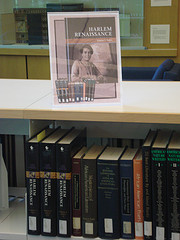
My part of the class preparations was to develop an exercise that would introduce the students to the 5 reference sets they’d need to navigate as they prepared for their final presentations. But the big question was how to make it easy for them to pick their sets out from the shelves and shelves of unfamiliar reference books, while still letting them see the sets in context rather than pulled out and put on a cart just for this assignment. Well, to ease this particular rub, I made signs for each set that had a full scan of the cover of the one of the set’s volumes, and then a cut-out image of the set’s place on the shelf.

Then I put these signs up on the shelves above each reference set.

That way, when the students came back to do their research after all of the librarians had gone home for the night, they’d be able to go back to the sets we’d shown them in class. I hope it worked for them.

Oh, and the exercise itself sounded great on paper, but would need more clarification next year. I still like the idea of it, but there were some recurring questions I should have anticipated.

Comments closed

Where Working Groups Break Down

Carleton and St Olaf share a catalog, so there are several working groups between the two schools designed to make this collaboration possible. I’ve been on the Public Access Working Group (which oversees the function and appearance of the catalog itself), and there are various other groups (Cataloging, Serials, Gov Docs, Etc.) that work to keep the two schools in sync as much as possible. And generally these divisions make sense. We either know what falls under our general purviews, or we know which other groups we need to work with to get a particular project done. My group, for example, often has occasion to work with the serials group and the cataloging group, since the catalog interface is fairly directly influenced by those two groups.

But every once in a while, these divisions are a little bit vexing. And no, it’s not when there’s a major issue that cuts across all of our areas of interest. That’s easy to solve: just call a mass meeting and make sure that representatives from each group are there. No, what’s vexing is when there’s a little problem, a little change, that could fall equally under the domains of half a dozen working groups. It seems like overkill to call a mass meeting, but lots of people need to know about the changes, and no one group is guaranteed to have a complete grasp on the issue.

Such is the case with a MARC field that was recently brought to my attention. It’s the 035 field, and we sometimes need it for gov docs so that MARCive records get overlaid properly. But apparently it’s recently been reassigned by the people who assign fields in MARC, so now [See comments for clarification] It’s a “system number” full of what looks to me like gobbledygook. So, already this affects the gov docs group and the cataloging group, right? Well, in our case it also affects the Public Access group because the 035 field is set to display with the label “Gov Doc #” in our catalog. (See the bottom of this record, for example, or this record for a government document.) Each group thinks it’s somebody else’s issue, so none of us are thinking about it, but it’s such a teensy little problem it doesn’t seem worth the effort of organizing a meeting of all three groups. And the catalogers who are actually working with the problem didn’t really know who to talk to about it in the first place.

It’s it funny how it’s so easy to collaborate on the big issues, and so thorny to try it with the little ones?
6 Comments