Skip to content

Category: Tools and Technology

The Ebb and Flow of My Online Communities

Online communities, like those in the face-to-face world, are fascinating to watch. They coalesce, wrap in on themselves, fray around the edges, unwrap a little, shift, possibly acquire new members or even glom onto a new core group of members, coalesce, wrap in on themselves, fray around the edges… and on and on.

Take my own history as an example. I started this blog and started reading other people’s blogs, and in the space of a few months found myself squarely in the middle of a vibrant community of librarian bloggers. A year or so later, Twitter and the LSW Meebo room started up. Conversations started in any of those places and bled over into our blogs, but there were also new people in the group — people who didn’t have blogs at all, or didn’t blog about libraries. And slowly the LSW Meebo room group became my center. A year or so later, the librarian Twitterati started shifting to FriendFeed, so I followed them (kicking and screaming, I might add — I had a bunch of problems with FriendFeed, some of which still bother me even though that’s become my social network of choice now). FriendFeed is slightly different in that conversations can happen within or across several “rooms,” and I’ve seen communities coalesce, wrap in on themselves, and then fray about the edges in several of these spaces within FriendFeed. Meanwhile, the blogging community had frayed about the edges (Meredith also just wrote about this).

Each time I’ve found myself in the midst of a new coalescing community I’ve met new people who inspire me, question me, encourage me, and generally be good friends to me. But each time it’s meant that people who used to represent the core of my network have shifted to peripheral status. Not unimportant, just less present.

And now I find myself on the fraying edges again. Almost certainly, this means that I’m about to find a new home, or re-find an old home, but at the moment things feel a little foundationless for me. Luckily, I have a couple of really interesting projects I’m working on (which I’ll probably write about soon-ish), so that should sustain me until my new center coalesces for me.

7 Comments
Citation Visualizations

A couple of people here on campus asked if there were any tools out there that would allow them to visualize the relationships between citations that they gathered over time in the course of a research project. Turns out, the options are limited and not at all user friendly. Here they are (thanks to Christina!):

  • There is CiteSpace. The demo video that you get when you click “webstart” and then go to “help” and “demo video” makes the whole thing look rather intimidating. It seems to run off of the same exports that we’d use to get information out of databases and into EndNote. The trick is, it appears to only work if you import stuff from ISI. I don’t see any way to manually enter a citation, though I’m certainly no expert on the software yet, so it may be there, just hidden. Here’s the User Guide (you may have to click through some server security stuff to see it).
  • The other option is Sitkis. This involves downloading ISI citations (again) and importing them into MS Access. I’m on a Mac at work, so I’ll have to see how this works when I get home to a PC with Access on it. Anyway, here’s Christina’s blog post about it.

Pretty limited options, eh? I sure hope there are more out there, but the People Who Should Know generally agree that there aren’t, at least, not yet. You know what I’d really love? If Zotero would take this project on.

3 Comments

Clinical Reader Train Wreck Just Keeps Going

Some day I’ll get bored of watching this train wreck in progress. But not yet. If you are, you can skip right over this post and rest in the knowledge that you’re more mature than I am.

Remember last week when Clinical Reader had only threatened a blogger, been exposed as having made up endorsements, started making up bogus Retweets, deleted incriminating tweets from their account, fired the pesky Canadians, and generally convinced thousands of people that they weren’t trustworthy? Since then, thing haven’t improved. Since then:

  • Whoever is trying to sanitize Clinical Reader’s online reputation (I assume it’s co-founder Allan Marks, but who knows) has been switching the original twitter account’s name at the speed of light. This breaks links that people had used in blog posts, but it unfortunately doesn’t erase the history from the deep dark recesses of the Internet, or delete people’s screenshots from their hard drives. Most of the good stuff is still live on the links in my previous post, and even more lives in this post on the Disruptive Library Technology Jester. (Moral of the story: Don’t be stupid online because the stupid never dies.) As of this writing the account has moved from @clinicalreader to @clinical_tweets to @amarks7 to @amarks14 to @amarks_ to @a_marks1 to @allan_marks (See below for explanation of the change in the first two names. And don’t expect @allan_marks to be valid for more than, say, an hour. As of 7pm, the name has changed 4 times since 9am today.)

  • Somebody took over the name @clinicalreader and posted a brief history of the debacle there.

  • Somebody else took over @clinical_tweets (they claim to be the fired Canadians) and started cockily claiming that they’d done the job they were hired to do because just look at how many people now know about Clinical Reader. Their claim in a nutshell: “You’ve All Been Used. Bwahahahah.” They’ve now killed the account.

  • A new twitter account went live: @clinical_reader. This had all sorts of tweets about how the real Clinical Reader wasn’t yet “officially” on Twitter but will let us all know when they are (this screencast from the Google Cache shows that if you hovered over an older version of the Clinical Reader site, it clearly linked to the original @clinicalreader twitter account). Then tweeted several rather official looking tweets about what a great service they are. Then denounced the other now-bogus accounts. And all of this while not officially tweeting! This morning, all their tweets had disappeared except for the ones saying that the tweets from @cliniclareader are not coming from the Clinical Reader service (which even whoever-it-is at @clinicalreader says, quite plainly).

  • Another new twitter account went live: @clinical_tweet. This seems to be the new, new, new official twitter account. Or something. We’ll see how long it lasts.

  • And now, the sockpuppetry really gets started. “Sally Jones” started a twitter account as @kensingtonlib in order to alternately level accusations at @lukelibrarian and laud Clinical Reader. I wonder who could possibly be using the name Sally Jones??

This is just too much fun. I’ll update this post if necessary (and add screenshots that I have on a different computer, later).

[Edit: 7pm on July 20th. I think I’m done now. If you haven’t had enough, search FriendFeed for “Clinical Reader” and see if more drama has surfaced. I’ll just add that I’ve been almost equally fascinated by the complexity of piecing together a coherent story when that story is playing out in so many social networks, by the flailing about of Clinical Reader, by the lessons this teaches about marketing online, and by the implications of this story in my own teaching. I think I’ll have to work some discussion of this parable into sessions I teach about evaluating web content.]

9 Comments

Best Bad Marketing EVER

I thought I could resist jumping into the fray on this one, but this story just keeps getting better and better.

Have you ever heard of the service called Clinical Reader? Apparently it’s a new service that acts kind of like a feed reader, only they decide which feeds you read, and it’s aimed at the medical community. The salient facts here being: 1) it’s new, and 2) nobody had heard of it. Until this week.

This week they used twitter to threaten legal action against a blogger, explain that they’d overstepped and let some unknown junior colleague too close to the keyboard, argue with the blogger and her ever-growing posse, apologize to the blogger, and now send out bogus retweets.* (See the chronology below for the gory details.)

What fascinates me is how quickly (in the space of four days) hundreds of people have gone from knowing nothing about this service to being pretty sure that everyone at Clinical Reader is completely insane. The social web can be an incredibly rich marketing arena, but it has zero patience for companies that get stuff wrong, and it rather delights in calling out this kind of behavior. This is the flip-side of crowd-sourcing, and companies and libraries hoping to harness online social networks would do well to watch this real-life parable unfold.

Chronology:

The story is way more interesting if you see it unfolding, so here are the best places to get it in kind of chronological order. This blog-version of the summary is necessary because Twitter itself is kind of difficult to reconfigure in a way that makes sense after the fact, and because Clinical Reader has started deleting tweets. Oops.

  1. Nikki noticed some less than ethical aspects of Clinical Reader’s site (which now includes edits linking to the apology she received)
  2. Steve summarized day one of the saga
  3. Nikki gathered together links to a bunch of stuff that happened after Steve’s post.
  4. The RT shenanigans begin, but these need more space, and screenshots, so here we go…

Clinical Reader went wrong in two completely wrong ways with the retweeting. (By the way, read each of the screenshots from the bottom up, because I forgot I should reverse the order and don’t feel like fixing it now.)


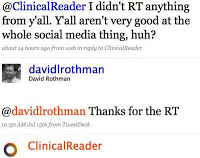
First, they thanked people for retweets even if the people had never retweeted them.


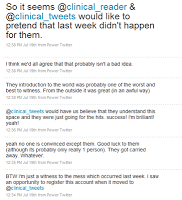
Then they seem to have completely made up tweets to retweet.

Amazing. Pardon me while I go pop some popcorn and settle in for the amusing ride. You can follow along on FriendFeed if you want.

P.S. The founder of Clinical Reader now says: “I have taken control of this account & parted company with former acquaintances in Canada whose behaviour I can only describe as schoolboy” (cite), and he is now apologizing to people. [The following sentence is apparently no longer true… which is ironic, since I was poking fun at Clinical Reader for misunderstanding how it works: “The problem is, he doesn’t realize that if he starts with one person’s name, there’s no guarantee that everyone else will be able to see what he writes, since Twitter only lets you see messages directed at mutual friends.” Further testing reveals that the other people would be able to see this message if they clicked on their @[username] page but not in their main Twitter feed. So, still weird, but not as egregious.]

* For those who don’t use Twitter, RT means “retweet” and is a way to redistribute something somebody else said, complete with attribution. It’s very much like a cited quote in a paper, only with links. So if I say “Something Clever” on Twitter, somebody else could say “RT @ijastram – Something Clever” which means “retweeting Iris Jastram who said ‘Something Clever,'” and the “@ijastram” part automatically turns into a link to my tweets. Quotation and citation in 140 characters or less. Pretty slick.

14 Comments