Skip to content

Category: Teaching and Learning

Tired, but Doing Fine

It’s been a good day. We all met for the opening plenary session (8:30 till noon!), and plunked ourselves down at tables kind of willy-nilly. I ended up at the “kid’s” table in the back of the room… not quite sure how that happened, but we had a blast and (kind of by accident) ended up doing quite well on all the exercises together. We were in danger of being split up by the Jigsaw activity (where each of us “teaches” one of five articles to the rest of us), but it turned out that four of the five of us had read different articles, so we pretty much all stayed at our table.

In the afternoon we had part one of two or three sessions on assessment. I’ve really got to get a handle on how I can use this in my instruction. I’ve been experimenting with giving the students more control of the class period, but then I’m always worried that they aren’t learning. So these concepts should be good for me. As in the first session, the ideas weren’t really anything I hadn’t heard elsewhere, but it’s good for me to have concentrated time to reflect on my year’s teaching, evaluate what I’ve done, and figure out how to move forward from here.

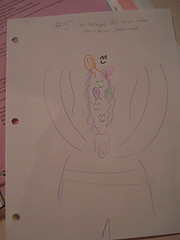
The third session was AWESOME. Randy Hensley is an amazing teacher. I admit, I was skeptical. He’d been writing all sorts of crazy uber-teacherish emails to us. Like, for example, the response he wrote to my posted introduction asking me “If you could do your first year of librarianship over, what would you do differently?” Uh, I don’t know. I had a pretty unbeatable first year, as far as I’m concerned. Anyway, I was all set to be annoyed and turned off by gimmicky exercises, but it wasn’t that way at all. Hey, I even drew a picture for the guy. That’s how amazing he was. I don’t draw concepts. I just don’t. Especially not with crayons.

(In case you can’t tell, that’s me using a zipper to open myself up and let out a bunch of smiley faces and balloons, which at the time seemed like a perfectly rational picture of using tools to reveal my personality… It’d been a long day. Stop laughing. STOP IT. And don’t go telling me my picture-woman has no head. I know that. I deliberately avoided drawing a head.)

Anyway, at one point I ended up on a stack of crates (which almost fell over, but didn’t, so I’m not dead). Don’t know quite what that had to do with anything. But he invited me up, so I went.

Which brings me to the other really weird thing about Immersion. I’ve learned to become an extrovert. Seriously. People here think I’m always like this! HAH!!! And who knows, maybe I am like this now. Computers in Libraries brought it out of me a little, but now I OWN this new person I am. And I like it. I love it that I no longer avoid introducing myself to people, or shake while doing it.

There’s lots more to write (I’ve been keeping a list… yeah, I’m a librarian), but it’s 11:30 here, and morning comes EARLY in Boston. I’d best call it a night. But there are a few more photos (still without titles or descriptions, sorry) up on my flicker site.

Just two things before I turn my brain off for the night: A pox on convention centers without wireless, and boo to long personal stories that should have been short and on topic responses to the presenter’s question. Nuf said.

Comments closed

What Writing Can Teach Us

This morning was the first of three consecutive mornings that I’ll be spending reading the sophomore writing portfolios at my college. This is my first time reading such things, and I must say that it’s kind of daunting.

You see, each year, all the sophomores turn in three to five examples of their writing from their first two years of college. Each year, some time soon after school gets out, a whole bunch of faculty and some staff (all volunteers) gather to read hundreds and hundreds of portfolios over the course of three mornings. And this year, I’m included in this bunch of readers.

Readers volunteer for a number of reasons. They want to see examples of assignments from other professors. They want to re-calibrate their own grading by reading masses and masses of writing. They want to intervene with students who need help. And the list goes on. It’s really fun to see a bunch of people taking on a task that just has to get done, but rather than just do it they reinvent it as a powerful professional development tool.

I’m there because my college is thinking of coming up with information literacy benchmarks for first- and second-year students. So another librarian and I are helping to read the portfolios not only to help make it through the boxes and boxes of papers, but also to find examples of information literacy at work and see if we can generalize our observations to help us develop an assessment matrix or a first-year info-lit initiative.

So far, after reading only a couple of portfolios, I’ve learned that:

  • underclassmen don’t understand citation, but that they can do it if guided
  • they are happy to use outside sources, but the sources control the writer rather than the other way around
  • that they think of “fact” and “interpretation” as much more distinct categories than they really are
  • and that I’m a very slow portfolio reader (I’ll really have to pick up the pace tomorrow… it’s been a long time since I was a regular writing tutor and could do this in my sleep.)

On a somewhat separate note, I’m quite happy that I can walk into a room full of faculty members and not only greet and be greeted by name, but also carry on conversations with them about everything from libraries to pedagogy to gardening and not feel out of place. I’ve worked hard this past year to build this kind of relationship, and it’s finally feeling less I’m “just staff.” In fact, all the librarians have been working at getting involved in all sorts of things across campus, and now we’re beginning to be invited to meetings as less of an afterthought. Slowly but surely…

(The Pinky and the Brain song comes to mind…) Tee hee hee.

1 Comment

Search Motivation and the Expert/Novice

I’ve been doing a lot of thinking and reading, lately, about what makes an expert and what makes a novice, especially when it comes to information seeking. There are all sorts of theories out there, but today I ran across one that really makes sense to me. There’s a discussion happening on the ngc4lib listserv at the moment called “What’s Better? Dumbed Down or Loaded with Functionality” (don’t get me started on the ideology of “either-or” that’s inherent in this question). Anyway, one responder made a comment that completely resonated with me. It’s a teeny little comment of just a couple of lines, but packed with implications. This person mentioned that even when he fails at a Google search, he continues looking and tweaking his search string because he’s “pretty darn sure” the answer’s there somewhere. This motivates him to keep looking.

And there you have it: one more piece in the expert/novice discussion. Novices have less knowledge of what’s out there to begin with, so they have less motivation to keep tweaking search strategies, so they are less likely to find what they’re looking for. This would also hinder their efforts to come up with viable research topics.

I don’t know how many students have come to me frustrated because they’re having trouble finding good stuff on depression in PsychInfo, and yet they’re unable to narrow their searches to a workable sub-topic because they don’t know what they’ll be able to find. To make matters worse, when they have spent 15 or 20 minutes not finding what they want, they ask if maybe they should change their topics, by which they do NOT mean refine… they actually mean CHANGE to a completely different topic. And then the cycle is repeated.

So file this away in the “how can I help with this” section of your brains. I don’t know how I’m going to help develop experts, yet, but I’m going to give it the old college try (just as soon as all the students get back from their summer vacations…[insert some pining for a summer vacation here]).

Comments closed

Today’s non-Demo Class

I’m sure you’re all on pins and needles wondering if I was able to pull off my new non-demo class today. Well… it wasn’t horrible, exactly… Here’s the rundown.

I did almost no clicking or typing. All search terms were arrived at by the students, and about 80% of the clicking was done by the students. So that was good. But part way through I got nervous that I couldn’t really tell what they had learned or what they still needed, so I started talking… and talking … and talking. Part of me was watching from the sidelines yelling “Shut up, shut up, shut up” at the rest of me. But the rest of me is deaf. Still, by the end the kids were engaging with each other and asking questions and reaching for the keyboard… so it can’t have been all bad. I just need to relax and SHUT UP.

Still, now I’ve tried to break the mold, and I’ve cracked it a little, but with practice I hope it’ll get better. It WILL get better. I’m sticking to my pledge (see the very bottom of this post).

1 Comment