Skip to content

Category: Teaching and Learning

eReserves: Blessing or Curse?

Blessing. Definitely a blessing to our users and database vendors, but a blessing with a curse-ish aftertaste.

Everyone is familiar with the blessing part. Users get 24/7 access to their course readings, and database vendors get a more accurate picture of the amount of usage they’re getting for their license fees. (Without eReserves we’d have to print out a copy of an article and put it on paper reserve, where it would be read by a class of students, photocopied by most of them, etc. But there’d only be one hit on the vendor’s server.)

But on our campus eReserves is an easy target for all sorts of campus ills. For example, it’s common knowledge around campus that eReserves is the cause of our horrible printing problem, with reams and reams of paper filing through our printers every day. And I’m sure that classes that depend more and more on journal readings and less on text-book compilations do make for more use of eReserves and more printing. But what nobody seems to realize is that all the requests for electronic access to journals means that more and more of our journal collection is e-only. And even if we have electronic access and print access, guess which one will be used most often? And what do people do with journal articles they find online? They print them to mark up over lunch or a midnight snack.

Not only that, but there’s more and more good, authoritative, quality research available on the free web, and you can bet that students print these pages by the ream. This is especially true because printing is free on our campus, so everything from email to research to homework spills from the two printers in the reference area at the rate of 7.06 pages every minute the library is open. (The the two reference area printers account for more printing than every other printer on campus… combined.)

I’ve also seen more and more students lately who prefer to scan print journal articles slowly, page by page, and then convert the images into PDFs all so that they could print (for free) rather than photocopy (for a fee). In related news, the use of photocopiers in the library has dropped so much in recent years that our printing department is considering removing a few of the copiers from the library entirely.

So the upshot is that printing is a definite problem, but the answer isn’t as simple as, “Well, with the advent of eReserves printing went through the roof….” The information universe is changing, not just one section of it. All of it. eReserves, journal subscription, database licensing, online publishing, assignments and pedagogical approaches to information, everything.

Oh, and eReserves is also not a devious plot to keep professors from ordering text books or paying copyright fees or anything else like that. Moodle can do all that so much more easily. ;)

Technorati tags: , , , ,

2 Comments

Responding to Student Writing and the Power of the Line

This past week I participated in a faculty workshop entitled “Responding to Student Writing.” In preparation for this workshop, each participant was asked to email the coordinator with the most vexing problems they have when responding to student writing. Most faculty members wrote about the problems of balancing the time it takes to write good comments on papers with their other duties, figuring out how to respond constructively, wondering if students ever read the comments, and wondering whether or not to write extensive comments on end-of-term papers.

I had to “interpret” the assignment since I don’t ever read or grade student papers. Here’s what I wrote:

I’m in the odd position of responding to writing without ever seeing the entire picture or reading the entire paper. I’m most often responding to the student’s interpretation of the assignment and the initial phases of topic selection. In the instances where students come back with a semi-finished product, I generally respond to the bibliography or the student’s summation of the argument and the types of evidence he or she has found to support that argument. In some ways, it’s much easier to respond to students about their thought processes and progress towards their goals when I only get these verbal summaries since it frees me from all the minute details that might overwhelm me if I saw the project in it entirety. But it’s also difficult to give feedback that will support the project as a whole when I only see distilled sections and versions of the project.

I also have to respond on the spot without the benefit of time to compose my thoughts and write something down. I’m often more comfortable writing than speaking, so I usually feel like I’m floundering to put my thoughts in order, communicate clearly, and keep the student’s ultimate needs firmly in mind all at the same time. I often wonder if my tone is appropriate, if they’re hearing what I think I’m saying, and if what I’m saying is effective. (When I’m really worried about this, I’ll often send a follow-up email that reiterates my main points, but then I run into the problem of time, especially when I have days that are packed full of back-to-back appointments with students.)

Like the first assignment, much of the workshop didn’t directly relate to me and my job, but it was nevertheless an incredibly beneficial and enjoyable workshop. I met some wonderful professors and had stimulating conversations about everything from art to assignments.

One of the most interesting conversations was with a studio art professor who, like me, had to interpret many of the activities to fit his teaching activities. He talked with such passion about the history of the line: how The Line started with the urge to represent and communicate and how it has diversified over time to include everything from representation art to writing. He talked about how creating art is always a way to possess, whether it be to capture an image you don’t want to forget or to articulate and keep hold of an idea, and that there is always an element of transaction involved, either literally or via communication.

What a beautiful thought. When we teach students to do research, we give them the keys to this act of possession and transaction. We help them to allow the originators of the work they study to complete this timeless transaction, this fulfillment of the original act of creation, of setting down representations of things and ideas via the eternal Line. And then the students, in turn, set down their ideas, using the same Line, waiting with eager anticipation for their readers to complete this new transaction.

And when readers comment on student writing, they grant that writing weight by taking partial ownership of the work via new instances of the Line, because the Line gains rather than loses power when more people own it, use it, and proffer it to others.

Comments closed

Of Socks and Writing

For the past three days I’ve been attending one of the many December workshops offered by faculty for faculty on our campus. This particular workshop was put on by our Writing Across the Curriculum program and was a fabulous opportunity to learn more about what good pedagogy looks like, think carefully about what we want our students to get out of their college experience, and get to know faculty from all over the curriculum. I don’t directly teach writing, but I do support those who do, and I almost never get three days in which to talk over the underlying goals of writing assignments with my faculty. What fun!

But everyone always looks forward to the last day of the workshop because on that day the Dean of the College presides over the annual outrageous sock contest. And this year… I WON! Last year I was deemed “almost tasteful” and was therefore disqualified. This year my fur-lined santa socks earned me a Sock Monkey grand prize.

Comments closed

Link Resolvers and Education

Looking back over the last two weeks, I can’t believe I’ve only posted twice! That’s got to be some kind of record for me. But I had car issues, and then vacation (which was WONDERFUL and long), and then I spent all day yesterday trying to catch up from being away. I didn’t succeed, of course, but I made a healthy dent.

Anyway, I’ve become curious about link resolvers and how academic institutions set theirs up. We use SFX, and so far I’m absolutely thrilled with it. I think of it in terms of eras: I graduated from library school in 1B.SFX (one year Before SFX), and it is now the year 2A.SFX (two After SFX). My library implemented it the first term that I was working here, so I never had to teach the tedious methods of hunting through databases, using Ulrich’s, interlibrary loaning, having the loan request rejected because we have the article (somewhere), looking again, searching Google, and then resorting to cursing and pulling out hair when trying to find the full text of an article. Instead, all I had to teach was “click on this handy little button and it will search all our databases for you.” Who wouldn’t be thrilled?

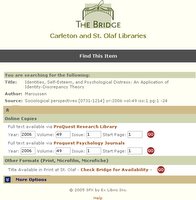
But there were all sorts of decisions that went into setting up our instance of SFX, decisions I wasn’t a part of, but that I need to think about now as we go through the endless cycle of evaluating our service, tweaking it, and evaluating it again. At issue right now is the question of whether or not we made the correct decision when we chose to have an SFX menu pop up every time a user clicks on the Find It button, or whether we should switch to having it deliver full text (if available) from a preferred database.

For those of you who don’t have SFX, or who have it configured differently, here’s what I mean. Let’s say I search and find a citation for an article from the journal Sociological Perspectives. Click “Find It” and I’ll discover that we have two subscriptions from two different databases, and St. Olaf also has the print. Click on either of the database options and I’ll get the full text; click on the print option and you’ll be taken to the catalog record for location and holdings information.

This system has three distinct advantages. First, it helps students figure out which databases they should be searching other than the database they’re currently searching. I teach my students to keep notes on databases that come up often when they’re looking for full text because those databases obviously have a collection of journals on your topic. This technique is especially useful for upper class students when they’re beginning to do research for their comprehensive projects. But it can also work the other way. I’ve mentioned before that unlike my co-workers, I mainly teach freshmen. And consequently, I also teach the less specific databases more often than my co-workers do (my co-workers rarely have to deal with students who just have to write “a research paper” on any topic). So I tell my students to watch the Find It menu to see if there’s a more specific database on their topic.

Another reason for providing choice, beyond simply my love of letting people choose what works best for them, is that over time students develop familiarity with the databases they use most often, so they may prefer to click on a link to their favorite CSA database, Ebsco database, or ProQuest database when it appears in the list of choices. I know I default to certain databases over others because I know that I can manipulate some vendors’ databases more easily than others.

And finally, some poor, young students dealing with requirements for “print” sources handed down from professors who haven’t explained that you can get “print” sources online from these databases, would really just prefer to click on that “available in print” link and go photocopy the article for themselves.

On the other hand… there’s value in immediate delivery whenever possible. I’m torn. Is delivery more important than education and discovery? Possibly. But I’d hate to give up the information I’m given when I’m presented with choices.

Carleton and St. Olaf will be deliberating on this issue soon, and I’m comforted that we can’t make a “bad” decision. I just wish I knew which was the better decision.

Technorati tags: , ,

10 Comments