Skip to content

Category: Teaching and Learning

On the Value of Feedback

Every fall one of my co-workers and I teach a class for a bunch of students in a rather unique situation. They’re freshmen who are taking two “linked” courses, meaning that all students in each course have to take the other course as well. One is a history course and the other is a writing course, and between the two classes, there are between 5 and 6 assignments that our library session must prepare the students to accomplish.

Well, this past spring and summer, the library acquired several rich resources that seemed tailor-made for these classes. The problem is, there was simply not enough time to introduce all four of the resources that we considered most important. (There are LOTS of other resources that we gathered on a research guide for them, but we’d pared the class down to four and couldn’t in good conscience pare it down any farther.) So we thought we’d try something new.

Operating under the assumption that because these students see each other every single day they’d have plenty of time to help each other out, we split them into four groups, each of which had a set of tasks designed to teach them their particular resource. Then we spent the last part of class having each group teach a couple of important points to their classmates. And overall, we thought it went alright. We were crunched for time even as it was, but we were hopeful that we’d started discussions that could continue on the course’ Moodle forum and in subsequent classes.

Then the writing professor did something for which I am very grateful. She had each student write one thing they thought worked well in our session and one thing they thought didn’t work so well. To a person, every single student listed the splitting up into groups as the one and only thing they did not appreciate about the session. Wow! When do you EVER get 100% consistent results from a survey? Never, that’s when. Almost every student listed the time they had to work with their resources as one of the most valuable things about the class, but every single one of them wanted a chance to try the other resources, and most worried that they won’t learn what they need to know from their classmates.

This doesn’t mean that they might not end up being just fine, or that they might not be able to learn from their peers. But it does point out that maybe freshmen, overwhelmed by the prospect of their first college-level research paper, might appreciate a little bit more direction, a little bit more explicit instruction.

So next year, we’ll have to think up another creative solution. The writing professor has suggested that perhaps expanding to two library sessions is in order… we’ll have to see.

Comments closed

Moodle, One Year Later

Tomorrow I’m joining a panel made up of me, our resident web-app coder guru, a faculty member, and academic technologist, and a student to talk about how things have changed one year into our adoption of Moodle as our campus’ course management system. We’re presenting this as the first of the term’s LTC lunches (generally a weekly gathering at which someone or some group presents on a topic relevant to learning and teaching while the audience munches away). I’ve only presented at two other LTC events, so I’m a little nervous, but apparently not nervous enough to have carved time out of the last week to actually prepare. I mean, I’ve thought about it a little bit, but not actually prepared.

And now, tonight, I find myself a little on the burned out side. Fall term is just not a good time for sustained or creative thinking. Fall term is a time to put out fires as quickly as possible and not look back. So, sitting here, thinking to myself how much I’d prefer reading or writing blog posts to planning this 8 minute spiel, it suddenly occurred to me that I could con myself into preparing for tomorrow if I wrote it up as a blog post!

So, here are my thoughts about how Moodle has affected the library, one year into implementation:

Moodle and Teaching

  • Preparing for classes: For those classes where the instructor makes use of Moodle, we librarians can now supplement the information the professor gives us about the class with direct observation of the readings students have been assigned, the context into which our sessions fall, and even the over-arching themes and questions that are important to the class. There are a lot of ways to tie our sessions to the course content, with the goal that they will interrupt the flow of the course content as little as possible. Everything from the examples we pick to the discussions we lead to the actual content of our sessions can be tailored to fit into the themes and goals of the course. When this happens, library sessions can actually augment rather than simply supplement course content.
  • Class logistics: Moodle makes it easy to find the exact course title, the number of students enrolled, and what students have been told about where to meet us, and other such useful information. I’ve also been able to compare lists of registered students to see if any in next week’s class already heard me speak last week. And if so, I work extra hard to make sure they’ll get as much out of the second session as they did out of the first.
  • Interacting with Students: Including contact information on a course’s sidebar (now made easier due to some custom coding which allows professors to simply turn on their librarian’s contact information), setting up shop in a class’ forum, or (though this hasn’t been tried) joining the class’ skype buddy list are all good ways of meeting our students where they are when they’re doing their assignments. Now, if I could just get my MeeboMe widget in there… but that’s probably asking a lot.

Moodle and My Other Work

  • Hey look, it’s an easy intranet! Whether it’s collecting useful information and links or hosting departmental discussions and schedules, Moodle has offered an easy way to set up quick and dirty intranets. The liaisons have one, the Library Leadership Group has one, the SCIC workers have one… and that means that we can manage our work easily. It’s made the biggest difference in the case of the SCIC site because now the SCIC students and the librarians they work with all have a common place to communicate, norm our expectations, and gather information.
  • Working with librarians at St. Olaf: Since we share a catalog but do not share network space, we and the St. Olaf librarians really benefit from an online space where we can house our meeting minutes, operational records, and other such useful stuff.
  • Project Management: We’re using our Moodle spaces to manage fairly complex projects. Not only are all the standard features (forums, places to keep documents, wikis, calendars, etc) important, but a couple of less standard features have come in very useful. One example is our newly formed eResources group. They’ve realized that very few people in the library operate with the same terminology when they’re thinking and talking about eResources, so one of their first projects this year is to create and define a uniform eResources vocabulary. To do this, they’re using Moodle’s glossary feature. They’ve divided the key terms among themselves, assigning themselves those terms in the glossary by categorizing the glossary entries according to their initials. And once the terms are defined, anywhere they’re used in that Moodle site they’ll appear highlighted with available definitions if you hover over the word.

So I think that’s what I’m going to talk about tomorrow, unless inspiration hits at the 11th hour. It seems like a representative sampling of the key ways that Moodle has impacted our librarian-ish existences in the past year.

2 Comments

Introducing High School Students to a College Library

Every summer a group of high school students, gleaned from high schools all over the United States, comes to campus for a week-long program called CLAE (the Carleton Liberal Arts Experience). There are various courses they can take (everything from “how to apply to college” to “the Harlem Renaissance”) with the dual purpose of introducing them to the idea of a liberal arts college and giving them a little bit of experience living and studying on a college campus. The emphasis is really on empowering them to think that college is possible, doable, interesting, intense, and fun.

And every year, one of the classes brings all the kids to the library. For the past three summers I’ve worked with the history librarian to prepare the students to engage in a modernized Washington/Du Bois debate. But this year the class and professor changed, so the history librarian and I started from scratch to build a class for students studying the Harlem Renaissance.

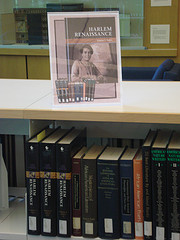
My part of the class preparations was to develop an exercise that would introduce the students to the 5 reference sets they’d need to navigate as they prepared for their final presentations. But the big question was how to make it easy for them to pick their sets out from the shelves and shelves of unfamiliar reference books, while still letting them see the sets in context rather than pulled out and put on a cart just for this assignment. Well, to ease this particular rub, I made signs for each set that had a full scan of the cover of the one of the set’s volumes, and then a cut-out image of the set’s place on the shelf.

Then I put these signs up on the shelves above each reference set.

That way, when the students came back to do their research after all of the librarians had gone home for the night, they’d be able to go back to the sets we’d shown them in class. I hope it worked for them.

Oh, and the exercise itself sounded great on paper, but would need more clarification next year. I still like the idea of it, but there were some recurring questions I should have anticipated.

Comments closed

What Do We Teach? Information Literacy and Information Technology in an Academic Setting

A few times a term, librarians from Carleton and St. Olaf meet to discuss an article that is either about some aspect of information literacy and IL instruction, or can be discussed from the perspective of people teaching information literacy. This morning, for example, we talked for about 45 minutes about Ann Grafstein’s new article in portal (which I highly recommend, by the way).*

On each of our campuses we’ve heard rumblings from time to time that what we do and what the IT people do is really fundamentally the same thing. When we say, “Uh, no, it’s really not,” they respond with, “I mean, if you forget the fact that they work in the IT department and you work in the library… just leave that out of the equation, what’s left is really fundamentally the same thing.” This is only true if by “fundamentally the same” you mean “help people do what they’re doing,” in which case almost everybody on campus fits that description.

The next argument is that we teach people how to get stuff out of databases just like IT teaches people how to manipulate spreadsheets. Well, I know our IT department does a whole lot more than that, and while I do indeed teach people how to get stuff out of databases, I do so much more than that. And a lot of what I do would be important even if there were no technology at all, or if the technology changed drastically.

So what do I do? What do I offer students that goes beyond a basic knowledge of subject headings, catalogs and databases, and the mechanics of search?

We Work with Content, Regardless of Format
When we teach database searching, catalog searching, search engine searching, and even *gasp* print index navigation, the format is simply a vehicle. Our true focus is on the content beyond the vehicle. This is why library sessions that aren’t tied closely to an assignment often result in zoned out students. If you’re simply teaching “this is a database… this is a subject heading” and the students aren’t trying to get at any content, everything feels unimportant and arbitrary. If the students are actively trying to find content to work with, and are finding the process frustrating, that’s when they pay close attention.

This is also why I’m against wholesale moves from print to electronic. Some sources simply work better in print. Some work better online. I would prefer to figure out which vehicle best suites the content and the students’ uses of that content than to squeeze all content into one format. Granted, electronic is a wonderful vehicle for many, many kinds of content, but not all kinds, and not all instances of each kind.

Evaluation of Sources
Probably more than any other component of this nebulous thing we call “information literacy,” evaluation of sources has taken hold as The skill that librarians are trained to perform and teach and that goes beyond simple location of sources. And while this task has become more tricky as more and more stuff floods the Internet, it is and always has been important even in the print-only world. I’m not convinced that it was ever easy, no matter how many people tell me it was so much easier when you had the print in front of you. I tend to think we simply haven’t honed our teaching skills in the newer formats to the same extent that we had before. But what do I know? I’ve never known an academic library that didn’t have JSTOR.

But I propose, as a topic for discussion, that while evaluating sources is definitely important, it has gained it’s current widespread status as almost synonymous with “information literacy” primarily because it’s taught in library school and because it has steps to follow. We’ve grown so used to saying that we don’t just teach “how to” any more, we also teach evaluation, that we don’t often look beyond that to the other things we can and do teach. And I’d propose that these other things are as interesting and as important, but that they don’t have clearly defined steps to follow and that they are not taught in library school (at least, not at the library school I went to).

What are these other things? Well, I think teaching research strategies falls into this camp even though these strategies do get lip service in library school, and we do mention them occasionally in classes, and we work a lot with them at the reference desk and in individual research consultations. And sussing out what counts as evidence for a particular discipline, sub-discipline, and audience is also a major component of information literacy.

Research Strategies
When I was in library school, we spent one day on information seeking behaviors and strategies (which mostly turned into a discussion about how we could get people to come to the library first rather than consult their friends), and about two weeks (with accompanying group projects and presentations) on evaluating sources. I am extremely grateful to have had evaluation beaten into my head with that kind of force because it has stood me in good stead. But I am still figuring out how to quickly and effectively help my students devise workable research strategies. It is not enough simply to know that they’ll consult friends and trusted professors, or to say that research is an iterative process. I want to default to thinking about helping my students navigate this thing that really frustrates them in the same way that I default to helping them think about how trustworthy their sources are.

What’s more, I don’t think students have a realistic sense of how much time research can take. I know… that’s not a radical thought… but here’s why it’s important. Someone might argue that we have to help them evaluate sources because they don’t think of asking for help with that because they don’t know that they don’t know evaluation, so they don’t know to be frustrated. They are often frustrated with the progress of their research, though, so it’s not as important to remind them that they will need help with this. Not so. They often get frustrated too late, when there’s no more time for interlibrary loan or restructuring arguments so that they can actually support what they’re saying with real evidence.

Matching Evidence to Audience
And this brings us to real evidence. “Real” evidence is the stuff that bridges the gap between your topic and your audience. If there is no gap, you need no evidence (and then it’s not really worth researching, is it?). So what counts as evidence to your field? What counts as evidence to the people in your field who would be interested in this particular topic? Will you need a traditional lit review or anecdotes? Will popular publications or snapshots of wikis on a particular days support what you’re saying and be credible witnesses for your case in the court of your audience’s opinion? Will you need statistical data or interviews with experts? Will your opinion count or will you have to cite others’ thoughts? None of these can be assumed to be important across the board. And I had no training whatsoever in thinking about these questions.

And yet, I would argue that this is the single most fundamental cornerstone of information literacy. Without this, everything else crumbles. And the closest we usually come to teaching this is to walk students through “what counts as a scholarly source.” That is a great start, and for some students in some classes that’s all they need. But it just doesn’t cut it for everyone in every situation.

So that is the beginning of my credo. I’m just starting to figure out what I my role is on my campus, and what I’d like it to be, and this is where I’ve gotten so far. I’m not done, and I’m sure I never will be done defining my job. But I’ve made a start. Sure, I also teach the mechanics of search and the steps for getting your hands on full text, but I do that in service of these other goals.


*Grafstein, Ann. “Information Literacy and Technology: An Examination of Some Issues.” portal: Libraries and the Academy 7.1 (2007): 51-64.

2 Comments