Skip to content

Category: Random Thoughts

Passion Quilt: Be Curious

Ever since Greg tagged me, I’ve been mulling over a seemingly unanswerable cluster of questions. It goes something like this: “What? I have to choose just one thing? And how can I quantify ‘most passionate’ when I’m not given to passion? And it should probably be serious, right? And… one thing? Really?”

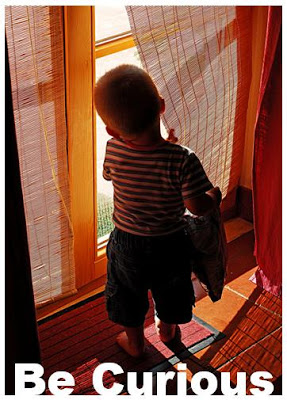
As often happens, I learned what it was that I wanted to say when I wasn’t actively thinking about this challenge. All of a sudden, while munching my sandwich and mentally rehearsing an upcoming instruction session, the phrase “Be Curious” popped into my head. Without curiosity libraries, childhood, and life would be pretty barren. And thus my Passion Quilt contribution was born.

Places to go from here:

The original meme rules (with commentary):

  • Post a picture from a source like FlickrCC or Flickr Creative Commons or make/take your own that captures what YOU are most passionate about for kids to learn about…and give your picture a short title. (Check, though I must say that if you search Flickr for “curious” you get a boat load of cute cat pictures.)
  • Title your blog post “Meme: Passion Quilt” and link back to this blog entry. (Mostly check and check.)
  • Include links to 5 folks in your professional learning network or whom you follow on Twitter/Pownce. (Clearly my rule-following ability can only be sustained through one and three-quarters rules. Consider yourself tagged, or not, as you wish.)

Technorati technorati tags:

Comments closed

Theory Feeds My Soul

I’m sitting here hunting for articles in hopes of creating a little literature review for myself on a topic I’ll be presenting on next week, and I’m cursing the practicality of my profession. Everyone’s writing “how to help students avoid plagiarism by teaching the proper mechanics” articles. But what I need is “why are the mechanics the way they are” articles. We’re To Practical, I Tell You!!!

In library school I got frustrated with those classmates who complained about my favorite class because “there’s nothing practical there.” At conferences, I don’t participate in the “I hope there’s some good practical stuff here” conversations that happen before the sessions.

It’s not that I don’t appreciate the practical. I live it. I get frustrated if there’s no practical connection or grounding when ideas get bandied about. But the theory and philosophy that forms the foundation of what I do, that is what feeds my soul, sparks my imagination, helps me judge the merits of practicalities, and helps me mold other people’s practicalities to my situation.

Maybe it’s the English major in me, I don’t know, but I feel starved for some well-thought-out theoretical research with a healthy mix of evidence (not all of which needs to come from practice), deep thinking, and logical reasoning. I look to blogs for my “how-to” needs, project reports, and increasingly for the philosophical musings that I would expect from journal articles. But our peer reviewed literature should be the strong-hold of our deepest thinking.

2 Comments

Transparent or Opaque?

Allow me to take a moment to rant a little. There are some common metaphors that are slowly but surely losing their meaning as people get them mixed up or use them to describe an ever broadening set of nouns. These metaphors are transparency and opacity. They are most often used to refer to processes and procedures, though lately I’ve seen them in all kinds of literature and used to describe everything from word definitions to philosophical ideas.

Here’s how they should work. Transparent processes are easy to understand. Opaque processes are not. Think of a box full of gears. If the box is transparent, you can see how the gears move and can therefore anticipate actions, think up changes to the process, and generally know what you’re dealing with. If the box is opaque, you can’t see any gears moving, so you have to guess how things might work.

This is why the metaphors get confusing when used to describe things that are not processes. If you’re talking about a thing (such as an idea), you might think, “If this idea were a physical thing, I’d want to be able to see it to understand it. Therefore I’d think it should be opaque, because you can’t see transparent things. If I can’t see this idea-thing I can’t understand it.” This makes sense but is not how the metaphor works. It just isn’t.

Here’s the rule: the transparency/opacity refers to an imaginary enclosure. If it’s transparent, you can see what’s going on inside the enclosure; if it’s opaque, you can’t. Transparency = understandable. Opacity = mysterious.

6 Comments