Skip to content

Category: Libraries and Librarians

What are we DOING as we support digital humanists?

As I manage student’s workload and facilitate the projects they do in support of digital humanities projects on campus, I’ve noticed that one of the underlying dynamics that I have to negotiate is what The Work is that the students do. People talk about job descriptions and the scope of the service, but unarticulated below of if that are deeply held assumptions about what counts as meaningful work for whom.

The student workers themselves are divided on this point. Some of them are very good at zeroing in on core questions that help us think through the project as a whole and set baselines for future decisions. They engage with the process of defining projects, and documenting decisions, and engaging with the campus, and they see this as part of The Work. Other students see this kind of thing as “administrative” work. They would prefer to DO rather than plan or document. Planning and documenting is not The Work to them.

I can see the same thing playing out in different ways with the faculty heading up the projects. Some see the student workers as collaborators with whom to exchange ideas about how to proceed. Others see the student workers as people to cary out project duties as assigned.

Meanwhile, as I look at my own work associated with digital humanities on campus, I can see that I’m kind of at war with myself on this topic. First, I’m an interim in this position, which I’m not good at. A couple of times I’ve wanted to engage with questions or jump into action and my steady comrade-in-DH has reminded me that we should do things right rather than soon, and I’ve felt chagrined each time because I know this and I think that in my regular work I’m usually good at this, but somehow in my current situation I seem to get ahead of myself sometimes.

Another layer of my own internal struggle is that my main goals as the interim DH supervisor is to keep the program afloat and to document, document, document. I want the transition for the new person to be as smooth as possible, and I want to be an effective project manager for my students. But sometimes I worry that I might be too deep in the “admin stuff” (as one student calls it) and pulling my students too far in with me. I can totally relate to the desire to just plug away at a project.

Planning, documenting, and program development are important parts of the job for each of us. They are definitely a good part of The Work of digital humanities on my campus. The trick is to figure out the right balance for each person. I don’t think I’ve figured out that balance point yet.

Comments closed
Big fun with small data

While I’m on shift this Sunday (during the most glorious fall day we’ve had, on a day that combines Family Weekend and Homecoming Weekend), I played around a bit with our chat reference statistics.

Our students have never really used chat reference much. In part this was our fault (we didn’t have a very friendly chat widget and we didn’t have the unlimited funds needed to have 24/7 reference service) and in part this was because on a small residential campus, the majority of the people who wanted help while we were on staff were already in the library. (That’s what students told us when we asked, and the data from this year bears it out by a slim margin.)  So last year we’d fielded three whole chat reference questions in the first four weeks of school.

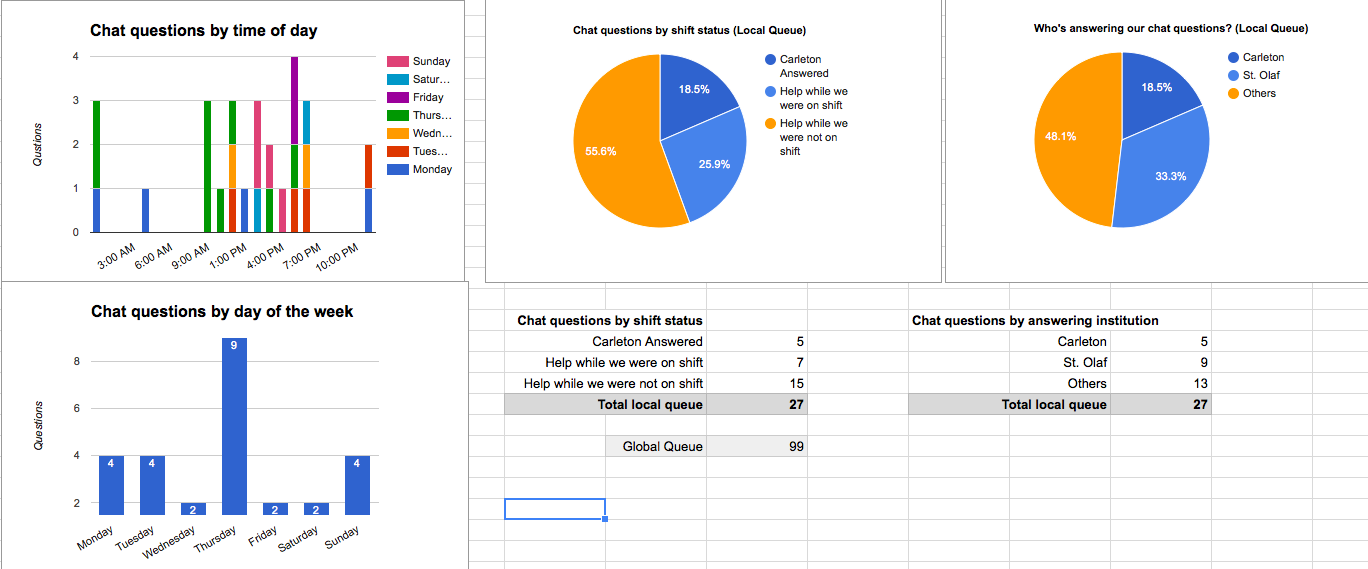
This year we’ve switched to QuestionPoint, which means we have 24/7 reference and access to a chat widget that looks a lot more like chat widgets people are used to seeing. Now here’s where the big fun with small data comes in. Because last year’s n was so small, I can say that this year we’ve had a 800% increase in chat questions. Woo!

If we’d changed nothing but the interface, we would likely have answered just the 5 questions that we have answered while on shift this term (66% increase), but the change in librarian coverage has made a huge difference. 15 of this year’s 27 questions were answered while we weren’t on staff, and another 7 question were answered while we were on staff but otherwise occupied. So that’s pretty cool. Usability and coverage FTW!

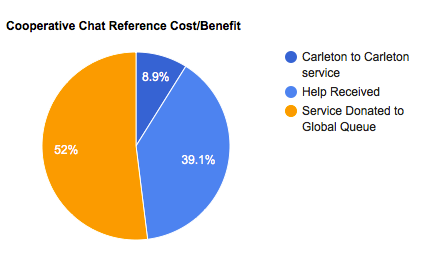
Updated to add: I was curious to see how the service is working from a cost/benefit perspective. We donate a specific number of hours per week based on our FTE, and it looks like the formula is working ok. We have answered 29 questions for other institutions, and between the help the collective has given us us and our own efforts, our patrons have gotten 27 questions answered.

2015-10-11_2246

Comments closed

Managing Digital Humanities Associates, Week 2

Well, classes start tomorrow, and I meet my student workers for the first time on Tuesday, so the time to get organized is NOW.

Along with several more useful meetings with people who have information and training to share about current DH projects on campus, this week a few over-arching things fell into place. First, the computers that the students will use (and, oddly, the positions that the students fill on campus) were officially blessed as “ongoing.” This means that the ancient computer will get replaced sometime in the next few weeks, and the newer computer will be automatically up for replacement when it reaches 5 years of age. What a relief! As anyone can tell you, the state of the digital humanities and of technology in general could be entirely different in 5 years, but whatever happens, I’m absolutely sure that faculty will still be performing scholarship, and student assistants will still need technology of some sort to help support that. So for now, that piece of academia’s future on our campus is a little less shaky. Whew.

A second big falling-into-place was that the college’s post-doc in Digital Humanities, Austin Mason, and I sketched out a kind of syllabus for our student workers. Their work is so very academic that this approach made natural sense to Austin and me. They have to get some basic training, but even more than that they have to learn to think like digital humanists. So they’ll each have the their own projects, but our weekly team meetings will also give them a chance to brainstorm with each other, explore topics in the field, and present their work.  We’re also going to explore more conscious and consistent participation in the DH community by putting our thoughts and updates out there in the DH blogosphere rather than locking it down in a Moodle site. The DHA program already has a blog that needs some work, so one of our group projects is going to be to clean up the current structure, About Page, Bios, etc, and develop a coherent structure and look for our future work. Mundane or private things can be published privately, but we’re going to use the site pretty heavily for both internal and external communication.

Along with that, I’ve spent a few hours today setting up a workspace in Asana for us and linking it up to a Google Docs folder structure. There’s a Gdocs folder and an Asana project for every DH project we’ll be supporting, and I’ve built in regular recurring tasks to ask for documentation and project management, along with prompts about when to check in with me.

Of course, I still haven’t managed to secure a table to put in the room where we’ll meet and work. Tables are, apparently, worth their weight in gold on our campus.

Comments closed

Managing Digital Humanities Associates, week 1

So, I’ve had this new responsibility for one week now, and what a week it has been! And I haven’t even met the student workers yet!

One thing that I think might be a distinct advantage of having a newbie in charge is that it gives all kinds of stakeholders on campus the chance to articulate their understanding of what’s going on and what they see coming down the pike. It’s kind of like having an external review without the external reviewers or the reports or the expense or the… well all of it except for the useful things everyone learns when they have to say their assumptions out loud. Now, I don’t think that people were necessarily in different places before this week or that I’ve triggered any “ah ha” moments or anything like that. I just think that it’s incredibly useful as we get ready to make decisions about the future of digital humanities on our campus to have everyone take a moment and say “This is what has been amazing so far, this is where I see things going, and here’s the stake I have in that future.” I’m going to do my best to document these things for the new librarian, but I also know that when we do hire the new librarian that person will add his or her own facets to these conversations.

I’ve also learned (again) that grant funding is a double-edged sword. We had a grant on campus years ago that was awesome but then left us with all kinds of aspirations and assumptions on campus that are no longer supported or funded. One tiny piece of that is one of the two computers my student workers will use. It’s now too old to function well but was bought with grant money and therefore isn’t on a replacement schedule, so who’s going to pay for it? And can we get it on a replacement schedule this time around so the headache doesn’t repeat itself ad infinitum? These are questions I hope to sort out during week 2. Wish me luck!

I’m also learning that this venture shares a characteristic with many of the exciting campus-wide initiatives that I’ve been a part of or heard a lot about: it is fueled by lots of talent and enthusiasm from many quarters on campus, but it is not (yet) part of a cohesive structure on campus. There’s nobody who “owns” digital humanities on campus, so coordination isn’t as tight as it could be and funding for things like computers (see above) is kind of up in the air. Luckily, solving that is high on the agenda for several of the big stakeholders on campus. Hopefully we can figure out how to get all the benefits of a cohesive structure without losing any of the start-up like innovation of the current semi-structure. (My own view is that this future cohesive structure should actually coordinate and fund the Digital Liberal Arts, not just Humanities, but more on that another time.)

And finally, the breadth and depth of the projects this small but growing group of student workers has contributed to is pretty awesome. And the students themselves seem like they’re going to be quite a team to work with (though I really wish they were all equally good at responding to my request for their schedules). I hope that I can give these students the structure and support they need so that they can keep doing the work they’re so obviously good at doing.

Here’s a little video about one of the projects that the students have worked on in the past.

Comments closed