Skip to content

Category: Libraries and Librarians

Human-Assisted Computer Coolness – or – Computer-Assisted Human Coolness

I realize that I promised a post long, long ago (4 days, to be precise) and never delivered. There are good reasons for that. But not interesting reasons. Short story: life is busier than usual at the moment.

But anyway… Monday was ARLD Day here (that’s the Academic and Research Libraries Division of the Minnesota Library Association as well as the local chapter of ACRL). And ARLD Day did something very, very right. They got John Riedl (who has a blog at GroupLens) to talk to use about creating the social web. Specifically, he looked at the top ten web sites in the United States (as ranked by Alexa)* and delved into their social aspects, and used this framework as a way to talk about research that’s happening among the developers of the social web.

For example, when he talked about the number one site, Yahoo (because it owns so many sites), he used Flickr as an example and talked about tagging. Did you know that initial research suggests that items get tagged with a few tags that almost everybody uses, and then a lot of tags almost nobody uses? Doesn’t sound so radical until you think that there’s no real curve if you graph this phenomenon. Statisticians would expect one of the tapering-off curves that we’ve come to associate with the long tail, but that’s not what happens here. Here there are simply a few tags that get used all the time for any given item, and a lot of tags that only get used a couple of times. Nobody knows what this means, but researchers are looking for ways to predict what those popular tags will be, or ways to help computers learn from early user tagging to predict which tags will become most useful as tagging continues. This. Is. Huge. Imagine pre-populating any catalog record with 5 to 7 useful tags! Imagine using this understanding of user tagging to revise and augment LSCH. The possibilities seem endless.

He also asked the question: Is tagging fundamentally a selfish behavior? This is important because you want tags in quantity and from multiple users. But how do you motivate users to add tags? Do you want the user to get something out of it or to feel the he/she is giving something to the community? If it’s a combination of the two (which everyone suspects is true), what’s the perfect mixture that will encourage as much useful tagging as possible? Well, so far the research shows a mixture, but that users are much more likely to add tags if they think this will help other people as well as themselves.

Not only that, but they had the best success getting users to add content (tags, ratings, and reviews) if they told the users a specific population their content would benefit, and if the system recommended items to which it thought you could add good content. (i.e. The system picks a movie that you will likely enjoy based on past behavior and tells you, “your review of this movie will particularly help fans of comedies and historical dramas.”) This combination of having targeted recommendations for community involvement and being told exactly who in that community you’ll benefit, was vastly more successful than more passive approaches.

Not only THAT, but they found the best content was submitted by users who knew their work was going to be looked at by another user. BUT, it didn’t matter if the peer reviewer was going to be an expert or not. Anyone will do. You just need peer review.

So far they’re testing this idea of teaching computers which tags are useful using their system MovieLens. Their users tag movies and then rate each other’s tags with a thumbs up or a thumbs down. And so far, initial results indicate that tags receiving thumbs down ratings are, in fact, poor, rarely used, and generally perceived to be poor. However, there’s not much pattern yet to the tags that get thumbs up ratings. They’re continuing to explore this.

One other aspect of this amazing keynote (probably the best keynote I’ve ever attended… no kidding!) that I think is particularly applicable to libraries is that as users rate and comment, they teach the company (or the library) what is important to them. I can envision combining failed search data, commonly used search terms, click-throughs, and direct participation (such as ratings) to figure out what research is being done, what kinds of sources are hot right now, and other such information that could inform collection development practices.

But as with any other social site, library applications would need an active community. Riedl pointed out that when Google bought YouTube, they paid for the community. They already had what he considers to be a better product, but they didn’t have the user-base, and that was worth more money than I can comprehend.

The community is also important because computers are bad at making judgments. They’re bad at looking at content and understanding what it is and what it’s about and how it’s related to other content. Humans, though, do this exceptionally well. So what the computer can do is find patterns in human behavior and crunch the statistical numbers for you. Computers calculate; humans judge. And figuring out how to maximize on these two skills is the subject of much research and development. And then figuring out how to trigger people to participate in these online collective efforts… that’s another who avenue of current research (see Karau and Williams in the bibliographical note below).

He talked about a lot of other things (such as how they’re working on the problem of keeping these user communities from gelling as only like-minded people can and instead encouraging people to see connections between their interests and either people or information that they might not agree with but that they will be interested in), but this is too long already. He also provided citations to a couple of articles,** but there are lots more listed in the research section of GroupLens or on his CV (PDF).


*In descending order: Yahoo, Google, MySpace, MSN, eBay, YouTube, Facebook, Wikipedia, Craig’s List, and Windows Live. He actually didn’t talk about because Windows Live because it’s “just another Google rip off,” so he included number 11: Amazon (for which he helped write the original recommender system!).

** Some references he mentioned:

Karau, S. J., and Williams, K. D. “Understanding individual motivation in groups: The collective effort model.” Groups at Work: Theory and Research M. E. Turner Ed. Mahwah, NJ: Lawrence Erlbaum Associates. 2001. 113-41.

Khopkar, Tapan , Xin Li and Paul Resnick. “Self-selection, Slipping, Salvaging, Slacking, and Stoning.” Proceedings of the ACM EC 05 Conference on Electronic Commerce in Vancouver. 2005. 223-231. (Preprint PDF here) [on the methods of decreasing user reputation on eBay, and how people go about avoiding this]

Resnick, Paul, Richard Zeckhauser, John Swanson, and Kate Lockwood. “The Value of Reputation on eBay.” Experimental Economics 9.2 (2006): 79-101. (Preprint PDF here) [on why reputation is important on eBay]

“Making a Guitar in Second Life” and “Suzanne Vega Concert in Second Life” (two YouTube videos about how craftsmen and artists are important even in a virtual world)

p.s. And since I’m a librarian, I also found this article on …. well, read the title.

Ling, Kimberly, et al. “Using Social Psychology to Motivate Contributions to Online Communities.” Journal of Computer-Mediated Communication 10.4 (2005). Online only.

2 Comments
Good Day

Today was ARLD Day here in Minnesota. I would write more than “it was awesome,” but I’m too tired and have too much other stuff to do. But I promise, I’ll write more than “it was awesome” as soon as possible. All I’ll say now is: developer of recommender systems + keynote = awesome. Think on that.

Comments closed

Clammering in the Hallways

Scott McLemee, with the help of Steven Bell, declared quite some time ago that there’s too much silence in the stacks.* Apparently he couldn’t find blogs that were specifically “maintained by academic librarians” and focused specifically on issues important to academic librarianship. Hi, I’m Iris, and I’m an academic librarian.

Actually, there were a couple of statements in this article that rankled. I don’t particularly enjoy thinking of my writing here as “splenetic” (no matter how true it may be some days) or hearing that I’m “not capable” of the type of writing McLemee and Bell would prefer. But whenever people get too defensive about these types of statements, authors always come back and argue that we missed the main point of their writing.

So let me be clear. McLemee is not, apparently, saying that there aren’t blogs out there that are both maintained by academic librarians and focused on academic librarianship, no matter how clearly that message seems to leap off the screen when the few of the blogs mentioned in the article are condemned either because readers “don’t really know if the [author] is an academic librarian” or because the blog’s topic “isn’t specific to academic libraries.” Instead, he maintains that his argument centers on two points. First, he is not aware of any blogs that have stepped up and become the “voice of academic librarianship.” And second, the lack of such a voice is sapping the profession of it’s cultural capital.

These are not simple arguments. Every time I think I’ve grasped their intent, it slips away to snicker at me from behind another corner. But even though this post of mine won’t stand up to the criterion of “great (or even good) insight,” I think it’s important to unpack some of the underlying assumptions here.

First, I’ve already written that good, clear writing is essential to our profession. So on that point, I believe McLemee and I agree. Without clear and insightful writing we librarians can’t hope to excel in academic environments because these environments eat, drink, and breathe scholarly writing. Scholarly writing is the lingua franca of our environments, and if we don’t speak it, we essentially exclude ourselves from the societies in which we live and work.

I do not believe, however, that a blog – any blog – no matter how consistently insightful, would prove to our chosen culture that we are fluent in its language. In order to be seen as “full-fledged participants in contemporary intellectual life,” we would have to publish in vehicles that are understood to be prestigious by our audiences (in our profession, academia, and the wider intellectual community). Currently, these only rarely include blogs or any other self-published vehicles.

And if what McLemee wants is “public spaces devoted to thinking out loud about topics” that are important specifically to academic librarians, and yet doesn’t want “reflective and/or splenetic mini-essays,” then blogs may never be the appropriate vehicle as blog posts, by their very format, lend themselves primarily to an op-ed style, much like McLemee’s own essay.

So I would argue that yes, good and focused writing is essential to our profession. Librarians with the gift of insight and eloquence should be encouraged to pursue their talents for the good of the profession. And these writers should also contribute to the professional discussions that happen online, the visible “thinking out loud” that will in turn inform their thinking and writing. Blogging is very important, but it cannot be all things. Not yet. Not when we’ve set up our lives in the midst of academia.

And when I reference the online “discussions,” I use the plural quite deliberately. No single profession can easily sum up the issues that are important to that profession. There are myriad issues, and most can be approached in multiple ways. Because of this, no single person can become the voice of the profession. And this is not a characteristic exclusive to academic librarianship. People can usually identify a handful of voices of Dickensian criticism or the theory of Universal Grammar, but it is impossible to identify the “voice of literary criticism” or “voice of linguistic analysis.” What is more, nobody thinks of this as a lack in either of those fields. Nobody calls this a “puzzling silence.”

What we do find are journals and publishing houses that take the lead in publishing the cream of the scholarly thought in those fields. In this way, McLemee’s idea of a group blog devoted to topics in academic librarianship makes sense. I would gladly subscribe to such a blog, and there are a few out there that I think contend for the title of academic blog for academic librarians, by academic librarians.

But even these blogs might fail to meet his expectations because issues that are important to academic librarians are also important to other types of librarians. Librarians in public and special libraries are just as engaged in “questions concerning public budgets, information technology, the cost of new publications, and intellectual freedom” as academic librarians are. I would argue that the different types of libraries are usually more the same than they are different. We may prioritize our foci differently, or emphasize certain parts of our missions differently. But for the most part, we care about the same issues and deal with the same or infinitely analogous challenges. Blogs focused on issues in academic librarianship may not, then, look very much different from blogs focused on public or special librarianship.

So perhaps there is silence in the stacks. But maybe that’s because the conversation isn’t happening in the stacks. Maybe the conversations are happening in the hallways. And maybe it’s hard to pick out the conversation because there are several, and maybe they’re happening concurrently and on multiple plains.

p.s. Does this count as disagreement and discussion?

*This article was just brought to my attention today, and though the article itself is old, my response to it is based in the world of current academic librarianship. I wonder if McLemee still thinks the same way?

1 Comment

Looking Back

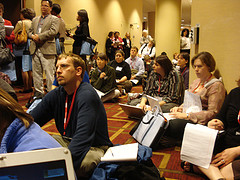
One of the most interesting things about going to two conferences in three weeks is that the contrasts between them become much more apparent. Take, for example, the dress codes. ACRL was definitely on the business casual side. We all looked exactly like what we were: 3200 librarians. At CIL, things were a little more casual and a little more hip all at the same time. We still looked like what we were, but there was a subtle difference.

Then there was the session envy… At ACRL, if you were sitting in a session that only you and about 10 other people decided to attend, you had a pretty good idea that everyone else at the conference knew something you didn’t and had decided to attend one of the 10 or so other sessions that would have been better. At CIL, if you attended a session that was only one third full, you knew that everyone else at the conference knew something you didn’t and had decided to attend the one REALLY hot session that period. (On the other hand, sitting in your un-full session you also had a seat and didn’t have to sit on the floor in the hall outside of the overflow room, so it wasn’t all bad.)

But no matter which conference, there are always library geeks. “Lunch 2.0,” for example, can only happen in a group of librarians. (In order to achieve Lunch 2.0, you must walk from your hotel and turn right toward many restaurants every day, lunch and dinner, until the last day. On that last day, you must turn left toward different restaurants even though “we’ve never done it that way before.”)

Looking back over these two conferences, I’ve met so many wonderful people, seen some truly cool stuff, and generally renewed my conviction that I’m in the best job ever, and I’m in it with the best companions around. It’s not without it’s frustrations (and after hearing many variations on the theme of “I could never do that at my library” I’m even more grateful for my co-workers and working environment than I was before), but it’s pretty darn amazing nonetheless.

Now, back in my “real world” of Sunday reference shifts, burgeoning to-do lists, classes, consultations, and meetings, everything seems just a little rosier than it did a few weeks ago. There’s no good reason for this. I have even more to do than I did before, and even less time in which to do it all. But at least for now, that doesn’t matter so much. I’m jealous of everyone who gets to go to Internet Librarian, but I’ll see you all at CIL next year. Just don’t have too much fun without me in Monterey, alright?

Technorati technorati tags: ,

Comments closed