Skip to content

Category: Libraries and Librarians

Morning of Nerddom: appointment schedulers and feedback forms

First of all, I’m back! I’ve been devoting any writing energy to some article revisions, but now those are all submitted and I don’t have to feel guilty about cheating on my article with my blog. What a relief.

Anyway, this morning I spent nearly all of my time shirking other responsibilities in order to set up an appointment scheduler and some feedback forms. A couple of my colleagues use and love schedulers, so I thought I’d give it a try, and I’ve been hearing non-stop lately about the value of very very brief assessment, so I thought I’d try that in a more formalized way, too.
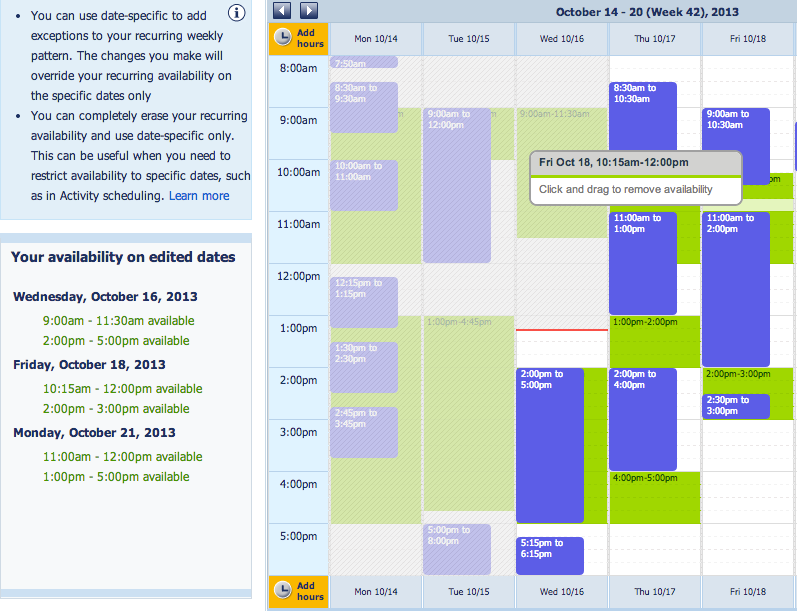
How my calendar looks to the scheduler
How my calendar looks to the scheduler. Blue is “busy” time from Zimbra via Gcal (this trumps available time). Green is available time that I can add to or erase by clicking and dragging.

I heard about ScheduleOnce on a recent friendfeed thread and made an account almost on a whim. “I’ll poke around and maybe set it up later.” Famous last words. It’s pretty nifty and lets me do pretty much all of the things I want, and some things I didn’t know I wanted. For example, I could set it up to send a reminder email to the student (maybe fewer no-shows?), and tell it how soon before the desired appointment time a student can book me. The one catch is that it’s made to work with Google Calendar, and my school uses Zimbra, so I had to import my Zimbra calendar into a google calendar (there are some limitations with this, but it’s better than nothing) and then tell ScheduleOne to look at the imported calendar for busy times (which required an upgrade to the $5/month plan). But if it works, it’s totally worth it to me.
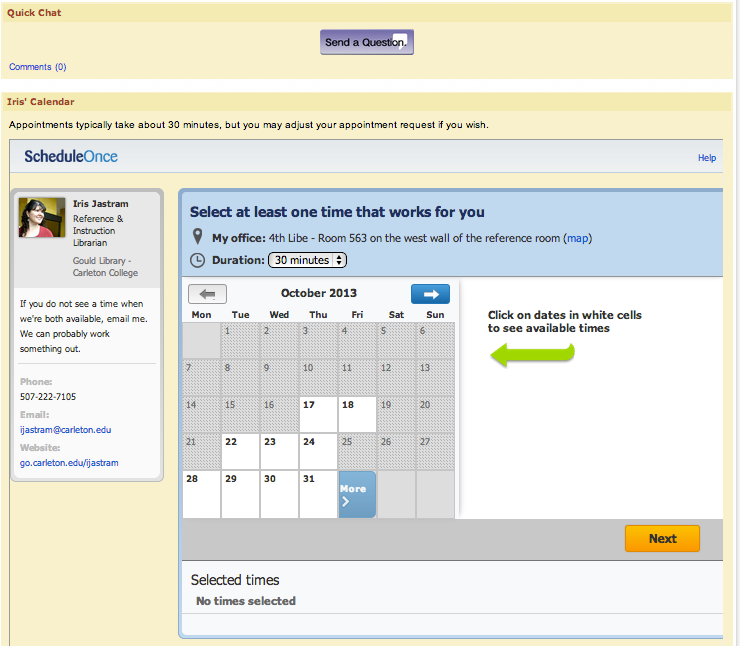
What my students see

After a couple hours of tinkering and testing and tinkering and importing and syncing and cursing Zimbra/Gcal quite contentedly, I embedded the scheduler page in my liaison page and thought I was done.

Then I remembered the “follow-up email” option in the scheduler that I had turned off. Who needs more email, right? Well, maybe people will give me some basic feedback if I ask nicely. So I hopped over to Google Docs and made a feedback form that basically asks two questions: “how satisfied are you” and “do you have follow up questions” (if yes, email me, because this form doesn’t collect any identifying information. Then I leave the traditional optional space to tell me more. Done. I added the link to a follow-up email thanking the student for the research meeting and telling them to email me if they have further questions, and I figured I was done.

But no. This made me think of the people talking about having students fill out forms embedded in libguides at the end of instruction sessions. I’ve done the “on the front of the notecard write something that was new and/or helpful; on the back write something that is still confusing or you’d like to know more about” kinds of exercises on occasion, and I’d love to do more of them, but I often don’t have notecards at the last minute. So I basically made that into a Google Form, embedded it in a page on libguides, and now I’m set to copy that page to any other guides I make. Tada!

And thus ends my morning of nerddom.

Update: 10/31/2013

This is going exceptionally well so far. I’ve done a few user error things along the way, but over all it has been such a help. Almost no futzing with calendars every day, and almost no back-and-forth emails with students about meeting times. I’m in love!

3 Comments

We’re Published! “Swimming the Matrix: A Dialogue on Teaching Undergraduate Research”

Danielle Theiss and Kiane Kovacs have edited and published a book inspired by the work and writings of Barbara Fister, one of the librarians I most respect in the profession for her complex thinking, clear writing, and general all around amazingness as a person.

The book itself has chapters of all kinds, each of which is inspired by the three main areas of Barbara’s public voice: Change and Academic Librarians, Student Learning and Research, and Publishing and the Academic Library. And one of those chapters is a dialogue that Steve and I had about working effectively with undergraduates. It’s decidedly not  your average library science essay, and it was awfully fun to do. We hope you’ll enjoy reading as much as we enjoyed writing it!

Jastram, Iris, and Steve Lawson. 2013. “Swimming in the Matrix: A Dialogue on Teaching Undergraduate Research.” In Finding a Public Voice: Barbara Fister as a Case Study, edited by Danielle Theiss and Diane Kovacs, 69–84. Chicago: ACRL.


p.s. Kudos to ACRL for their fabulous author agreements.

2 Comments

Things we know about how information works that our students do not (yet)

Sometimes when I teach first year students how to use a book (the table of contents and index are the “google of the book” telling you what’s inside and where to find what you want) I get shocked looks from profs. In fact, last week one prof argued gently with me that I was surely mistaken that this kind of thing was news to our first year students. Surely they know how books work, how periodicals work, or that encyclopedias are often ordered alphabetically.

Well, thank goodness for Barbara Fister who just started compiling a list of just these kinds of things, where we have a tacit understanding of how information works but our students do not. Everything on her list resonates strongly with me and my experience of first and second year students.

Go read it! Tacit Knowledge and the Student Researcher

2 Comments

Information Literacy in a Utopian High School

About a month ago I got two separate emails from completely different people asking about what I think high school students should know about information literacy before coming to college. I, uh, procrastinated a bit. The question was just kind of daunting and got all wrapped up in all the normal thoughts people have about these things (“College students today, they just don’t understand even the BASICS!”) along with some worried thoughts I wasn’t expecting and don’t actually believe in (“If they know this stuff when they get to me, what will I do?”). Plus, we’re in the last few weeks of school here (yes, still) so I could procrastinate while being busy with student questions, which could even be a great excuse except that I know I was just putting it off.

Before I go any further, I should point out that not only have I never taught in a high school myself, I never even went to high school. So I’m certainly no expert in what gets taught there. My perspective is that of a librarian who spends the first 10 weeks of every school year teaching about a third of our first year seminar students. Also, these are ideas, not a curriculum. I’m just thinking out loud here, as usual. So with that said, what should high school students know before coming to college?

Habits of Mind

  1. A research paper is not (usually) a report. Very few reports get assigned in college. When faced with their first research projects here, students really really want to write what John Bean terms an “all about” paper — these tend to have “And then” as a standard transition and they basically summarize all known facts about a particular topic.
  2. Curiosity, and high comfort with the idea of finding out what people know about whatever you’re curious about. I have a browser open nearly all day every day, and I can’t tell you how many searches I do in a day — everything from checking on the spelling of a word (Google is my dictionary) or figuring out more about something I saw on TV or something I’ve read.
  3. Understanding that journalists, scholars, business people, etc don’t have their well-formed ideas drop on them from the sky. They do not utter Truth-with-a-capital-T. They offer perspective and (hopefully) support that perspective with some context/evidence/proof.  They, too, went through the messy process of figuring out what they even wanted to know about a given topic, and the uncertain phase of collecting and analyzing and rethinking and collecting some more. This is a really difficult lesson to learn, so the sooner you start thinking about it the better! And the better you know this, the easier it will be to engage with outside sources rather than simply report on them.
  4. Gather information, THEN write the paper. The other way around is just painful.
  5. Cite what you use. This is good for you (no plagiarism) and good for your reader (more context), and besides, you’ll be graded on it. This is a habit more than a skill because the individual rules for this citation style or that matter far less than the habit of bringing in and acknowledging the participants in the conversation that you’re having in the form of your research project.
  6. Talking to people (especially librarians or writing consultants or discipline experts) is not cheating. It’s the way knowledge creation happens. And since this isn’t a “report” getting information isn’t the whole point. You’ll still be able to think about and communicate about your analysis and synthesis and conclusions. Those journalists and scholars who didn’t have their ideas fall on them out of the sky? They talked to people, too.

Research skills

  1. I tend to expect students to have searched google. A lot. This is not always the case, but it’s the assumption upon which I build many of my classes and one-on-one instruction.
  2. Books are good, and knowing the parts of the book (table of contents, the amazing thing that is the index, the introduction, the conclusion) will help you get the most out of a shelf of books in extremely short order.
  3. Browsing is good. Search can only get you so far, particularly if you are a novice in the field (which is everyone in high school) and therefore don’t know the vocabulary that each field develops and uses to exchange ideas. I call this the Term Economy, and it’s what makes searches work or fail. If you haven’t paid much into that economy yet, browsing is even more your friend than it is for everyone else.
  4. Call numbers mean a topic. You don’t have to know what topic any given string means, but knowing that really helps with browsing.
  5. Find full text based on a citation. Only about 30% of our incoming students can do this and I would love it if all of them could.
  6. Keep track of what you find. Whether that means printing stuff out, saving it to something like Zotero or Evernote or whatever, it will stand you in really good stead.

Tools

  1. Word processing
  2. Basic proficiency with a browser
  3. Browser addons (so many library tools involve bookmarklets and browser addons)
  4. Citation generator? Zotero is great and useful in many many more ways that just producing citations. Straight up citation generators? I’m neither opposed to nor in favor of them. The only thing I really care about is whether the student knows enough about basic citations to be able to look at a citation and use it to find the text. THAT’s what’s important about citations. The rest is periods and commas.

I’m sure there are plenty of other things high school students do and should know before entering college, but these are the things that trip up my first year students either consistently or spectacularly.

3 Comments