I was going to write about scratch paper today (really, I was), but that can wait for another day. Today I’m thinking about Darien Library, Drupal, and John Blyberg’s SOPAC (Social OPAC).
A year and a half ago, when he released the first version of the SOPAC for the Ann Arbor District Library (here’s his blog post), Blyberg’s extensive customizations were definitely cool, definitely innovative, and definitely had potential. He was working hard to put lipstick, a wig, and a dress on his pig. Well, now he’s covered the pig altogether. I won’t get into details (mostly because I only barely understand them myself), but he has coaxed his Drupal-based web site to pull information from their ILS rather than pushing the searcher into the ILS’s environment.
Other people have tried to insert new interfaces between their ILS and their patrons with more or less success, but I think Blyberg has just shown us an example of this type of project that not only works well (drawing on information from the ILS, from a local database of user-generated content, and potentially from a much larger database of user-generated content from other libraries), and is ILS-agnostic, butthat also looks good.
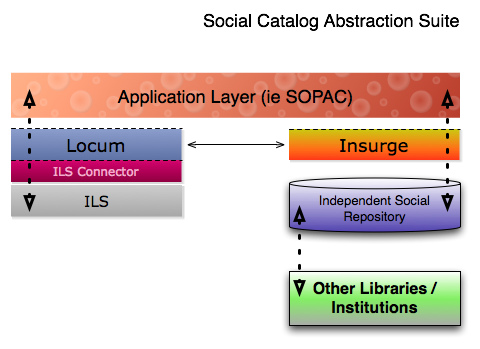
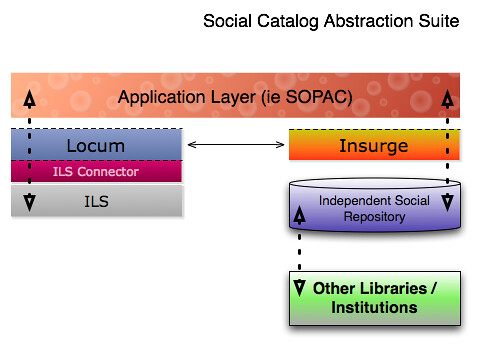
Here’s the diagram he uses to explain where all the information comes from:
And here’s what the catalog looks like (notice the juicy tags on the left):
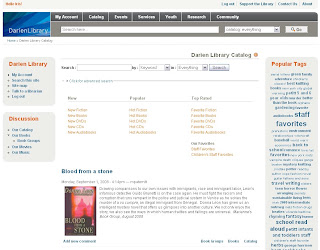 When you do a search, results appear in the main content area of this same screen, fully themed to match the site. So beautiful!
To say I’m jealous is an understatement. If we can’t bring ourselves to migrate ILSs, I want something like this. But I do have two reservations: this still requires the discovery layer to harvest and store information from the ILS, and that pig is still under there somewhere. As far as I can tell, the ILS is still locking down untold treasures in the form of data that catalogers have worked so hard to include in our records and it’s preventing us from exploiting that data fully. An actual relational database as the foundation for bibliographic information would make me so very happy. Still, this is really really exciting. I can’t wait to see if other libraries pick up this open source software and continue to develop it further.
Comments closed