Skip to content

Month: September 2007

Managing My Bookmark Toolbar

Like most people, I keep a variety of bookmarks and bookmarklets on my browser’s bookmarks toolbar. But ever since sites started associating cute little icons with their URLs, I’ve developed a kind of complicated method of managing this toolbar. You see, I’m an icon kind of a gal. My eye gravitates towards the cute picture rather than the words describing it.

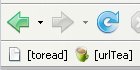
The problem? Most bookmarklets don’t come with an icon. So you just get the little blank piece of paper and some practically useless words (like the “toread” bookmarklet in this image).

So here’s my multi-step process. Bookmark the website associated with the bookmarklet (in the case of my urlTea bookmarklet I bookmarked urltea.com). Then click on your new bookmark so that it gathers the proper icon from the site and looks all pretty. Meanwhile, drag the bookmarklet to the toolbar. (Ok, I know you can’t do this “meanwhile,” but it sounded good.) Now view the properties of the bookmarklet, copy the javascript in the “location” box, and then paste it into the “location” box of the now-former bookmark to the site. Now you can delete the un-beautiful bookmarklet because, well, you don’t need two bookmarklets, do you?

My last step is to enclose the names of my bookmarklets in square brackets. This way I can tell at a glance which buttons do something and which are simply bookmarks.

Comments closed

The Problem of Literary Research

Two years into being a lit librarian (as well as 6 years of studying literature and writing literary criticism of various sorts and levels), I finally realized what makes literary research so hard. All these poor students are looking for research about their literary works, and they want examples of criticism that approach those works from particular theoretical frameworks. But the MLA International Bibliography and other databases for literary research don’t index by theoretical perspective. I can’t ask it for New Historicist readings of Daisy Miller, for example. And because of this I can’t easily figure out quite what New Historicism is, or who the key scholars were/are, or flesh out a “history of criticism on this piece” kind of literature review.

And I can understand why this is the case. I mean, can you imagine the overhead involved in making decisions about what theory/theories are represented in an article, applying this to a databases as massive as the MLA International Bibliography, or updating the constantly changing terminology associated with literary theory? And yet, this is one of the three primary query-types I’m asked to help with (the other two being “things interpreting this work” and “things characterizing this author.”)

It strikes me that this could be one of those perfect uses for social tagging in research databases. But until then, these poor students are in for a long and frustrating stint of following up on citations, using Web of Knowledge to develop a better feel for the network of scholars writing from a particular theoretical framework, and generally having to move beyond the now-normal task of picking articles with interesting titles from result lists.

In other words, I think that in many ways, the skills required for good literary research are still some of the least translatable into the electronic world. And these skills will probably continue to be much more based on building up vast internal schemata of authors and publishers then on boolean searching until a) databases add indexing about theoretical frameworks or b) MLA (and others) goes social and let us help them describe these works of criticism in ways that are useful to literary critics.

Comments closed

Anyone Want to Come Work With Me?

The seven of us in the Reference & Instruction department are thrilled with the idea that soon we will be eight! Here’s the ad (and here):

Purpose of this Position:

Carleton College seeks an innovative and energetic librarian to join us in our lively and imaginative program of information resources and services. This new full-time position will increase our support of the social sciences from 1.0 FTE to 2.0 FTE. This is an ideal position for an individual who is 1) looking for an opportunity to work in an institution focused on teaching, in collaboration with an unusually fine group of students, faculty, and colleagues; 2) committed to excellence in teaching; and 3) deeply rooted in and excited about a social sciences discipline. The Reference and Instruction Librarian for the Social Sciences will report to the Head of Reference and Instruction.

Responsibilities:

  • Work closely with current liaison to expand support to faculty and students in social sciences. See: http://www.carleton.edu/campus/library/reference/liaisons.html.
  • Assist in information literacy planning, teaching, development, and instruction.
  • Participate in a well-utilized individual student appointment model.
  • Participate in our Research/IT desk service.

All members of the team participate in campus initiatives and faculty development presentations, evening and weekend reference rotation, and reference collection development. Liaisons also work together on user guide design and development, production of handouts and publications, and quirky publicity activities. We are committed to collaborating with IT and other academic support units.

Carleton College is a highly selective, residential, liberal arts college located about 45 miles south of Minneapolis and St. Paul. The Gould Library (http://www.carleton.edu/campus/library) strongly encourages and supports professional development, initiative, and imaginative approaches to information services. We place a high value on a solid grounding in the world of books and scholarly information.

Minimum Qualifications:

Required:

  • ALA-accredited MLS or equivalent.
  • Strong service orientation, initiative, and flexibility.
  • The desire and ability to work both independently and as a part of a collaborative, decision-making team.
  • Excellent interpersonal skills.
  • Outstanding oral and written communication skills.
  • Strong teaching skills.

Preferred:

  • Academic library experience, including reference and teaching experience.
  • Strong interest in, knowledge, or experience in assessing user needs.
  • Intrigued by uses of social software in libraries.
  • Advanced degree in the social sciences.

If interested, please send a letter of interest (including where you learned about this position), résumé, and three references complete with address, email, and phone numbers to Carleton College, Human Resources, One North College Street, Northfield, MN 55057. Application review begins October 22, 2007, and continues until the position is filled. Visit our web site at www.carleton.edu. Carleton College is an equal opportunity employer committed to excellence through diversity.

“Social Sciences” at our school means Economics, Education, International Relations, Political Economy, Political Science, and Sociology & Anthropology (a dual department here).

So… who wants to come work with me?

Comments closed

First Week

Walking through the student union just now, I was reminded again that the first week of classes in Fall term is probably the worst week of the entire school year. Sitting at one of the tables was a young girl that I think I recognize from New Student Week. She was making herself as small as she could, and trying so very hard not to cry. So very hard. Poor thing.

Being away from home and then inundated with work and promises of work with no idea how that work can possibly get completed in 10 weeks is just about the most helpless feeling in the world. All I wanted to do was go over and hug her. But then I remembered that when I’m in that state if anybody is nice to me that’s it, that’s when the crying starts. And once it starts, there’s no way to turn it off. So I didn’t hug her.

I hope I made the right choice.

6 Comments