Skip to content

Pegasus Librarian Posts

Empathy, But Not Sympathy for Innovative

There’s been a lot of discussion recently about the state of the catalog, both here and on other blogs. It’s such a hot topic that I get double or triple the number of messages from ngc4lib than from other lists. (If it weren’t for the incredibly interesting and insightful posts on that list, this kind of volume would force me to unsubscribe instantly, but luckily it’s worth every minute.)

People like Michael Stephens and Nicole have said that Innovative is not very innovative.

John Blyberg of blyberg.net has responded to this and similar complaints by penning an ILS Customer Bill of Rights.

Over on One Big Library, dchud has been arguing that there’s a problem with this bill of rights because we signed the contracts so we’ve only ourselves to blame. And surprise, surprise, this has sparked off more discussion.

Someone has even put together an Amazon interface as it would look if Amazon were an “OPAC”(via TTW).

Now, don’t lynch me before you hear me through to the end, but I’ve got to add another bit to this whole discussion. At our last users group meeting Dinah Sanders was talking to people at the reception, and the topic of conversation was pretty predictable given the general state of things. These users all wanted to be able to do stuff with the catalog… web 2.0 stuff, fun stuff, necessary stuff, stuff that should be do-able. And Dinah’s response was always the same. She’s been wanting to do all that, too, but there’s no time, and they aren’t supposed to fix stuff unless they’re actively supposed to be working on that module or code. Her refrain was (and I quote), “As we touch it, we can fix it.” YIKES!!!!!! That’s the definition of over-extended! It must be horribly frustrating to work on a project where you can see necessary fixes but can’t do anything about it.

Wait! Don’t tar and feather me yet. Hold off for a few more seconds. Remember, I said I can empathize. But this undesirable situation is exactly why we need to rethink the ILS. If it were modular, each part could be engineered by people who had time to keep up with technology. If it were modular, the discovery system wouldn’t have to be designed by companies that excel in collection or budget management, for example.

There would be new problems with this modular approach, of course, and standards would have to be clear so that the modules could be seamlessly interoperable. But having a system that’s so big that obsolete code can’t be fixed unless the entire section is being reworked anyway is a long way from a perfect solution.

Comments closed
Libraries and Living Memories

Today the annual reunion extravaganza is beginning at the college where I work. Alums from almost every class year ending in a 1 or a 6 are converging on our little town for a long weekend of revelry and memories. The librarians always put on a whole host of activities during Reunion (including a reception for former library student workers) and it’s fun to hear how many alumni end up choosing careers as librarians.

But probably the most heart-warming part of the whole weekend is watching the college archivist interact with the older alums. Often, these alums don’t have anyone there from their year, or any of the surrounding 10 (this year there is one alumnus here from the class of ’36!). The archivist, though, reminisces with them as if he had been alive and in school with them. He knows the names of professors and classmates. He knows what things looked like. He knows the issues that were important topics of discussion at the time. He’s AMAZING.

And he proves that libraries are more than just repositories of information; libraries are centers of living memory. Living memories enrich our lives of today and help us build towards our lives of tomorrow. I raise my glass to you, Eric. Thanks for clarifying yet another glorious aspect of this wonderful job.

3 Comments

Obvious?

This morning was the second of three mornings spent reading portfolios. I have to say, this could grow on me. We sat there at round tables reading paper after paper after paper. Every once in a while someone would giggle at a particularly humorous turn of phrase (some of these were even intended to be humorous). Every once in a while someone would ask those sitting nearby to help decide what grade would be appropriate, or what comments would be most helpful.

Two moments stand out for me. I read one portfolio by a student who was a very good writer… but he knew it a little too well. I couldn’t figure out how to write a comment that basically said “You’re a great writer, but try to humor your readers and pretend you’re not a god.” My favorite word of the entire day, though, came when I was reading the most incomprehensible piece of writing I’ve ever read. I was literally just looking to see if the sentences were complete because I couldn’t understand a thing that was going on. And then, in the midst of this, the writer started yet another incomprehensible sentence with the least perfect word possible: the word “obviously.” I burst out laughing, and (when I’d shown it to the other readers at my table) pretty soon my half of the room was laughing. Nothing was less obvious than the points the writer was using to support the argument, except perhaps for the conclusions the writer was drawing based on those points. (I’m still giggling as I write this…)

2 Comments

Adding to my Furl

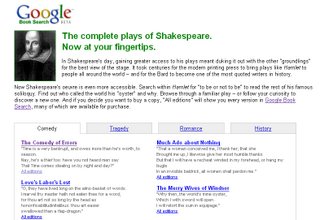
Google Book Search is implementing a new feature which I applaud as the first feature that will make a significant contribution to my life and work. This new feature is a landing page that gathers together all the works of Shakespeare. (Thanks to TechCrunch for pointing this out.)

Cool! Into my Furl it goes, along with three sites on music cognition research and one site of Greasemonkey scripts.

[Update: The Reflective Librarian points out that there is some very sloppy scanning going on for this Shakespeare collection. I wonder how systemic this is in the project as a whole?]

Comments closed