Skip to content

Pegasus Librarian Posts

Collections of Collections

Life and work and crazy deadlines on massive projects have all been ganging up on me lately to keep me from posting (or cooking, or doing my dishes, or sleeping much, or… really anything that usually makes up the rhythm of my existence). The bad thing about this is that I’ve never felt quite this overwhelmed before (though it sure is making me look forward to having another librarian join our team!). The good thing is that when so many things happen in such a short space of time, I can see patterns in the kinds of confusion my students face much more easily.

One such typical confusion that’s been brought to the fore in the last couple of weeks has to do with the concept of collections of collections. We deal with this concept all the time in libraries, and in academia in general. We know without thinking that special collections, archives, government documents, journal collections, and teaching collections in individual departments all have their own internal coherence. They have their own rules about what constitutes a relevant description and what doesn’t, what finding aids make sense, and what physical or digital organization makes finding and using the information hum along smoothly. Who would use the world “Carleton” to describe anything held in our archives like they would in our regular book collection? And who would organize our regular books by publisher like they do in gov docs, kind of?

Take that a step further and look at all our bibliographic databases. Some are indexing only (like MLA International Bibliography). Some include abstracts. Some search the full text of the article. Some ONLY search the full text of the article. No matter their structure and search philosophy (because I do think choice of primary access comes down to philosophy most of the time), each database has it’s own internal rhythms and vocabularies, strengths and eccentricities. We’re very used to approaching each new collection, probing it for clues to its vocabularies and strengths, and then mining it for insights into our research problems.

And this is just the way it is. (And incidentally, this is what makes federated search such a bear of a concept… but more on that later, maybe.) We are used to this state of affairs and navigate it as easily as we change our wardrobes to fit new seasons. Which is why, when we encounter digitized collections online, we don’t even blink. Of course they’ll have their own internal rhythms. Of course they’ll resonate to their own vocabularies.

But this isn’t the way the search-engine optimized web works. The new default order of things is that for any given search box to search everything under it in exactly the same way with consistent results. (I know, I know. This isn’t how it actually happens. But it is what people think happens, which is more to the point.) So faced with a portal like, for example, American Memory, what are students to think but that entering search terms in that little search box will search through all of the content and bring back relevance-ranked results? And yet, American Memory is a collection of collections, just like our library here on campus is a collection of collections. That search box is almost entirely useless and is causing students no end of frustration. They see result lists that are either 0 or 9 bazillion, and both results bother them so much that they’ve been coming the reference desk in droves to find out what they’re doing wrong. They’re confused and frustrated, and they absolutely “know” that the fault lies with their search abilities rather than with the problem of having a cute little search box that is desperately trying to search the contents of hundreds of collections that have about as much in common as Medline and the MLA International Bibliography, or as our musical recordings and our map collection. Up until this point in their lives, Google has searched web pages for them and delivered understandable results. They’ve never before had to consider the implications and complications that discrete collections present.

(Oh, and in case you’re wondering, explaining the concept of collections of collections, and explaining how to use the cute little search box to find collections rather than items has relieved frustration so far.)

1 Comment
New Trading Cards

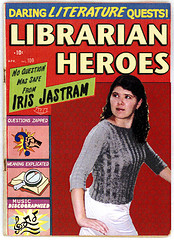
I finally got around to scanning my trading card for this year. We changed up the theme quite a bit, and my coworker surpassed herself in photoshop fu when she designed and executed these cards.

Each librarian has a different banner across the very top (clearly the science librarian wouldn’t want to be involved in Daring Literature Quests), and each has a different set of inset pictures down the left side. Only the question mark picture remains the same in all 8 cards.

One thing I’ve noticed is that these cards seem to appeal to a wider age-range than our previous cards did, which is fun!

1 Comment

Freshmen’s Questions About the Library

For one class that I teach with a colleague every Fall term, the professor helps prepare her freshmen for their first library experience by having them read an article by Barbara Fister* and then write down questions they have of the librarians (me and a colleague, incidentally). Usually, these questions are very topic specific (“where would I find how much money was spent training fighter pilots in WWII,” for example). But this year, they had a discussion in class about the Fister article which generated a much different set of questions, which the professor then forwarded to my colleague and me. Here are a few that were particularly compelling:

  • Aren’t students supposed to be independent? Is asking for help appropriate?
  • When does help slide into collaboration? Do you ever worry about doing a student’s work for her?
  • What is the reference desk? Where is it? Who is there? What is the etiquette for approaching it/them?
  • How does one learn to use the library with an appropriate blend of asking for help and learning to fend for oneself?

Prompted by the clear uneasiness over our roles as librarians and over the broader question of how academic support fits into the academic world, my colleague and I decided to spend some time at the beginning of our library session trying to contextualize library assistance in an academic world. And here’s what we told them:

They are right: we are not here to hand over the perfect research each student will need for each paper. We’re here to help the students learn to figure out when they need to do research and then to find, evaluate, and use the sources they need. Just like we don’t believe that they are born knowing how to write at a college level so also we don’t believe that they were born knowing how to do library research. They don’t think that handing in drafts to their writing professor is cheating, and they don’t think that office hours with their professors will result in the professor doing their work for them. Instead, drafts are commonly seen as good writing practice and a chance to get feedback; office hours can be a great time to practice thinking like a scholar and, also, to get feedback. Well, meeting with librarians works the same way. They give you practice and feedback at this complicated and largely mysterious task of doing library research.

I hope that their other questions (such as “why use the library rather than search engines?” and “how do you pick quality sources out of huge numbers of hits” and the like) were answered in the normal course of our session. But I’m glad we got the chance to directly and explicitly address these more nebulous concerns.

Fister, Barbara. “Fear of Reference.” Chronicle of Higher Education. June 14th, 2002 (Or, for those who don’t have subscriptions to the Chronicle… click here.)

2 Comments

On the Value of Feedback

Every fall one of my co-workers and I teach a class for a bunch of students in a rather unique situation. They’re freshmen who are taking two “linked” courses, meaning that all students in each course have to take the other course as well. One is a history course and the other is a writing course, and between the two classes, there are between 5 and 6 assignments that our library session must prepare the students to accomplish.

Well, this past spring and summer, the library acquired several rich resources that seemed tailor-made for these classes. The problem is, there was simply not enough time to introduce all four of the resources that we considered most important. (There are LOTS of other resources that we gathered on a research guide for them, but we’d pared the class down to four and couldn’t in good conscience pare it down any farther.) So we thought we’d try something new.

Operating under the assumption that because these students see each other every single day they’d have plenty of time to help each other out, we split them into four groups, each of which had a set of tasks designed to teach them their particular resource. Then we spent the last part of class having each group teach a couple of important points to their classmates. And overall, we thought it went alright. We were crunched for time even as it was, but we were hopeful that we’d started discussions that could continue on the course’ Moodle forum and in subsequent classes.

Then the writing professor did something for which I am very grateful. She had each student write one thing they thought worked well in our session and one thing they thought didn’t work so well. To a person, every single student listed the splitting up into groups as the one and only thing they did not appreciate about the session. Wow! When do you EVER get 100% consistent results from a survey? Never, that’s when. Almost every student listed the time they had to work with their resources as one of the most valuable things about the class, but every single one of them wanted a chance to try the other resources, and most worried that they won’t learn what they need to know from their classmates.

This doesn’t mean that they might not end up being just fine, or that they might not be able to learn from their peers. But it does point out that maybe freshmen, overwhelmed by the prospect of their first college-level research paper, might appreciate a little bit more direction, a little bit more explicit instruction.

So next year, we’ll have to think up another creative solution. The writing professor has suggested that perhaps expanding to two library sessions is in order… we’ll have to see.

Comments closed