Skip to content

Pegasus Librarian Posts

Becoming a Librarian for Languages

When I first started this job, I knew there was a lot I didn’t know about the unique needs of the different departments I’d be serving. I knew that typical research needs varied by discipline, and that I’d be serving three broad disciplines: languages, literature, and music. But I’d never done research in language or music courses, so I didn’t know what that kind of research looked like, or what it would need from me. So I made a plan. (I’m a planner, what can I say.) My first year, I’d just keep my head above water. I’d learn to teach, learn to work at a reference desk that actually got real reference questions (not the case at the two placed I’d worked during library school), and concentrate on not making a fool of myself. The next year, I’d figure out what it means to serve language departments. And the next year I’d figure out what it means to serve the Music department.

Needless to say, my plan didn’t go quite that tidily. But in general, I did concentrate on peering under the hood of a different discipline each year. I’ve already written about some of the things I’ve learned about being a Music librarian, so I thought I’d share a bit about what I’ve learned so far about serving language departments.

Time is of the essence:

I spent at least a year being frustrated when professors of languages would ask me to please come teach everything there is to know about the library, and please keep it to 15 minutes. At first, I thought I needed to practice those skills you learn about in library school and at ACRL’s Immersion program and say, “That won’t be possible. If you give me 45 minutes here’s what I can cover.” It turns out, though, that in this particular instance that is not always the best strategy. Sometimes, sure, if the project facing students is a major research paper, or if the class is not (as they often are) focused on language and simply using a research paper as another way to gain facility with that language. But if the course’s primary goal is to move students toward language fluency, then the teachers are under a massive time crunch. They know that they’re racing the clock to expose their students to the number of hours of instruction it takes to achieve fluency in a language. And yes, it’s measured in hours.

Here is the chart that a group of language faculty presented this fall as part of their ongoing discussions about curriculum review. Notice that for the Category I languages (like French) it takes 575-600 class hours to achieve basic fluency. For the Category III languages (like Cantonese) it takes 2200 class hours to achieve fluency. (Source, the National Virtual Translation Center which takes some information from the Foreign Service Institute.)
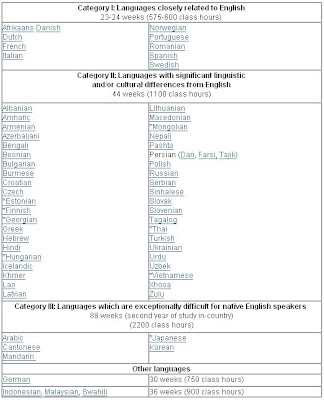
With time to fluency ticking away, an hour of library instruction (delivered in English) is just too costly. So the faculty and I have started coming up with solutions that don’t involve me jeopardizing their instructional goals. I sometimes come and give a 15 minute overview and a handout that prompts students to ask me questions. Then they come to visit me in my office, singly or in groups.

Sometimes that option would eat up all of my time, so I ask for two or three 15-minute chunks of time with the class spread out over several class periods. The end result is that I’ve taken more of their precious class minutes, but this way students don’t go for an entire session without hearing their foreign language of choice so it doesn’t seem to derail instruction as much. It’s always a balancing act: the relative worth of my time balanced against precious classroom minutes.

What Language Students Need from Me:

Depending on the assignment, this changes, but language students need a couple of tips that no other students need. For example, when searching in a given database, should you search in English or in the foreign language? If searching in the foreign language, does it matter if you use accent marks or other non-standard-for-American-writing characters, or will the system understand that e may mean é? Since search is basically character matching, these questions can make the difference between relevant results and no results at all, so I’ve started including them in the research guides I build for those students (example).

At a library the size of Carleton’s (good sized, but not like a large research university’s library), language students also need to know how to interlibrary loan materials. I always tell them that in these classes, they MUST search and order ILL items early. Once that’s done, then they can procrastinate as much as they like. Every term a few students don’t realize how very serious I am about this point and end up having no good sources to work with.

So that’s the big stuff

Other than that, I’ve learned from working with my language students how to give up the mouse and keyboard while doing searches. There’s nothing like trying to scan through a result list in German, or brainstorming for Chinese search terms to encourage me to say, “Here, you take over and tell me what you see. … Now, do you see anything on the page that looks like….”

I used to be completely intimidated when contemplating my work with language classes. I felt uncomfortable standing in front of a class and knowing full well I couldn’t speak the language or even pronounce the example search terms we were using. But after a couple of years, I think these experiences have taught me to be more comfortable with the idea that I can contribute to student learning without any grounding in the subjects their studying.

3 Comments
"Is It Okay To Call You a Librarian?"

Sitting at the reference desk yesterday, I started talking to the student worker next to me about this and that, and she mentioned that a librarian had come to talk to her class last term. Then she got a concerned expression on her face and asked, “Is it okay to call you a ‘librarian?’ Is that the right word?”

“Of course,” I said.

“Oh. Good. Well… see, I was confused because in high school we weren’t allowed to call one of the women who worked in the library a librarian. She’d get mad and say, ‘Don’t call me a librarian. I’m not a librarian. She is. I’m a media specialist.’ She made a really big deal about it.”

I explained that it might have been a big deal to those two library employees because probably one of them had a masters degree in library science and one of them didn’t. I tried to reassure her that she didn’t need to worry about offending people here unless she called them “block head” or something.

She seemed relieved and very interested, but the amount of relief that showed on her face worried me. In light of the recent blog drama having to do with who is and who isn’t a librarian, who deserves respect, and who deserves recognition, I’d like to ask that we keep our patrons in mind. I’m certainly not against helping people understand the difference when it’s appropriate, but making them worry about addressing us because they’re afraid of getting our titles wrong won’t accomplish anything.

Comments closed

It’s the Little Things

I’ve written before about our Research/IT desk, and how we sit elbow-to-elbow with student workers who don’t actually work for the library. These students work for the SCIC (Student Computing Information Center), but they’re in the library for almost all of its open hours to answer technological questions and keep the printers humming merrily along. (Have I mentioned how much I love this recently? It’s helped us concentrate on actually working with research related questions rather than spending most of our time filling printers with paper.) Well, I’ve never been good at learning names, and I’ve found it especially difficult to learn the names of the string of students who may sit beside me during any give week of reference shifts. So this fall I instituted the practice of getting their shift schedules from their supervisor and entering them into a calendar that I then shared with the rest of the reference staff. Now I can turn it on next to the reference librarian’s shift calendar, or my own calendar, and quickly “cheat” to find out who’s sitting next to me at any given time.

It always takes quite some time to build this calendar, since each shift requires between 14 and 18 clicks to enter… But it’s time well spent, in my opinion. It started as a way to cheat, but it’s actually helped me learn names over time. I feel like I’ve gotten to know students better this year and can carry on conversations with them much more easily, and I’ve drastically cut down on the mental shenanigans involved in trying to have conversations with people whose names you just cannot for the LIFE of you remember. You know the kind of conversations… “How can I talk about this without ever prompting the need to insert a name…” I hate those conversations, so I would often just sit there and not talk to the students, which contributed to the vicious cycle or awkwardness and lack of name recognition. Who would’a thought that a simple calendar would make such a difference in my ability not to look like a dork at the reference desk… oh, and have a great time with student workers?

Comments closed

On Trying New Things

I’ve been thinking a lot recently about an odd shift I’m seeing. It seems like a couple of years ago, there was a big push in my corner of libraryland to “try new things,” which was mostly code for “try a blog, try a wiki, try IM, try social bookmarking, try Flickr, try ANYTHING.! Please!!” It was pretty exciting to blog and read blogs during that time. I learned a lot from people who pointed to new extensions they were using, new social tools, new uses for “older” tools.

But recently I’ve felt (and I know others have felt) like there’s nothing more we can contribute to this discussion that’s really and truly new. We can go to conference sessions geared to introducing the newest of the new tools and already know about every single tool discussed and know a handful or even a fistful of libraries that are using them. We might even be using them ourselves.

The same can be said for “new” service models or collection changes or any number of other topics. Maybe it’s a function of my having been slightly too overextended in the last few months to have the energy to get excited about or imagine new implementations of the ideas I’ve heard about, but I know I’ve had the feeling recently that maybe there isn’t much more that’s new to learn about in my previous areas of interest right now. What’s more, I’ve heard a few other librarians say similar things. “I just can’t come up with anything that other libraries haven’t already tried. There’s just nothing actually new going on here.”

It’s almost like my whole corner of the library world took a collective sigh and realized we’re tired.

And maybe there’s truth in this feeling, though I doubt it. Maybe we’ve settled far enough into the social web or the fill-in-the-blank-new-Library2.0-service world that it’s no longer confusing enough to wonder about or new enough to get excited over. Or maybe we’re all just getting over the Long Winter (it’s snowing here today… seriously… maybe 8 inches by tomorrow morning). Or maybe there’s enough communication now that where we would previously have had a hard time knowing about what other libraries are up to, now it’s quite easy to skim a feed reader and get a quick run-down every single day. (If this is the case, I think it’s a wonderful development.)

But my hunch is that while we’re pretty much trained from college on upward that “original” is a synonym for “good,” and “derivative” is a synonym for “lazy,” it actually doesn’t work that way in real life. It doesn’t matter if 3/4 of the libraries you know about are implementing a new service or tool. Even if other libraries have tried whatever you’re trying, there’s still usually no way to adopt implementations wholesale. Almost always, you have to evaluate and tweak and shift and re-mix ideas to fit your own context and your own community.

And this leads me to believe that maybe the problem isn’t that there isn’t anything new happening; that the problem is with me. I’m the one sighing and acknowledging that I’m tired. I’m the one who’s been overextended just enough to shut off that creative part of me that used to read what people are doing and start scheming about how it would look at MY library. If this is the case, I sincerely hope that my trip to Computers in Libraries will jump start that portion of my brain and help me not just know but actually believe that it doesn’t matter that other people are doing cool things already. They’d still be new and cool to think about trying here. And these reports I’m reading and the others that I’m generating, and the lessons I’m learning from planning a conference, and the other lessons I’m learning from helping out with Print Management implementation?… Maybe these are still interesting and not just “the same thing that everyone else is doing, so why would they care.”

We’ll see. Here’s hoping.

Technorati tags:

6 Comments