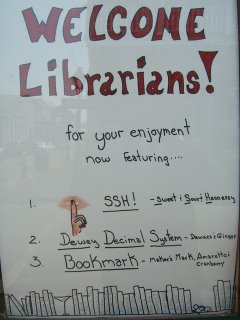

I just got this picture via email (with permission to post). Apparently there were librarian-themed drinks served at area bars in New Orleans.
Learning in Libraries and Loving It
I just got this picture via email (with permission to post). Apparently there were librarian-themed drinks served at area bars in New Orleans.
I’ve been to a lot of conferences in the last year. Big ones and teeny ones, local ones and far away ones. And based on all this field research, I’ve just realized that I committed a major faux pas when I gave my talk this week. I never once mentioned Millennials. I wish to apologize for this oversight and plead for forgiveness based on the defense that I didn’t know what I was doing (obviously). Henceforth I promise to either talk about this new breed of human or come up with a very good reason for not talking about them.
Here’s the thing, though. I’m getting a little tired of the hue and cry. These kids are … well … kids. And just like every other generation of kids, they have needs and they have desires. And just like every other generation of librarians, we have to figure out what our users’ needs are and fill those needs, individual by individual and group by group. We also have to figure out what our users’ desires are, and cater to as many as are possible within the realm of reason and as many as are helpful.
Personally, I think saying things like,
“I’ll be doing a few panels of Millennials in the coming months. I always enjoy talking to these people and their insights and thoughtfulness always impresses.” (Stephen’s Lighthouse)
is not helpful. Don’t get me wrong Stephen has a lot of really good stuff to say. I admire the fact that he’s working hard not only to find ways of serving library users as well as possible, but also to push other librarians to do the same. But speaking of kids as if they’re aliens is, I think, counter-productive. In these sentences, “Millennials” becomes a term to describe a group that are completely separate, completely Other.
The two sentences I’ve quoted (found in a post that highlights some very interesting and useful information about his demographic sample) are pretty typical of what I call “Millennial Discomfort.” This disease is taking the library (and IT and education) world by storm. It’s reaching epidemic proportions.
Lets face it: there’s another generation running around, and eventually they will take over the world. In the mean time, we need to do exactly what we’ve done for generations upon generations… figure out what we can do to make sure they survive and flourish.
So instead of learning about and using MySpace, Flickr, del.icio.us, and all the rest because the Millennials are doing it (doesn’t that sound oh so middle-school-ish), let’s start learning and using these services because they’re useful and fun for our users and ourselves. Let’s learn as much as we can from the web services people like or the information seeking habits people have. Let’s remember that there are lots and lots of kids who are NOT tech savvy. And let’s remember that those kids who are tech savvy are not necessarily savvy in deciphering and leveraging the meaning, rhetoric, implications, or sometimes even the basic content of the information they take in. Let’s spend that proportion of conferences devoted to cries of “The Millennials are coming! The Millennials are coming!” and rededicate that time to learning from each other about new processes, best practices, and yes, even some of my beloved theoretical underpinnings. We can do it. I KNOW we can. There’s so much to talk about, think about, and do.
It’s been a weird week… I’ll step off my soap box now.
8 CommentsToday was the Reference Symposium at the University of Minnesota, and may I just say, inviting a bunch of librarians to a conference and then making them pay for wireless access is SO 1.0! (One of my coworkers paid for the temporary log-in and the rest of us mooched off of hers. So I’m writing this in EndNote, and I’ll be copying it into my blog when I get back to work this evening.)
First up was the indefatigable Stephen Abram. [Update: he links to his PowerPoint here.] As usual, he had a lot to say, was witty, and only a little bit crude (he was being very careful). :) But he kind of started out on the wrong foot with me and it took me a while to get back into the flow. See, basically the first thing he said is that he knows some people need to write in order to learn, but he wanted us just to listen and know that his powerpoint would be up online soon (I’ll link to it when it is). Well, there I was sitting in the third row SMACK dab in front of him with my computer open trying to get online so I could blog… and he was assuming that I was “just” taking notes. Hmmm. Assuming that note-taking is just a memory device is very 1.0, but he’s a smart guy and he’ll learn…
Anyway, he talked about a lot of the things we’ve been thinking and blogging about lately, Second Life Library 2.0, Web 2.0 services, and of course…Millennials. (I’m beginning to think that it’s not a “real” library conference if at least half the sessions spend minutes on end cataloging how different Millennials are from the rest of us. This is not helpful!) But a couple of things really stood out to me. First, we as a profession are unclear and uncomfortable with our epistemological position on barriers. Second, collective intelligence really is the future (steak knives, here we come!). And third, brain scans and eyeball tracking research on different demographic groups is COOL and much more useful than complaining about those techy kids these days. (I’ll only cover the first highlight here.)
So what’s up with boundaries? Stephen began his talk by criticizing traditional reference desks, comparing them to pharmaceutical counters. Unlike at a pharmacy, we shouldn’t be thinking about how to be imposing and authoritative. “Do we really want to be like those people who are pushing drugs?” he asks? So barriers are bad… I got it. But then, a couple hours later, he begged us to please use anything other than Google when helping patrons because “we need to look like we know something different.” So… barriers are good? I’m sure I’m missing something, and I wanted to ask him to clarify this, but he went so far over his time that he used up ALL of the next presentation’s time as well, so there wasn’t time for questions. So, if you read this, Stephen, what’s the connection?
I also appreciated that he couched his discussion of Library 2.0 in terms of Ranganathan’s principle that states that the library is a growing organism and always has been. I firmly believe that L2 isn’t fundamentally different from what we’re doing and have been doing.
2 CommentsToday was ARLD Day at the Arboretum just outside of Minneapolis. Aside from the thick clouds and persistent rain that kept us from taking our planned walk through the grounds after the day of meetings, it was a great day with three main take-away messages:
Now that you’ve got your take-aways, here’s some detail.
First Take-Away
The first take-away heralds the beginning of the planning of a concept that could revolutionize research. The University of Minnesota has been working (under a Mellon grant) to develop My Field, a research portal of the future. It’s not live yet, not even in beta (we saw mock-ups of page concepts at this session), but the documentation is here and mock-ups (in powerpoint) here. Basically, it’d be a space where researchers could log in, have resources suggested to them, gather other resources, tag everything, develop goals and time-lines, collaborate with other scholars, share what they want to share, keep private what they want to keep private, and get help with anything from resource discovery to publishing.
Now that they’ve finished working through the planning grant, they’re moving toward getting an implementation grant that would fund both the library and the computer science department to design the various mix-and-match components of this highly web 2.0 space. The really good news is that this thing would be completely open source.
Second Take-Away
The second point came from the morning’s keynote address given by Constance Steinkueler on the intersections between Massively Multiplayer Online (MMO) gaming and cognition, learning, and social interaction. Not only was she an engaging speaker (even though she’d broken her toe just the morning before speaking to us and had to hobble around during her presentation), but she did an absolutely fabulous job of charting the cognitive and skill-building activities that (should) make gaming so intriguing to educators. I’ve heard talk of gaming before (though as my last post makes clear, my poor computer just won’t let me join in the really high-powered stuff myself), but this is the first time I’ve heard someone make such a clear connection to my work life. Here are some snippets from the notes I took at during the address. (I was too busy taking notes to actually blog while there, which I think also speaks to how interesting and engaging the talk was.)
I should note that the discussion following the presentation was particularly un-useful. People asked the same old questions about the connection between violence and gaming… And I never got up the courage to ask whether any research had been done to show if these wonderful cognitive skills are often transferred to other areas of gamers’ lives. Too shy. I need to get over that.
Third Take-Away
The final take-away point came from the session called “Find Your Inner Gamer: Adapting Instruction for Digital Natives” by Robin Ewing and Justine Martin from St. Cloud. This session focused on what makes games such engrossing activities that people of all ages will spend 20+ hours every week exploring, trying, failing, trying again, learning, and collaborating. Wouldn’t it be great if they could be even 1/20th as engaged in a 50-minute session?
Well, these two librarians have been looking for ways to do just that, and they’ve begun by distilling what makes gaming so engaging. They’ve found that gaming engages gamers because they focus all attention on a goal or a problem, there are rules and goals to keep things focused and give instant feedback, there’s the challenge and the satisfaction of achieving new levels, players have control of their actions, and they are in a fantasy world, so they are free to be creative and experiment with new things.
They’ve translated this into their instruction by making sessions student-driven (that’s right, NO DEMO!), doling out “power-ups” strategically so that just when students want it most you reveal the added searching power of AND, and intentionally working in feedback and reflection. This last is analogous to touching something in a game, having something happen in response, reflecting on what happened, and moving forward with that extra piece of knowledge that can be tested and re-formed as necessary.
Comments closed