Skip to content

Category: Libraries and Librarians

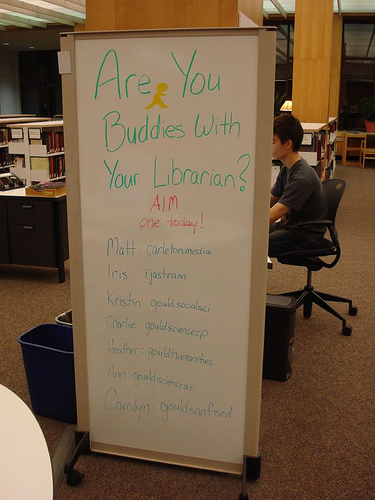
IM Reference at Carleton: A Low-Key Affair


Last year, sitting at our Research/IT desk, we started noticing that the SCIC workers sitting next to us were often engaged in lively conversation via IM. At about the same time, a few of us got started on Google Talk and it quickly spread through the rest of us as a way to ask quick questions of each other throughout the day without actually interrupting each other as completely as we had been by popping into each others’ offices. (Personally, I think this was mostly a strategy to keep me in my office because I was new and doing a lot of popping in to ask questions… but nobody’s admitting to that ulterior motive.)

We really took to this as a method of communication. We still do a lot of popping in, but now we have communication choices. Not only that, but every once in a while we’ll be fielding a tough question during the night or weekend desk shift and end up IMing a co-worker for help. This isn’t frequent, but I’ve benefited once and I’ve helped out once, and both times there’s no way the reference interaction could have been successful otherwise. We’re also keeping in social contact after work, which I really enjoy.

So after we’d played with this for one school year, we decided we wouldn’t mind creating AIM accounts to give out to students. We each have our own account, and we can each be online when we’re able to answer questions and offline or “Away” when we’d rather not answer questions, so we completely sidestepped all of the staffing and coverage issues that comes with “real” IM reference. On the other hand, this relies heavily on our liaison model, with students encouraged to meet with the librarian for their classes and major for anything more than general reference help. So in this sense, it’s more an extension of our individual consultation service than of our reference service. But it provided a no-risk method of trying a new service this term, so we decided to go this route.

So far, the response has been mixed. One of my co-workers has answered a couple of IM questions (and we all rejoiced), but the rest of us haven’t yet. [Update: It appears I’m wrong. One more of my co-workers has answered a couple of questions, and she is even one student’s very first IM buddy!} We’re also running up against a strong culture of face-to-face interaction here at Carleton, and some students have voiced the opinion that it’s “sad” when people can’t stand up, walk over, and ask us questions.

So I wouldn’t call our experience a rousing success if you look at it as a stand-alone service. And yet, there are three reasons that I’m glad we’re doing it and that we don’t have any plans to discontinue it.

First, it gives us a chance to experiment with a new “toy.” This is always valuable, especially when there’s no cost associated with that experimentation.

Second, it contributes to our efforts to not only BE approachable and accessible to students, but also to APPEAR to be approachable and accessible. I’ve been thinking a lot lately (as I experiment with Ask.com vs. Google or worry that my laptop is dying and notice how that changes what I think about putting into it) about the appearance vs. the reality of usefulness and trustworthiness. And basically I’ve come to the conclusion that the appearance of trustworthiness is more important than the actuality. If I trust something, it takes a lot to get me to go back on that trust, and the converse is also true. In the same way, I think building the appearance of accessibility, expertise, and usefulness to our students is at least as important as actually providing accessible, expert, and useful assistance. And our new AIM handles are helping with this… I think.

Third, I don’t care if I only receive one IM question. That’s one question that may not have come to the desk. And it’s not costing me anything in time or money to have AIM running in the background on my desktop. Even with a culture of face-to-face interaction on campus, there will always be someone who is shy about approaching the desk, or simply communicates better through the written word than the spoken word. There are lots of students that I only hear from via email, and I can foresee a time when these students will make me a buddy rather than putting me into their email address book.

Of course, I’m still waiting for that first IM question… but it’ll come. I’m nothing if not optimistic.

Technorati tags: , ,

3 Comments

The Research/IT Desk

Sitting here at the reference desk for my Monday afternoon shift, I’m reminded of one reason that I no longer dread my desk shifts. Well, one obvious reason is that now I have a lot more reference experience, so I no longer tremble whenever a student asks, “Do you have a minute?” But experience aside, I prefer desk shifts here because I rarely have to answer any technical questions, un-jam copiers and printers, recover lost papers, teach graph making in Excel, or trouble-shoot any other computer problem. At my previous library, this is mostly what I did during desk shifts.

It’s not that our students are more computer-savvy than the students at my previous library. If anything, there are more computer questions here because we have three computer labs here instead of one. No, this bliss is all because someone a couple of years ago (in September of 2004, to be precise) came up with the brilliant idea of providing a joint service point merging research help with technical help, transforming our reference desk into the Research/IT desk. So, to alleviate my sadness about not being at Internet Librarian, I thought I’d amuse myself by writing this all down before we forget what the first few years of this service were like.

The Progression

Before I begin, I should mention that I am NOT the authority on this subject. I just work here. My co-worker, Heather, is the point person for this and has presented on it several times and done a poster on it at ALA.

Anyway, For many years, now, Carleton has had IT support for students. They call this place the SCIC (pronounced “skick”), and it’s a pretty full-service joint. A whole battalion of geekish students (affectionately called “SCICers”), headed up by two full-time staff (“the SCICitator” and another guy without a nickname… we’ll have to work on that), troubleshoot software and even repair some hardware and clean up virus infestations.

Well, two years ago the decision was made that the SCIC would start sending some of the student workers over to the library to sit next to the librarian on duty at the reference desk. I wasn’t working here then, so all I know about these early experiments is second hand. Basically, everyone could see that it was valuable… except the student workers. They didn’t like being away from the SCIC because here they’re on their own, their fellow student workers are a building away, they are more visible so they can’t play games or wear headphones, and there’s different technology to learn. The biggest thing that year, though, was communication. The librarians weren’t these students’ supervisors, and we didn’t even really get to know them very well because there were 40 of them rotating through the library, and the librarians’ desk shifts weren’t consistent. So any SCICer could quite possibly work an entire term without working next to the same librarian more than once or twice.

Last year things got more formalized. SCICers staffed the desk for the entire time the library was open (even when there weren’t librarians on duty), and the SCICitator worked with the librarians to provide formal training in the special types of service and support issues that come with working in the library (microfilm reader/scanner/printers, SMART board issues, referring research questions, etc.). What’s more the SCICitator decided to schedule only second-year SCICers in the library, so they wouldn’t be learning the basics while cut off from their fellow student workers and their supervisor/mentor. On the librarians’ side, we regularized our reference desk shifts so that we would always be sitting next to the same students (except in the case of substitutions). Most importantly, though, we formalized the communication that happens between the librarians and the SCICitator. One of the librarians acts as the liaison to the SCIC and meets with the SCICitator briefly every week. She also coordinates training for the students. We’ve also worked on developing a habit of emailing the SCICitator if a student does really well or goes above and beyond, or if they miss shifts or in other ways slack off.

And slowly but surely, we’re seeing an attitude shift among the SCICers. It’s now a rare thing for them to show up with the attitude that this service point it “extra” or less cool. Some of them even try to shift their schedules so that they work only at the library.

The Benefits

Librarians immediately saw a significant drop in the number of “short” reference questions we answer. By itself, this is just interesting to us. But it become significant in terms of the service we provide when you pair this trend with the steady increase in the number of “long” reference transactions we have. Students are finding us available for in-depth research assistance now that we aren’t running after paper and re-starting computers. Now only that, but students are starting to seek out the technical assistance at our desk that they would previously have taken to the main SCIC, so there has been a significant increase in the number of questions handled by the SCIC side of the Research/IT desk over the course of the past two years. (The library is the busiest building on campus, so it makes sense to have this service here rather than sending everyone to another building.)

The Challenges

There are two main challenges that we’ve faced: communication/reporting and statistics collection. Formalizing the communication channels has really helped, and now that at least half of the SCICers don’t remember working when there wasn’t a library service point, they don’t balk at librarians stepping in to give them duties or brainstorm about solutions to problems. And this year we’ve gone to online statistics collection, which seems to feel more legitimate to these students. We know that they were under-reporting last year because many of them couldn’t be bothered to fill in little hash marks on a piece of paper. This year they’re still probably under-reporting, but making entries into an online database just FEELS more important, so they’re making the effort.

So we haven’t completely worked through all the ins and outs of this service point, but I’ve gotta say, I really like it. It frees us up significantly, and we get to develop relationships with a whole new set of students that we never really saw before.

Technorati technorati tags: , ,

2 Comments

Our Library’s Watch List

I’ve heard from people who want to know what our library has on it’s “Watch List,” so I thought I’d post them here.

But first, a little bit of the back story. If you remember, at the end of last year we had a series of surprisingly interesting and stimulating meetings about out library’s strategic plan (my posts about these meetings are here and here, and now a draft of the plan is available online as a pdf). Part of this plan involves watching trends and developments in the library world outside of our college. So each department made up a list of the things that they either are or would like to be watching, and then the full library staff met to pare the list down to those items that seemed interesting and important to the library as a whole and that meshed well with our strategic plan. Now we have a blog (visible only to library staff, and which I wrote about here) in which we track what we’re seeing, and we use WordPress’ category function to label each post according to the watch list item or items it covers. We can also use the blog space to suggest new items for the watch list, or to discuss taking items off the main list if those topics have stopped being of interest.

And here’s what we’re watching.

Collections:

  • Collection development with interlibrary loan
  • Storage/archival/retention issues: what to save, where to keep it
  • Preservation (print and electronic)

Electronic, new and emerging formats:

  • Licensing (Licensed streaming video as an alternative to videotape and DVD, and flexible copyright and licensing agreements
  • Statistics
  • Collection and management of websites
  • Electronic Resource Management
  • Digital Library: streaming videos, ebooks
  • Open Access publications: cataloging and including in collection
  • Image and multimedia management applications.

Access to our collections:

  • Aggregator neutral records (MarcIt)
  • Record enrichment (table of contents, dust jackets, reviews, comments, tagging)
  • New search interfaces, non-text search (visual, audio), and displays of search results
  • Metadata (Non-MARC, integrated from a variety of sources)
  • RSS feedsfor new book info, e.g.
  • Outsourcing cataloging and shelf-ready materials

Services:

  • Interlibrary loan (international, unmediated, costs, ILLPOD, etc)
  • Delivery systems (CC/StO) expansion
  • Self-checkout
  • Reference models at peer libraries, virtual reference and appointment models
  • Data & GIS in a liberal arts library setting
  • Students’ use of new web publishing models for research (wikipedia, mashups, web 2.0).
  • Social Software and other applications that help users organize their research and information (personal information management, bibliographic management tools, etc).

Digitization:

  • Who, what, how
  • Scanning and OCR service points
  • Institutional repositories

Equipment (hardware & software):

  • Printing
  • Touch screen computer monitors
  • RFID
  • Ares (Atlas course reserves product)
  • “Print/bind on demand” in-house or from publisher (not warehousing titles)
  • Open source software for libraries

Space:

  • Cafes/Coffee Shops
  • Space needs for Collection

Campus Initiatives:

  • Copyright
  • One card checkout technology

Other:

  • Government Documents
  • Workflow design
1 Comment

The Research/Writing Connection and Why There Shouldn’t be Turf

Head on over to See Also, where Steve Lawson writes thoughtfully (as usual) about the connection between research and writing, information literacy, and the differences and similarities between librarians and disciplinary faculty.

To what extent should librarians help students see multiple sides of the scholarly conversation, develop their own arguments, or give other advice about constructing effective presentations? The only answer I have is “it depends.” It depends on a lot of things, but one of the most important is the librarian’s relationship with the professor. I know one professor, for example, who encourages her students to meet with me as they’re deciding on a topic, as they’re writing their papers, or at any other time in the iterative writing process. She and I in effect double team the students, pushing them to think not only about the answers to their research questions, but also about what makes a good research question in the first place. On the other hand, I know professors who bristle if I do anything more than teach the difference between keyword and subject searching. One professor would prefer me not to talk about evaluation of sources because that’s something properly done during office hours and by “struggling through” drafts.

While I would never suggest that librarians should usurp the professor’s role, I think that there are three specific ways in which we are uniquely placed to help students as they learn to engage with sources. First and most obviously, we are trained to think in terms of sources. We can make educated guesses about whether the information sought would be collected in a compilation, submitted to academic journals, explored in depth in a monograph, reported on in the news, or entered into an encyclopedia. We are adept at jumping straight to the questions “who would publish about this and where would they publish it?” Over the last few weeks, I’ve become acutely aware that most students cannot make educated guesses about these sorts of things. They just guess.

Second, we do not grade students. I’ve had students express confusion to me when they wouldn’t have jeopardized their standing in class to ask a “stupid” question. And I’ve had a couple of good responses from professors who, when I alerted them to a pattern of confusion in their classes, took steps to alleviate that confusion.

Third and most important, librarians are not usually as deeply immersed in the particular subject matter at hand as are the faculty. This often seems like a liability since we can’t simply pull related facts and theories out of our memories and construct searches from this base of knowledge. But far from being a liability, this is actually our greatest advantage. Because we don’t simply “know” the topic at hand, we get to model learning about the topic with the student. The hardest part about this is remembering to narrate our thought processes to students as we work together. I was reminded of this earlier this week when a student asked me how I knew which record in a result list to open. I explained that I didn’t and then consciously narrated through scanning the result list, picking up on clues from publication types and titles, looking at years of publication, and so on. Then I’d click on the record and narrate what I was seeing: title, author, publication name, subject headings, abstract. All this is new to students (especially first year students, though some seniors are almost here), but after a few minutes of this type of modeling most students will begin to take ownership of the search, suggesting new directions, pointing out records to open, and eventually running off to continue on their own. When we model learning, taking notes, going back and modifying old searches, picking up on clues, and getting excited when we find a juicy article, we’re not only helping students locate the information they need, but we’re also helping them learn the art of research.

On a related note, I would add that in addition to negotiating where librarians’ skills overlap with and complement disciplinary faculty’s skills, we should also consider how our skills overlap with those of the writing professionals on our campuses. Last spring I was invited to attend a meeting of writing professionals in our region, and it was eye-opening for all of us to realize that we both think about our jobs in similar ways, and that we both work with students on the same projects. And yet, students are trained not to expect too much help with mechanics and “proof reading” at the writing center. Writing professionals and faculty both expect students to learn about constructing effective arguments when they work with writing tutors. Why should it be so different for librarians? Just as writing tutors work with writers more than with papers, so also academic librarians are in the business of working with researchers, not simply of providing research.

Comments closed