Skip to content

Category: Libraries and Librarians

"Is It Okay To Call You a Librarian?"

Sitting at the reference desk yesterday, I started talking to the student worker next to me about this and that, and she mentioned that a librarian had come to talk to her class last term. Then she got a concerned expression on her face and asked, “Is it okay to call you a ‘librarian?’ Is that the right word?”

“Of course,” I said.

“Oh. Good. Well… see, I was confused because in high school we weren’t allowed to call one of the women who worked in the library a librarian. She’d get mad and say, ‘Don’t call me a librarian. I’m not a librarian. She is. I’m a media specialist.’ She made a really big deal about it.”

I explained that it might have been a big deal to those two library employees because probably one of them had a masters degree in library science and one of them didn’t. I tried to reassure her that she didn’t need to worry about offending people here unless she called them “block head” or something.

She seemed relieved and very interested, but the amount of relief that showed on her face worried me. In light of the recent blog drama having to do with who is and who isn’t a librarian, who deserves respect, and who deserves recognition, I’d like to ask that we keep our patrons in mind. I’m certainly not against helping people understand the difference when it’s appropriate, but making them worry about addressing us because they’re afraid of getting our titles wrong won’t accomplish anything.

Comments closed

The Problem with Vocabulary

There are a couple of things I really like about being primarily a subject librarian, and about having subject librarians easily accessible in a college library. For one thing, it sure helps when those crazy-hard questions come to the desk and you can say something helpful-sounding like “I can get you started with some of the basics, and then you should go see so-and-so for more in-depth help.” Of course, then there are those crazy-hard questions that come to the desk and are in my area, so I can’t pass them off… but we’ll forget about those for the moment.

But one of the things that’s most valuable about this division of labor in an undergraduate environment is that each librarian can concentrate on developing discipline-relevant vocabulary. I’m not talking about vocabulary in the “how to talk to students” sense at the moment, though that’s certainly very important. After all, even “primary source” means something different to each discipline. No, I’m just talking about terms and vocabularies associated with topics of research. When a student of literature comes and talks to me about rhizomatic narratives or the relationship between metaphor and ideology, I have a whole thesaurus in my head that opens to the correct spot and starts coming up with alternate search terms. I know where these things fit into umpteen different literary theorists’ perspectives, I can recognize key works referenced in the titles of scholarly papers. Not only can I employ these terms and names directly by adding them to my search, but I can recognize articles in a result list that might be relevant simply by calling on this mental map of the topic. Then I can open those results and use vocabulary I find there to create new searches.

Since search is fundamentally a character-matching game, with people supplying characters in a row (i.e. words) and computers matching those characters to the characters in its index, lack of vocabulary renders search essentially useless. I don’t know or recognize the terms that are central to, for example, the IMF. So I’m basically stuck with ineffective searches and only limited options for refining my searches. And I can’t help steer students to refine their terms because I have no mental map of this topic beyond “something to do with money, and something that’s international.”

If we don’t have access to mental maps, how do we build our students’ mental maps? And how do we generate search examples that will help them learn?

And how do I develop mental maps of all the research topics my students need help with?

8 Comments

Exploding an Article

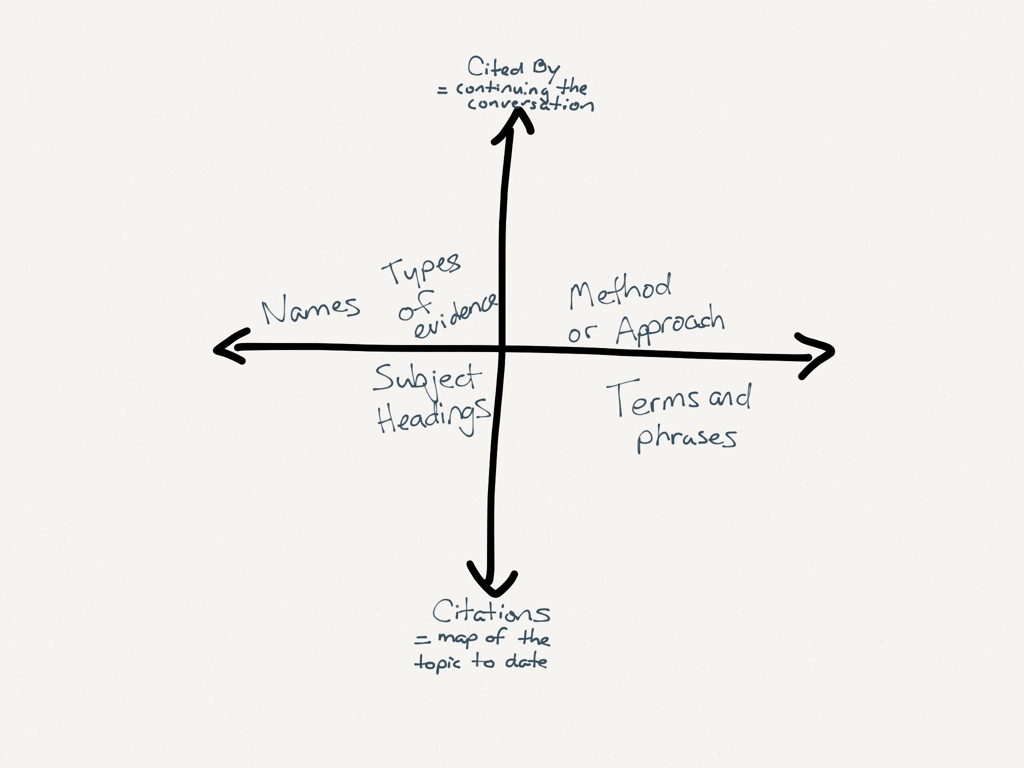
I don’t know why I hadn’t thought of it in these terms, before, but this morning just before a lightning-speed class I suddenly realized that if you have a good article in hand, you can look in four “directions” for more articles like it. (I use “article” because that’s what I was working with this morning, but it works for anything with citations, I guess.)

You can move backward by mining it’s bibliography. You can move forward by using Web of Knowledge to do a cited reference search. And you can move side to side (sort of) by reading it with an eye both for content and for vocabulary that you can use when constructing future searches.

exploding article
By Iris

8 Comments

Maintaining Research Guides, the Never Ending Struggle

I spent a good part of today trying to wrap my brain around a new subject area so that I could a) figure out which resources might be important for the assignment, b) figure out if we had access to those resources, c) figure out what to substitute for the stuff we didn’t have, d) create an online research guide for that assignment, and ultimately e) stand up in front of that class on Wednesday and say coherent and useful things rather than idiotic and generally boring things.

As I was experimenting with new sources and concocting tips for the students who will soon be using them, copying and pasting relevant chunks from other guides, and then deleting about a third of the information after realizing I’d needed it to wrap my head around the project, but my students probably didn’t need it… as my guide emerged little by little throughout the day, I mused on the changing role these guides are having in my professional life, and on their convoluted lifespan.

Before going further, a word of explanation. At our library we have three kinds of guides: subject guides, course guides, and general guides. General guides are those things that aren’t specific to a discipline at all (like “Using the Library from Off Campus“). Subject guides serve as portals for research within a major, and there’s at least one for every major on campus. Each liaison maintains the subject guides for his or her liaison departments, and we each have the option to create a course guide for any course we think needs one.

Recently, I’ve begun rethinking my guides. It started last year when I changed almost all of them over from being organized around types of sources (finding articles, finding books, etc.) to being organized around topics or tasks (finding primary sources, finding social/historical context, finding authoritative scores etc.). Now this year, I’m using the subject guides more and more while I’m at the reference desk, both to organize my own thoughts about a new topic and, more importantly, to model this behavior for students. After all, it’s probably much more useful to send students the extra click through a subject guide than to force them to sink or swim in a list of 200 or more research databases! This also keeps me honest, because I actually use the guides all the time, so their faults scream out at me until I finally get time to remedy them.

And in my life, I do my most careful thinking when creating course guides. These grow out of a specific research task and force me to really come to grips with the research challenges inherent to that task. Then, at the end of each term, I retire the term’s course guides but copy and paste the best bits into the subject guide for the appropriate major. Next term, as I create new guides, some chunks can be copied straight out of the subject guide, but there’s always something new, or some sections that just aren’t appropriate for the larger guide, so those get built from scratch almost every time.

And so this circular evolution of course guide to subject guide and back again keeps me writing and updating guides pretty much every week of the year.

p.s. For the curious, today I was working on a guide to Medieval and Renaissance Music (link will be live through March 2008, after which point it’ll be archived offline).
Comments closed