Skip to content

Category: In My Classroom

The Whirlwind Class

After my first year here, when I realized that I needed to sell the power of a library instruction session from the inside rather than the outside (meaning, by actually teaching rather than begging for time) to those departments that hadn’t made much use of my services, I came up with a plan. The plan was to point out that students would come seek me out for help if they knew my face and could see that I’m a real person and not scary or mean or intimidating or any of those things. I pointed out that if professors were structuring their classes in a way that relied on their students coming to me rather than having me come to their class, they’d have to give me at least a little face time.

For reasons I’ve described before, this mini-class idea was especially important to the language departments, but it wasn’t just them. In a 10-week term, pretty much every professor is jealous not of hours, but of minutes of class time. It’s been one of the most interesting challenges of my time here to figure out a) when library sessions really are important and how to explain that to faculty, and b) when they’re not as important, and how to get students the help they need without the structure of a classroom.

So here I was, offering whirlwind sessions of 10, 15, or 20 minutes here and there. I’d bop in, hand out my trading cards and maybe a subversive handout, explain how to find my Availability Calendar, and then teach the class one thing that so boggled their minds that they’d realize I might be worth coming to see with questions later. My goal was to teach something that the teacher wouldn’t have known. Something flashy. Something so pithy and assignment-relevant that if this was the only thing these students learned all term, I’d be ok with that. And you know what? This is very very hard to do. I put more time into preparing these mini classes than I do into most of my hour-long classes.

And for the most part, I’ve been very pleased with them, and several of them have grown over the years into either longer sessions, or into more sessions over the course of the term. But they’re certainly not good for every situation, or even most situations. They’re really only good if several conditions are met:

  • It’s an upper-level class
    I have zero time to cover the basics.
  • Students will be working on wildly different topics
    I’ve had times when students did come to me after my whirlwind class, but I spent the first half-hour of every appointment going over the very same processes and resources… NOT a good use of anyone’s time.
  • I get the first portion of the class period, not the last
    Even when I finish my bit on time, the sessions usually stretch on as the professor and/or students ask questions. Of course, this leaves me in the odd position of having professors who think I accomplished a lot in 15 minutes, when really I was in their classrooms for twice that long.
  • I don’t have too many of them in a term
    They take a long time to prepare, and I would never have time to see every student in every class in every department I serve as an individual appointment.

Still, they do serve their purpose sometimes, and if nothing else, it’s a foot in the door. Still, I’m becoming a little bit uncomfortable with the thought that I might become known as “the one who can do a 15 minute class.” In reality, this is not enough time, and students do struggle with this stuff, and accessing and deploying the literature of a field is an integral part of becoming a scholar in that field. Simply plunking keywords into databases is only the first baby steps in that process. And really, if professors work with me and tell me what their course goals and readings are, I can craft a longer session that isn’t just an add-on to the class. They can be chalk full of course content and therefore not actually take much away from the incredibly precious minutes in a 10-week term. And I don’t want to undermine the efforts of my colleagues as they also struggle with ways to make their content and expertise an integral part of the classroom experience in their departments.

p.s. Yes… I know… I’ve been tagged. I’ll work on it. Really I will.

2 Comments
Exploding an Article

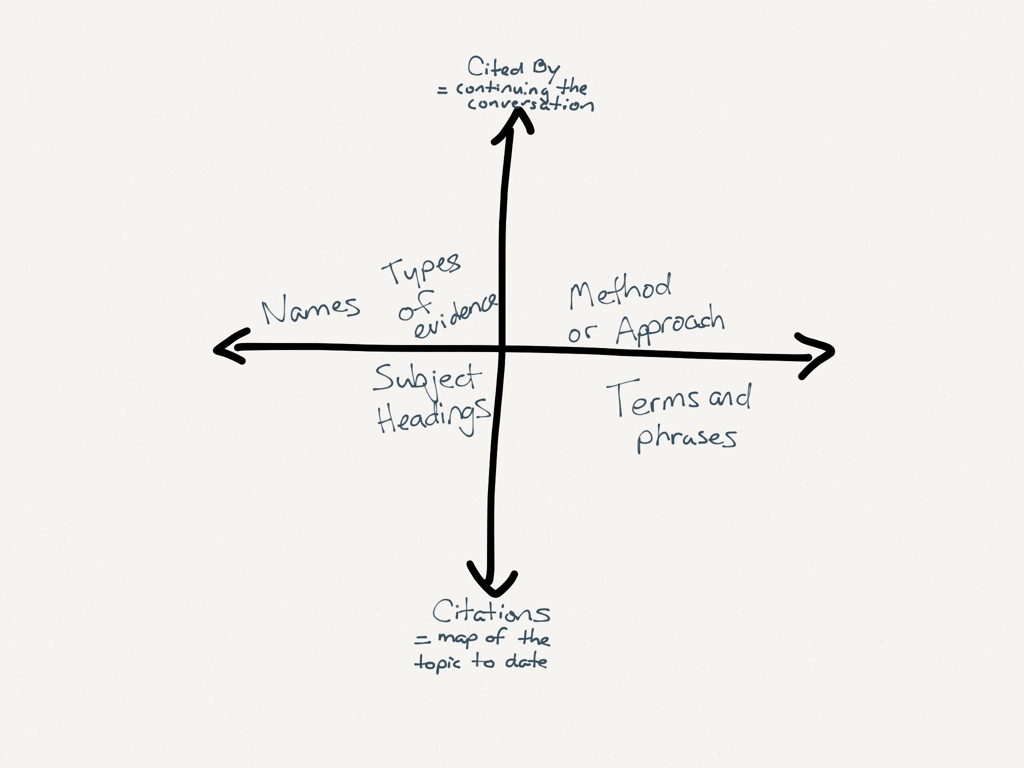
I don’t know why I hadn’t thought of it in these terms, before, but this morning just before a lightning-speed class I suddenly realized that if you have a good article in hand, you can look in four “directions” for more articles like it. (I use “article” because that’s what I was working with this morning, but it works for anything with citations, I guess.)

You can move backward by mining it’s bibliography. You can move forward by using Web of Knowledge to do a cited reference search. And you can move side to side (sort of) by reading it with an eye both for content and for vocabulary that you can use when constructing future searches.

exploding article
By Iris

8 Comments

Subversive Handouts: One Librarian’s Secret Weapon

I’ve recently (within the last year and a half) taken to the idea of handouts. Real, printed, paper handouts. I almost never list specific resources on those handouts, though, since I save that kind of thing for the online guide that goes with each class (unless I have a good reason to think the class will want a paper cheat-sheet). That kind of handout works well with some teachers and some students, but I’ve never been able to pull it off to my satisfaction. Instead I create what I’ve affectionately termed “subversive handouts.”

Before you get too worried, I should say that the name came from my very first incarnation of this thing and is no longer an accurate description of the genre. I’d been asked one too many times to do an “everything the class will need to know about research in 10-15 minutes, please” session. All efforts to get more time failed, so instead I paired the class down to the two small tasks that I thought the students would need most… and I created my very first subversive handout. This listed the two things they’d learn that day at the top, continued with a lengthy list of catchy and interesting/important sounding skills they could ask me about later, and concluded with my contact information and the URL for my calendar at the bottom.

The idea was threefold:
1) Students would still get a little concrete information and a chance to see my face (invaluable if they’re supposed to come make individual appointments with me later).
2) They’d have their imaginations jogged about the kinds of things they didn’t know were possible, or the skills they didn’t know they needed to learn.
3) The professor would see that “everything they need to know” encompassed a whole lot more than the library catalog and finding journal articles. And I won’t lie; in this original case, this third point was the most important to me.

And you know what? It worked. I ended up staying 15 minutes past time as the professor and students asked me questions off of that handout during class time. That meant I had effectively doubled my face-to-face time for with that class, and everyone was engaged and asking questions.

Since then I’ve used the “Here’s what we learned today… Here’s what you can ask me about any time… Here’s how you can get help…” handout in many, many classes. And while they’re useful for lots of kinds of classes, they’re particularly good for two kinds of sessions: those like the one I described above, and those where the professors know full well that the primary goal of a short session is to introduce their students to me so that the students will be more likely to come see me with their research conundrums later. And my original experience of having professors and students alike ask questions from the handout while still in class has held true of almost every session for which I’ve created one of these. (Here’s an example of one I created for English major thesis students.)

Even though I almost never create these handouts with the primary goal of educating the professor any more, the name has stuck. It’s just so fun to knuckle down to the task of creating a handout and be able to rub my fingers together and imagine myself scheming minor subversion. (Imagine shifty eyes and a monologue populated with mutterings such as “They didn’t know they’d want to know about THIS…. Mwa-ha-ha-ha.”) This little bit of fiction is all it takes to make a mundane task feel interesting every single time. Which I suppose means that I’m easily amused.

24 Comments

Class: Citation as a Lens for Interdesciplinarity

By popular request from my twitterish friends, here is the basic gist of the class I taught today.

Context:
One of the amazing professors here (I have to say that, she’s reading this :P ) teaches a class which, being interdisciplinary and being a lower level course, often ends up introducing students to the world of interdisciplinarity. So this professor and I have decided to prime the students’ brains early in the term for two concepts: there are different disciplines out there and they each have their own conventions for good reason, and you’ll have to follow one of these conventions soon, so here are the basics.

Class (PPT):

  • Citation has many goals, and avoiding plagiarism is only one of these goals (and frankly, the least interesting of the bunch, in my opinion… see my opinion). These goals have to do with the fact that writing is enherently communicative, and communication happens primarily within a community of inquiry. As you read throughout this term, see if you can determine a little bit about each authors’ relationship to research and to his/her community of inquiry simply based on the citations included in each piece of writing. Citation…
    • Shows respect for your community
    • Communicates clearly within a community (like jargon)
    • Reveals what kinds of evidence are most important to a community
    • Builds context for your argument
    • Gives credit where credit is due
  • There are three interlinked rules that all citation styles strive for:
    • Rule of Least Confusion (get your readers to exactly what you want them to see)
    • Rule of Brevity (Accomplish the first rule as succinctly as possible)
    • Rule of Readability (I know… doesn’t seem like any style accomplishes this one)
  • EXERCISE: Working in groups, look at these three journal articles and build your own citation style that fulfills the three rules of citation and that reflects the values of the “community of inquiry” that is your class. Report back what you decided to include, exclude, and why.
  • Comparing MLA, APA, and Chicago (show citation to the same work, three different ways)
    • MLA is designed specifically for the “softer” humanities, such as languages, literature, and the like. This style foregrounds authors and their works and chooses to mention but not highlight dates, since most of these disciplines don’t do as much time-sensitive research (works of literature rarely become “obsolete”). The important evidence in this field is often the words that particular authors wrote, so the author and title are the two most salient pieces of information.
    • APA highlights authors and dates. It serves many of the harder sciences, and information in these disciplines can quickly become obsolete. What would you think if a person gave you computer instructions based on a manual from 1992? Most of the information in that book would be out of date and therefore not useable.
    • Chicago Manual of Style is somewhere in between MLA and APA. It is especially useful for interdisciplinary work, which is as likely to use time-sensitive material as it is to use material that is not time-sensitive. It foregrounds the author and the work, but it acknowledges that the date and the publication itself may also be important to the author’s argument. Footnotes bring this information to the reader’s attention at the point when the author quotes or makes reference to another author. The bibliography provides a summary of all the works cited in the document, allowing the reader to go out and easily find all the author’s sources.
  • Basic Elements of Chicago, and examples of citations for the primary kinds of works (this is the nitty-gritty details bit)

So there you have it. That’s what I was up to today. Since I wasn’t actually teaching the mechanics of Chicago style and was concentrating on how to read its citations and what the citations could tell you about how useful the works themselves would be, I didn’t spend long on the nitty gritty bits. In all, this was a 40-minute session.

Since we’re talking citation, I should mention that I out-n-out stole many of my views on citation as a function of disciplinary priorities from one of my esteemed co-workers. But I was really excited to see how that kind of thinking could help me move this class toward a richer understanding of interdisciplinarity.

7 Comments