Skip to content

Category: Carleton

Let the Pilot Begin!

I spent a good portion of today working out the logistics of a new pilot program we’re trying. I’m so excited to see if it works, it’s not even funny!

But first, the background. Our writing center contacts professors who will be teaching WR (“writing rich”) courses across the curriculum to see if these professors would like a writing assistant assigned specifically to their classes. So, for example, a bunch of English courses and a handful of sociology/anthropology, PoliSci, and History classes promise to provide their students with a portion of the intensive writing experience that’s required for graduation. And professors teaching these courses have the option of working closely with a single writing assistant who will shepherd enrolled students through all the writing assignments.

Well, last year the director of the our writing center and I began scheming ways to make our two operations work together more closely. I attended a writing professionals’ mini-conference with her. She invited me to start training new writing assistants. And this winter we’re taking it a step further.

She provided me with a list of courses that have a writing assistant assigned to them. Each week at our departmental meeting, I’ll check with the other librarians to see if they’ve been asked to work with any of these WR courses. If they have, they will contact the writing assistant for those courses in invite the assistants to the library session. That way the writing assistant will understand the research process and options when working with each of the enrolled students. They’ll also be encouraged to send students our way when they read drafts.

I’m going to choose one course to take this set-up one step further, just to see how it goes. I’m going to have one writing assistant take down the names of student that could use a librarian’s help and (with the students’ permission, of course) hand that list over to me. I’ll then initiate the contact with the students. I’m curious to see if overcoming that initial shyness of approaching a librarian for help makes a significant difference. On the other hand, I’m a little worried that this might be more of a workload than we can handle. Hence the pilot within a pilot… and zero publicity. It’ll just be between me and my writing assistant (and a few thousand of my closest internet buddies).

So today I got the list of courses and their corresponding assistants and spent some time creating a new section of the Moodle space we use to collaborate within my department. Hopefully with courses listed, contact information easily at hand, and spaces for noting our impressions of the process we can keep this thing moving forward smoothly and effectively. Goodness knows that if the process isn’t as easy as falling off a log by the time classes start (tomorrow, by the way), the scheme will never fly.

Wish us luck!

Comments closed
Writing with Numbers: a Faculty Workshop

Today was the last day of the annual faculty workshop sponsored by our writing program. This year we’re reprising a topic from two years ago: Writing with Numbers. The idea being that students often have minimal expertise in integrating numerical evidence into their papers regardless of whether the paper is primarily about numerical evidence or is a non-numerical paper that could nevertheless benefit from a few well-placed numbers. This is Numbers As Rhetorical Tools rather than a workshop on statistics.

On the first day John Bean (from Seattle University) walked us through the fine art of creating assignments that both encourage students to learn by grappling with problems and also learn to match their writing to various audiences. The next day, my co-worker introduced strategies and sources for find everything from census numbers to large datasets. (And by the way, she deserves a lot of credit for structuring a talk intended for an audience made up of professors from all sorts of disciplines, some of which routinely analyze huge datasets and some of which only occasionally need a population number from the census.) That day was fun because so many people had their imaginations tickled with possibilities for integrating numerical information into their course assignments.

Today the professors teamed up to revise assignments for their upcoming classes. And of course, we had our annual Sock Contest! For this contest, the Dean of the College appears and judges all of our socks to see which are the worst. There are two categories: Holiday and GodAwful. (Though many people spanned the two.) I won last year in the Holiday division for some truly ghastly Santa socks, but this year I dug through my drawers only to find that I’d already thrown away the shocking-green-and-orange shaggy socks that I wore constantly as a kid. Ah well… the world is probably a better place without having to see those socks.

Comments closed

Working with our Writing Center

I’ve written before about working with writing centers. About a year and a half ago the director of our writing center invited me to a joint meeting of writing center professionals and librarians. As is usual with such things, the meeting was great, but the conversations that our campus’ writing center professionals and I had on the way to and from the meeting was even better. In fact, it resulted in my being invited to make a 10 minute appearance in the writing consultant orientation the next fall, and for our two services to exchange publicity materials and generally start talking to each other in a new way.

Well, this fall things progressed much further. Rather than repeat my 10-minute appearance at the tutor orientation, the WC director generously handed over a full week of their fall mentor group sessions. (Writing consultants here don’t take a course prior to working in our writing center. Instead, they gather for one Saturday early in the term, and then for the rest of the term they meet in small “mentor groups” each week for an hour, during which time they discuss a reading with their writing center mentor. One week may be “Working with ESL students,” and another may take on plagiarism. This year, one of the weeks was library week.)

Preparing for these sessions proved to be challenging for several reasons. First, there were logistics. 5 sections of a class in the space of a week puts quite a dent in my calendar, and this year there were some scheduling snafus which will hopefully be ironed out next time we do this. Then there was the challenge of finding a reading that would be appropriate for students, that would give them some touchstone issues to discuss that would be relevant to their work, and that would encapsulated the practical and epistemological worth of the library on an academic campus. Turns out, our profession doesn’t really write such thought-pieces in a way that is appropriate for students. Either that or I just couldn’t find what was out there. So I assigned a piece James Elmborg had written about writing centers and libraries and how we’re a good match.* And finally, I realized that I’ve become completely dependent on preparing library sessions with an assignment in mind. Not having an assignment stymied my efforts to put this thing together for quite some time. I hadn’t realized how dependent I am on using the assignment as a way to prioritize what gets included in a session.

Anyway, at the advice of a co-worker, I finally decided to build the session around a theme of “how we are similar.” I hoped that this would give them something to latch onto (since they lacked the grounding force of an assignment, too), and that it would give me a way to work out my own uncertainties about turf.

Yes, I said “turf.” Here I am, going around believing that if we librarians feel the need to “own” Information Literacy, we lock ourselves into an unsustainable, less-than-perfectly effective, and ultimately untenable position. Not only are we insufficiently staffed to be the sole purveyors of Information Literacy to our population of undergraduates, but our students need to learn these skills in the context of their other learning if they’re to develop any kind of facility or nuanced understanding of the research process. What’s more, how can we make the claim that IL is an essential part of a liberal arts education, that it is inherently intertwined with learning on many levels, and then sequester it in the safe confines of the library? And yet, here was I, worried about turning these writing consultants into mini-librarians.

Luckily, my co-workers have wise heads on their shoulders and pointed out that I was worrying for very little reason. The best outcome possible would be to equip these consultants to help their peers think through research problems at point of need, and that they would know enough about what we do to feel comfortable making the decision to refer writers to us when needed.

So these sessions stressed our similarities. Just as consultants “work with to develop writers, not writings,” so librarians work to develop good researchers rather than hand over the perfect research. We both deal with citation, so we talked about resources for that and when consultants could, perhaps, want to steer students our way. We both deal with “it’s due tomorrow” issues, so we talked through strategies for dealing with these students. Of course, we also covered a few library basics, the “how do I know if this counts as a print source” conundrum (they loved the idea of Ulrich’s as a giant cheat sheet of “print” resources), and where to find the research guides that we create for most classes we support.

All of this seemed to go over well, so next term we’re stepping it up a notch. The writing center director and I are coordinating support for the “writing rich” courses on campus so that each librarian can know if classes they’ve been asked to support also have a dedicated writing assistant. If there is a WA, we’ll invite them to the course’s instruction session so that the WA will have the same understanding of the research involved as do the students we’ll all be serving.

Meanwhile, I’m going to try my own little pilot project. I’m going to arm one of my WAs with a reverse sign-up sheet. This way, the WA can identify students would could benefit from an individual session with me, provide me with the students’ names, and I can follow up and schedule one-on-one appointments. We’ll see how that goes.

*Elmborg, James K. “Locating the Center: Libraries, Writing Centers, and Information Literacy.” Writing Lab Newsletter. March, 2006. (Available Online)

1 Comment

New Trading Cards

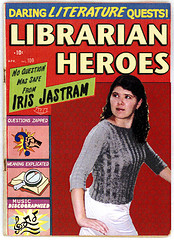
I finally got around to scanning my trading card for this year. We changed up the theme quite a bit, and my coworker surpassed herself in photoshop fu when she designed and executed these cards.

Each librarian has a different banner across the very top (clearly the science librarian wouldn’t want to be involved in Daring Literature Quests), and each has a different set of inset pictures down the left side. Only the question mark picture remains the same in all 8 cards.

One thing I’ve noticed is that these cards seem to appeal to a wider age-range than our previous cards did, which is fun!

1 Comment