Skip to content

Author: Iris

"The Library" and Other Grand Unifications

A few weeks ago, while attending ACRL, I heard a question that nagged at my imagination: “If we define a doctor as ‘one who practices the art of healing,’ what is the analogous one-sentence definition of a librarian?”

Yes, I know that boiling everything down we do into one sentence is a little bit absurd, and that the given definition for a doctor is similarly circumscribed. But to the extent that we use such questions to focus and motivate our thinking, I think they can help us to step out of our own day-to-day existences (full of tasks and politics and committees and budgets and “where is the bathroom”) and gaze out at the broad, breathtaking, and inspiring vista of our profession as a whole.

This is exactly what Kathryn Greenhill, John Blyberg, and Cindi Trainor have done in their Darien Statements on the Library and Librarians.

So what happens when you make “grand, optimistic, obvious, and thankful” statements about The Library-with-a-capital-L? So far, it seems that people take a deep breath, let the statements sink in, feel them, taste them, and then start comparing them to everything we do and have done and hope to do in this profession, trying to see how the statements stack up against reality. This strikes me as a beautiful response. Even most of the responses that contend that “Your Library-with-a-capital-L doesn’t pertain to my library” or that “saying that ‘The purpose of the Library is to preserve the integrity of civilization’ is far too ambiguous” are evidence of this kind of productive, stimulative thinking.

Today I’ve been thinking about the relationship of The Library to individual libraries, asking myself “What is the one-sentence definition of a library?” and wondering if it’s similar to asking “what is poetry?” Is it like porn, where you’ll “know it if you see it?” And what do we learn by theorizing a Platonic Library? In what ways does this focus our thoughts and motivate our futures regardless of our individual circumstances?

T. S. Eliot theorized about the art of great poets in his essay “Tradition and the Individual Talent.” A great piece of criticism in itself, I have always particularly appreciated the way he positions the best poets as those who display their individual talent through grounding in the poetic tradition rather than in opposition to it. He explicitly does not say that the best poetry is “traditional” or copy-cat-ish or anything like that. Quite the opposite. He writes that “tradition is a matter of much wider significance [than “blind adherence” to past forms]. It cannot be inherited, and if you want it you must obtain it by great labour” (Eliot, paragraph 3). In his view, writing from a sense of tradition requires that poets step outside of their own location in time and space, “write not merely with his own generation in his bones” (Eliot, paragraph 3), and become the catalyst that will make the particular and the general spark into art. In the same way, being a librarian in a particular library is rendered meaningful and significant not solely based on our own individual missions and actions. We have the fundamentals of The Library that bolster our efforts and define our innovations.

The beautiful part of Eliot’s essay, though, comes in the 4th paragraph in which he explains the ramifications of having all of poetry tied together by Tradition. “No poet, no artist of any art, has his complete meaning alone,” he writes. Everything written must be valued and appreciated in relationship to everything else that has been written, but this influence is not unidirectional. “The existing order is complete before the new work arrives,” he says, “For order to persist after the supervention of novelty, the whole existing order must be, if ever so slightly, altered” (Eliot, paragraph 4). If we accept the theory of the Platonic Library, the Tradition that allows for poetic creativity, then we are also accepting that as each of us effects change, we fundamentally affect The Library as a whole. This strikes me as a daunting, inspiring, thought provoking, somewhat terrifying, but empowering outcome of theorizing a Platonic Library even for the many individual libraries that may not feel included in the Darien Statements.

This post has gone on over-long and is really just a sketch, just my first attempt to figure out what about the idea of a Library-with-a-capital-L resonates with me so strongly. I hope some of you will speak up and help me figure out what I’m saying, where I’ve gone wrong, and what makes sense to you. I don’t fully understand my own stance at the moment, but like Steve, I know which conversation I want to be having.

7 Comments
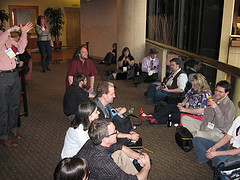
Best Conference Ever… In An Odd Way

I’ve been lying here on the couch for most of the day, too tired to move, or read, or get up to put on a CD. I feel like I’ve been extruded, or beaten about the head, or like I’ve given blood twice in one day. But you know what? It was totally worth it to spend time in DC with so many of my favorite people.


The really interesting thing, for me, was that I left this conference feeling like it had been the most productive conference I’ve ever attended… only I didn’t attend this conference. I just hung out in the lobby (or on the floor when our LobbyCon ran out of chairs and so we invented CarpetCon). And yet, I had all kinds of interesting conversations with other librarians about merging IT and research service points, unconferences, taking what we can from unconference philosophy and applying it to instruction (this Catherine’s idea, which she blogged about here), academic media librarianship, the death of Second Life as a viable experiment, Open Source library catalogs and how many people are seriously considering them now, to what extent it’s a good idea to shift our information to the cloud, benefits and drawbacks of WorldCat Local, … and whatever else came to mind. It was so much fun to sit there among these incredibly smart and talented people for two days and two nights, soaking in their ideas, feeding off their energy, and doing a healthy amount of joking around in the process.

I wish I’d had a little more energy to participate in everything while I was there. A couple of times I hit that “it hurts to be alive” level of tired and had to sit out some really interesting conversations. But other than that, there’s nothing I would have changed about this trip. I loved having the actual conference right there, with all the people going to actual sessions buzzing about the things they’d heard, what they thought had been interesting, and what they thought hadn’t worked out quite so well. It was like having the blogosphere happening in real life right there in front of me.

Oh! And since every conference must have at least one “Wow, it’s a small world” moment, here’s mine from this trip. Jessamyn and Laura Crossett and I stayed up far too late Tuesday night talking in full middle school sleep-over mode. Part way through the conversation, Jessamyn mentioned the town where she lived when she was young, and it turns out that for several years I drove right past her house every single week, at least once, on my way to the church where my dad was the assistant pastor. From there I moved to a suburb of Chicago and lived less than a mile from the Dominican, where Laura Crossett was at the time. So there the three of us were, in that room, and I’d spent years and years so near each of them. Weird.

P.S. The picture above was taken by baldgeekinmd and features me (or, the half of me that didn’t spill off the right hand side of the picture… yep, that’s me in the white sweater and jeans) and a healthy chunk of the lobbycon regulars.

1 Comment

I’m Leaving on a Jet Plane

At the very last minute, I decided to fly out to DC (well, Crystal City, actually, which is the travel equivalent of buying a vinyl rather than a leather couch). The chance to hang out with a whole bunch of incredibly cool librarians, talk about whatever comes to mind, and do so without registering for an actual conference just doesn’t come around all that often for me, so I’m pretty thrilled.

Actually, in my better moments I’m thrilled. I think of seeing some of my best friends in the world, of joking and being serious, of eating out, and of generally doing whatever seems best to do at the time, and these things seem very very good. Then I remember that doing this requires that I do unpleasant things like pack and figure out logistics and in many other small ways step beyond my comfort zone, my routine. These things feel much less good. In my worse moments these things are nearly enough to make me question the whole prospect of the trip.

This is a pretty typical set of emotions before I travel, though, so I’m not surprised. The day before the trip I always wish I’d just decided to stay home. But then I get to the airport, through security, and up to the gate. I sit down to wait for boarding, and suddenly everything seems better. At that point all the preparations over which I have any control are done and all I have to do is go with the flow. At that point, I can blend into an anonymous crowd and watch people or daydream or read or do whatever comes to mind. At that point, the trip finally starts to feel like a good idea.

I’m looking forward to that moment. And this time I’m particularly looking forward to what comes after I reach Crystal City since I’ll get to meet some new people and reunite with some of the people who know me best. And I can’t wait to experience my very first LobbyCon.

So all in all, things are going well. And now I’ll concentrate on the glorious potential of this trip as I go out and run some errands and then pack.

2 Comments

Charitable Writing

A couple of years ago Meredith Farkas wrote a post in which she introduced Josh Neff’s phrase “charitable reading” to the library blogosphere. The phrase is a good one, so it has bubbled up from time to time over the years. Essentially it means “read what people write and assume that those people meant well and that they are not stupid.” Granted, occasionally people don’t mean well, and sometimes they are stupid, but the idea is not to have those as your baseline assumptions.

I’ve been thinking a lot about this in the last several months (two years is an eternity in blog years but not very long in human years, so I’m allowed to still be thinking about this, right?), and I think that this is only half of what makes for productive written discussion. The other half is Charitable Writing: assume that your audience is not stupid, that they mean well, that they are probably trying to do the best they can or think carefully or otherwise conduct themselves well, and that they wouldn’t be reading and interacting with you if they didn’t want to.

Lately I’ve found myself unsubscribing from blogs and twitter feeds that, even though they have potentially useful content, present ideas in ways that sound condescending. Somehow that tone of writing screams “I’m pretty sure I’m smarter than you!” so loudly that it drowns out the calm murmur of the authors’ interesting ideas. This tone forces to me to work far harder at Charitable Reading than feels fair. It eventually wears me out. And so I unsubscribe and trust that others will point me toward the truly important posts.

Charitable Reading is hard. I fail at it frequently. But I think Charitable Writing is even harder because it it requires that authors see beyond the facts that they’re conveying, step into somebody else’s head, and hear from that other person’s perspective the tone that they probably didn’t know they were conveying… and then to do this from multiple potential readers’ perspectives. With so many potential ways of failing at this kind of writing, it’s a good thing that readers will be trying to read charitably!

3 Comments