Skip to content

Author: Iris

Learning to Support Indigenous Studies

Image from https://native-land.ca/

As the librarian for American Studies, I’ve supported a few relatively minor Indigenous Studies projects. Now, though, I’m supporting a class that’s just enough outside of my comfort zone that it’s forcing me to slow down and really think differently about what I’m doing. And I’m realizing that a) my past approaches aren’t going to work with this class, and b) I might have been wrong all along.

Just as a couple of examples, I hadn’t come to grips with the challenges of reconciling the essence of something as simple and work-a-day (for me) as a research guide (with all its implied and overt messages about Proper Research in Academia) with the realities of the harm that colonial epistemologies have done and continue to do. I hadn’t realized or grappled with the importance of foregrounding indigenous voices or ways of knowing, or of not relying on academic sources to legitimize observations and analysis (which is such a reflexive move in Western academia). I hadn’t ever coached students to recognize authority clues in contexts and constructions so far outside of my own background and training.

Of course, I haven’t solved these issues, and I’m sure I haven’t even recognized a whole world of similar issues. And on the one hand, one of my primary roles in the lives of these undergraduates is and should be to mentor them through academic ways of knowing. But on the other hand, I’m hoping to learn ways of doing this that don’t also do harm — ways that promote ethical, respectful, thoughtful approaches to research in general and to cultural research in particular.

As I start grappling with these questions, I’m reading. So far I highly recommend:

There’s so much to say about these readings, but here’s a quote that helped me come to terms with the uncertainties I was feeling.

“Because these culturally based hierarchies of access to certain domains of cultural knowledge are often determined by an individual’s gender, age, ancestry, clan, and status, they are directly in tension with some of the underlying principles of librarianship that place a high value on free and equitable access to information.”

Becvar and Srinivasan, page 422

The simple act of naming these tensions helped me sit more comfortably with the new-to-me epistemologies and their implications for my work, and it helped me begin the process of first recognizing and then integrating unfamiliar epistemologies. (From here, moving on to Christen’s article was quite lovely.)

And one last quote that stuck with me:

Can the imagination and technological prowess that promoted open access publishing, open source software, and Creative Commons licenses exist side-by-side with those alternative systems of knowledge production that rely instead on social relations maintained and forged through negotiated interdependencies, which have as their goal the mutual gain between stakeholders in social, economic, and cultural terms?

Christen, page 2880

Christen thinks this is possible, with work. I’m on board for the work.

Comments closed

Libraries Are About Connections

Image by geralt

People tend to see libraries as houses for collections. Sometimes they also see that we’re full of other things, too. People often see librarians as people who know how to navigate the various systems associated with the library. Sometimes they also see that we navigate other things, too.

I see librarians as people primarily attuned to the gossamer threads that connect people, connect information, connect artifacts. What makes those connections vibrant? What kills them? We cultivate our awareness of various kinds of connections, and we study how to pull on the right threads at the right time to foster new connections. We see that these connections mean more than the information bits themselves.

Discrete bits of information are worthless, but they come alive when connected to other information and to a person’s curiosity or need. I don’t want to say that a person without information or social connection is worthless, but I’m also not sure what that existence would actually look like. I can’t imagine it, so I can’t say anything useful about it.

I’ve been thinking a lot about these gossamer threads — where I see them, what they mean — and the more I think about it the more I see the care and feeding of these connections as the foundation of all that we do in libraries. Sure, I connect patrons with books, articles, and artifacts of various kinds, but I also encourage them to see the connections between that work and other works, that author and other authors, that system and other systems. And when I read an article, it turns out that I read it primarily for the ways in which it maps out its connections for me: which words are in the “dialect” of this community of practice? which mechanisms help us name and follow established connections (keywords, subjects, bibliographies, etc)? which works/creators (credited or assumed) form the work’s foundations? which works carried on the conversation afterwards, does this creator know these other creators personally? do they go out for drinks together? do they subtweet about each other? which connections build up the authority of this thing? which connections are ossified into fact or convention and which vibrate with potential for new exploration or embodiment?

And what happens when you put this undulating set of connections next to another set of connections? What gets remapped? What blossoms? What fades?

As a librarian, I know a lot about our search systems, our collections, collections available elsewhere, information flow in an academic context, my community…. But what I really see and tend and navigate all day every day are these gossamer threads. The connections that give everything meaning.

Comments closed

Citation Style Alignment

Good friend and Professor Extraordinaire Adriana Estill shared this alignment chart with me this morning. Happy Friday!

(Not sure what this is? Here’s more about alignment charts. I think this must be the original, by Jonathon Owen.)


Edited to Add: If you’ve ever supported legal citation, you’ll know why Friend of the Blog, Pete Smith of Sheffield Hallan University, suggested this addition, which I have added to the alignment chart:

2 Comments

Information Has Value – Computer Science edition

After yesterday’s post I had a fascinating discussion with someone who codes for a living about whether patents were a viable research resource in CS. First off, they’re extremely hard to understand. And yes, I definitely agree, and it’s a good reminder that when I talk about this with students I also talk explicitly about what I expect they’ll be able to learn from the exercise.

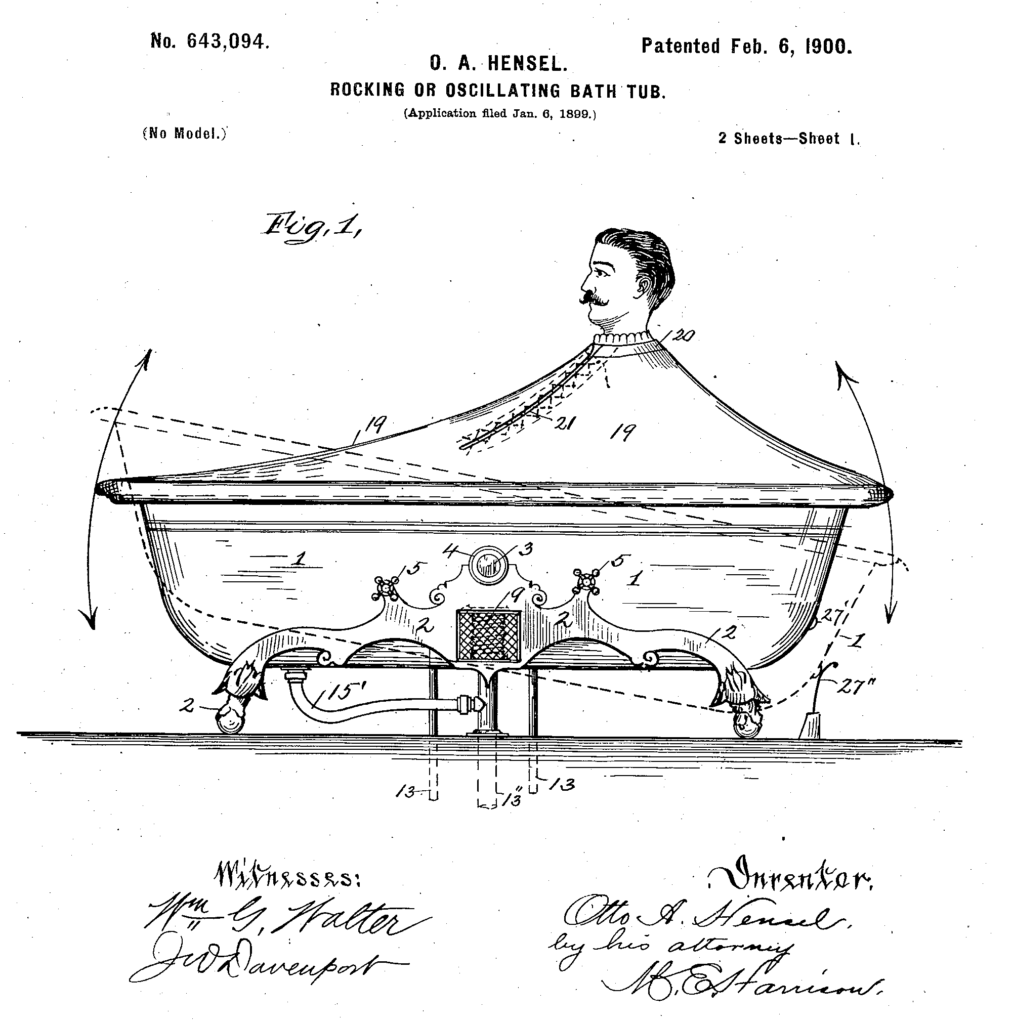
Hensel, Otto A. 1900. Rocking or oscillating bath-tub. United States US643094A, filed January 6, 1899, and issued February 6, 1900.
  1. If you find a patent that you think is related to your topic, look at other similarly classified patents to see what problems people are tackling in the field and who is tackling them.
  2. As you look through similarly classified patents, collect vocabulary that you can use in future searches. After all, most search systems simply match letters in a row rather than semantics, so if people are talking about the same thing but using different words to do so, you won’t find that whole side of the conversation.

While reading in order to understand the patented process is probably not feasible for most people, reading instrumentally has been super useful for me when exploring CS topics.

So far so good, but what really set me thinking was this industry coder’s take on the disadvantages of reading patents. Apparently he’s told not to read patents because knowingly infringing on someone else’s IP brings worse penalties than unknowingly infringing. In order to mitigate penalties, they don’t look at patents. So now I’m wondering how to guide students as they prepare for a world in which, at least some of the time, lack of information has value. And how do I square that with the idea of the very real costs involved in having a bunch of people reinventing wheels and falling into the same pitfalls, all so that if they get sued it won’t be quite so bad? And how do I square that with how this upends the progress narrative of the sciences in general, a set of disciplines which so carefully finds gaps in knowledge and then fills them, or finds the limits of current knowledge and then pushes those limits back bit by bit?

I wonder if it matters what sector you’re in, or even what specific companies you’re working for. And I wonder how liberal arts students might engage with this conundrum in a way that prepares them for life after graduation, whether that life involves CS careers or not.

Comments closed