Skip to content

Month: April 2007

WHY?


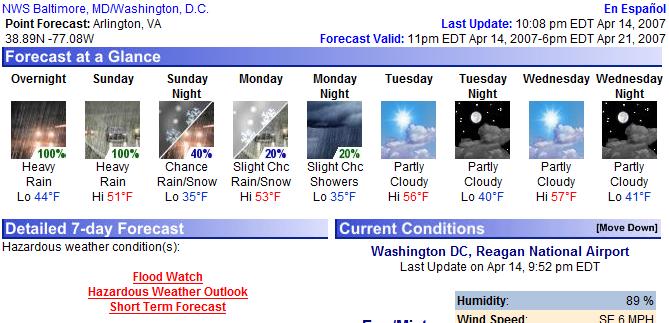
The weather is conspiring against me. Here’s what the forecast looks like for the next few days in Arlington, VA (yep, that’s CIL territory). Sorry that I can’t get Blogger to make the picture clearer. Click on it and you’ll be able to read the tale of woe.

I sure hope my flight works out tomorrow… They’re in for a regular ol’ nor’easter.

Technorati technorati tags:

Comments closed

Google Really Does Know Everything

In the midst of rather frantically pulling together a class Thursday night, one of our community regulars (i.e. not affiliated with the college, but here all the time anyway) popped in and asked if I had a minute. I didn’t. Not really. Not only is this guy has very involved question and often works with us for hours at a time, but he’d decided to come to my office rather than talk to the librarian who was actually at the reference desk.

So it was with a great effort of mind and will that I put on a smile and said, “Sure, but only a minute because I’m running off in just a bit. What can I do for you?”

Meanwhile I was thinking, “Don’t sit down, please don’t sit down. The last time you sat down you didn’t get up for over an hour, you questioned why I would look for an educational theory in an educational database when you didn’t want to apply it to an educational setting, and you used the now-famous phrase ‘I’m talking but you’re not listening.’ Please don’t sit down.”

And he didn’t sit down. He just handed over a yellowing clump of papers, clearly ripped from a journal many moons ago. He explained that he’s had this article for a long time, that it’s missing some pages, and that he doesn’t have any citation information so he can’t find a copy of it. Not only that, but the title of the article was pretty generic, so guessing at a discipline or database would have been kind of tricky unless I’d read part of the article.

Switching into non-teaching, hand-him-a-fish rather than teach-him-to-fish mode, I typed the entire title into google (in quotes of course), and the second result was a JSTOR link. Since I was on campus, the link worked beautifully. Less than 5 seconds after receiving the original article into my hands, I was dashing off to the printer to retrieve the full article. Thank you Google! Thank you JSTOR!!!

I felt like an info goddess. He was mightily impressed. And he left without sitting down. So we were all happy. The only problem being that now he’ll probably always come back to me, and I’m not at all conversant with the areas he studies.

Comments closed

I’m Fine, Thanks

Ok, my last post was quite a downer, written in the heat of frustration. I stand my assertion that we need clearer terminology and selection processes, but like many other frustrations, this will not rule my life.

No, and my scary class tomorrow won’t rule my life either because, get this, it’s now two classes! Now I’ll do the part on finding foreign language and English language articles and books (including ILL and finding full text) tomorrow (in 45 minutes). Then next Friday I’ll teach proper citation (in-text, annotated, and regular bibliographies) for 20 minutes. This is instead of doing everything in 40 minutes! I’m SO pleased.

So for tonight I’ll sit back and figure out how to squeezing tomorrow’s class into 45 minutes. I think this will involve a handout that lays out how to get to the foreign language holdings in 4 databases and two catalogs (ours and WorldCat). It will also include an online guide. But beyond that, we’ll see.

(See, I told you I’d have things prioritized by tonight.)

5 Comments

Databases, eCollections, eResources, What?

So, I may not be writing much for the next couple of days. I was fine and generally on top of stuff here at work until this morning. Now, all of a sudden, I have back to back appointments all day and most of tomorrow morning, plus I suddenly have a new class for a new (never-taught-for-before) professor in a new (never-taught-for-before) department to teach tomorrow at noon. Oh, AND, we’re supposed to suggest purchases for the general collection sometime in the next few weeks (we normally only buy for the reference collection), and we’re in the midst of a high-velocity push to identify and trial databases.

Now, this isn’t a pity-me post. I’ll be fine. One way or another, by the end of today I’ll have prioritized my life again and gotten things moving smoothly along in my head. But what all of this highlights for me is that collecting electronic resources is hard. Very hard. I don’t know so much about the process that I can’t even ask for help, and when I do ask for help I know so little about what I’m asking for that it comes out all wrong and I keep being told the stuff that I already know rather than the stuff I don’t understand. Then I feel stupid, my helper and I have both run out of time, and I’m still no better off than I was to begin with.

I also don’t think that there’s clarity in our profession about e-collections and “databases.” The terminology speaks to our general fogginess on these notions. “Database” isn’t descriptive at all. Even our content management system is database-driven, but we’d NEVER call that a database. So if my department is supposed to recommend databases, and these come out of an eResources budget, who’s looking at the online newspaper collections, and should those be paid from the same budget?

So far, it seems like everyone thinks somebody else is looking at e-collections of journals and newspapers. People in my department haven’t really had them on our radar because we think of them as serials (and we collect for reference), and people in other departments think that we’re looking at them because they’re just like (and often bundled with) these “database” things (which my department does play a role in evaluating and recommending for purchase). And so far, when my department is asked to approve or deny renewal for things like MLA International Bibliography and Sociological Abstracts, other things like Nature online or Science online also crop up in the lists of “Databases” that are up for renewal. These are not the same thing. At all.

And were does something like JSTOR fit in? There are more and more collections that offer the option to buy the content outright, and then pay yearly access fees. Where do these fit? How do we decide if they’re “Databases” or not?

Basically, I’m confused by the whole process of evaluating and choosing databases, and this confusion is only amplified by my confusion over what exactly I’m evaluating in the first place. Add to this that I only do this very rarely (like, maybe once a year), and you get a confused librarian who feels stupid because she has to relearn the process every year because a couple thousand reference questions, a couple hundred student appointments, and a few dozen classes have pushed all of what she learned last year clear out of her scull.

But now I’ve got to stop letting my brain run in circles around these unanswerable questions and get down to the business of building a drop-dead gorgeous class from scratch while I also meet with a few students (one of whom wants to find out about getting an MLS after graduating from here).
4 Comments