Skip to content

Month: March 2007

"Extra" Metadata: Two Roads in that Yellow Wood

And while I’m in a musing mood… I think there are two directions you can go when faced with metadata (be it AACR2, Dublin Core, or what have you) that’s populated with a whole bunch of information.

You could say, “Hey, we’re putting more information into this record than our patrons use, so let’s not work so hard.” (Better study your patrons good and hard, though, before assuming you know this for a fact.)

Or you could say, “Hey, we’ve got all this stuff. What could we do with it that we aren’t doing yet?” (But be aware that this could range from the simple to the we’d-need-to-hire-programmers complex.)

The path you choose will depend on your circumstances, your patrons, and your ability to dream up ways to exploit metadata. But the path you choose will make all the difference.

Comments closed

Print vs Electronic Workflows

I’ve been kind of immersed in workflows recently. Our workflow consultants delivered their much-anticipated, much-talked-about, and much-feared reports yesterday. And today I’m musing about a few of their recommendations. Some I don’t think will fly at our library, or at least not to the extent they propose, but that’s a topic for another day or another lifetime. Tonight I’m mostly interested in the question of the relative workload of a print collection vs. an electronic collection. (Notice, I’m not talking access, relative value, or any of that. Just workflow and time commitment.)

I’m all for e-access. I love love love e-access to journals. Nothing makes me happier than to click our link resolver button and find that I don’t have to walk the 100 feet or so to our print journal collection. And I’m cautiously in favor or transitioning to e-access where ever that is warranted.

But… when I hear that we should consider reducing our print periodical holdings at every opportunity, I worry a little bit that only one part of our workflow would see a benefit while other areas might see increased time commitment. Granted, print periodicals take up a lot of space, a lot of packing and unpacking, a lot of binding, and countless other processes. But what might the process be in an e-only or e-mostly environment?

  • Acquisition decisions will take more time because suddenly we’ll be deciding on costly bundles of journals rather than single journals. We’ll have to think even more carefully about the benefit of groups of journals because we may not want every journal in the collection, and it’s a hefty chunk of change.
  • How much time will it take for ILL and eReserves staff to wade through license agreements to see what they can lend or copy from an e-collection rather than relying on more standardized (though not necessarily easier) copyright law? (I’ve talked about the other possible effects of e-resources on ILL before.)
  • Keeping up with links and holdings and access issues and changes in subscriptions won’t go away any time soon.
  • And there may be other unforeseen processes that we don’t know about because we’re still learning what an e-mostly world would feel like at our library.

I don’t know if these increased time commitments would or wouldn’t be worth the savings in the periodicals department of technical services, but these and other repercussions should be taken into account if efficiency is the name of the game.

And I haven’t mentioned archiving. It goes without saying that this is an important issue that has to be considered every time we cancel print subscriptions. But everyone knows that, and it’s not up for debate at the moment.

5 Comments

Rest in Peace, but Not Yet…please

Yesterday my laptop started making the sound of a somewhat rattly jet engine just before take-off. I’ve heard this sound before when my dad’s computer died, and after it started that computer only had a few hours left to live before it started melting crucial components. So I immediately turned everything off so that I could save those few unmelty hours for file transfer later. But at this point I’ve heard all but the death rattle. That computer is dead. It just doesn’t know it yet.

So this morning I ordered a new computer. Looks like I’ll be getting a Vista upgrade way sooner than I’d planned… No time for letting Microsoft work out the kinks. No time for hearing about track records. No time to learn from people who’ve gone that route. On the plus side, I just had to upgrade to 2 gigs of RAM in order to kick into a really good discount and save myself about a hundred bucks. Suweet! And what I’ll do with the 120 gigs of hard disk space, I don’t know (though I’m guessing that about 100 of that will be taken up just with Vista…). Maybe now I’ll even be able to get onto Second Life and see what all the fuss is about.

Now I just hope that I can keep old blue going long enough to cough up all my files before I consign it to the recycling kit that’s coming with my new laptop.

4 Comments

Gimme Gimme Gimme

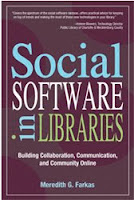
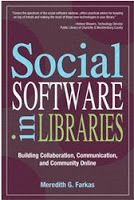
Yeah. Big ol’ “Me Too!” on this one. Cuz why? Cuz Meredith rocks, that’s why. Oh, and the book looks good, too.

There’s a section in the first chapter (a much better teaser than most introductions, btw) that I think asks the essential question: Why should librarians care about social software? Answer it for you and your library, adopt Meredith’s answers, or do whatever else it takes, but don’t leave this question on the back burner.

My answers? Well, they map very closely onto Meredith’s, and they’re constantly evolving, but here’s a sketch of their current state. I have not found that my students are very familiar with many of the social software we talk about all the time. I’ve had students ask me why I’d want to IM, diss Facebook and MySpace, give me blank stares when I mention social bookmarks, wonder what Flickr is and point out that I’ve left of the “e.” And don’t even get me started on RSS. But that doesn’t mean that social software isn’t important to me in my library with my user community.

No, social software is still important for many reasons, but foremost in my environment is that it’s a way for me to provide value-added, nimble, real-time, personalized access to online resources and research support, learn from and collaborate with colleagues near and far, and improve my own workflow and my students’ workflows. Six months from now, these reasons will have evolved again, I’m sure. But through it all Meredith’s last paragraph says it all. These things are, above all, tools. They’re tools that help libraries stop being faceless institutions and start being teams of people helping people.
Comments closed