Looking back over the last two weeks, I can’t believe I’ve only posted twice! That’s got to be some kind of record for me. But I had car issues, and then vacation (which was WONDERFUL and long), and then I spent all day yesterday trying to catch up from being away. I didn’t succeed, of course, but I made a healthy dent.
Anyway, I’ve become curious about link resolvers and how academic institutions set theirs up. We use SFX, and so far I’m absolutely thrilled with it. I think of it in terms of eras: I graduated from library school in 1B.SFX (one year Before SFX), and it is now the year 2A.SFX (two After SFX). My library implemented it the first term that I was working here, so I never had to teach the tedious methods of hunting through databases, using Ulrich’s, interlibrary loaning, having the loan request rejected because we have the article (somewhere), looking again, searching Google, and then resorting to cursing and pulling out hair when trying to find the full text of an article. Instead, all I had to teach was “click on this handy little button and it will search all our databases for you.” Who wouldn’t be thrilled?
But there were all sorts of decisions that went into setting up our instance of SFX, decisions I wasn’t a part of, but that I need to think about now as we go through the endless cycle of evaluating our service, tweaking it, and evaluating it again. At issue right now is the question of whether or not we made the correct decision when we chose to have an SFX menu pop up every time a user clicks on the Find It button, or whether we should switch to having it deliver full text (if available) from a preferred database.
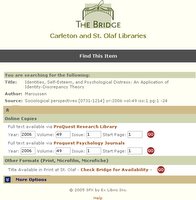
 For those of you who don’t have SFX, or who have it configured differently, here’s what I mean. Let’s say I search and find a citation for an article from the journal Sociological Perspectives. Click “Find It” and I’ll discover that we have two subscriptions from two different databases, and St. Olaf also has the print. Click on either of the database options and I’ll get the full text; click on the print option and you’ll be taken to the catalog record for location and holdings information.
This system has three distinct advantages. First, it helps students figure out which databases they should be searching other than the database they’re currently searching. I teach my students to keep notes on databases that come up often when they’re looking for full text because those databases obviously have a collection of journals on your topic. This technique is especially useful for upper class students when they’re beginning to do research for their comprehensive projects. But it can also work the other way. I’ve mentioned before that unlike my co-workers, I mainly teach freshmen. And consequently, I also teach the less specific databases more often than my co-workers do (my co-workers rarely have to deal with students who just have to write “a research paper” on any topic). So I tell my students to watch the Find It menu to see if there’s a more specific database on their topic.
Another reason for providing choice, beyond simply my love of letting people choose what works best for them, is that over time students develop familiarity with the databases they use most often, so they may prefer to click on a link to their favorite CSA database, Ebsco database, or ProQuest database when it appears in the list of choices. I know I default to certain databases over others because I know that I can manipulate some vendors’ databases more easily than others.
And finally, some poor, young students dealing with requirements for “print” sources handed down from professors who haven’t explained that you can get “print” sources online from these databases, would really just prefer to click on that “available in print” link and go photocopy the article for themselves.
On the other hand… there’s value in immediate delivery whenever possible. I’m torn. Is delivery more important than education and discovery? Possibly. But I’d hate to give up the information I’m given when I’m presented with choices.
Carleton and St. Olaf will be deliberating on this issue soon, and I’m comforted that we can’t make a “bad” decision. I just wish I knew which was the better decision.
 tags: libraries, link resolvers, open URL