Skip to content

Month: April 2006

MARC in the new millennium

In his essay “The Inevitable Gen X Coup,” Brian Mathews says that “MARC is dead.” I don’t think so. I think MARC is under-exploited. Add a touch of FRBR and some interconnection with user metadata, holdings information, and the like, and MARC is still a hugely viable and valuable source of information. It’s not MARC that’s dead, it’s the container we’re using to manipulate and display that bibliographic information. Well, I guess OPACs are “not dead yet” (as my favorite British comedians would say), but they’re moving in that direction.

(Cool! I just discovered FRBR has its very own blog!)

Comments closed

The Lego Age

I was at Paul Miller’s session at CIL where he made the now-famous analogy between new web services and legos. Specifically, he was talking about the ways in which new web applications are made with whole sets of loosely associated and interchangeable bits. (Think Firefox and its extensions.) This theme was applied specifically to ILS vendors in a recent discussion of the Library 2.0 Gang (Thomas Brevik, Michael Casy, Dave Errington, Paul Miller, Michael Stephens, and Richard Wallace). Wouldn’t it be cool if there were a base ILS model onto which you could pile as many or as few “extensions” as you wanted?

Say you wanted RSS functionality, or AJAX pre-searching, or a mashup that would show users the exact locations of their books in the stacks. All you’d have to do is download those extensions. (And by the way, there are catalogs out there that have done each of these things.)

So maybe when we’re talking with vendors we shouldn’t be asking “what features does your ILS have?” Maybe we should be asking who’s developing the plug-ins or add-ons or extensions, where the user forum for suggestions and questions is, and which of the developers have blogs.

(This Library 2.0 Gang also expressed quite a bit of interest in the upcoming Internet Librarian conferences, both the one in California and the one in London. They’re also interested in developing “Conference 2.0” and in the book Ambient Findability.)

Comments closed

Course Management Systems — decisions, decisions

My school is currently evaluating two course management systems, Moodle and Sakai. I haven’t worked here very long, only about 9 months, which is apparently about 2 years less than the amount of time they’ve spent thinking about these course management systems. Last term, we finally did a side-by-side comparison of the two systems by having a handful of faculty use each (the faculty got to choose which to use) and then surveying those faculty and their students.

Today, the IT staff, members of the web development team, and librarians met to discuss the survey results, decide what other studies need to be done, and plan for a presentation to the faculty at the end of the term which will announce the winner of this little contest and explain the rational for our choice. What we decided was that we have a lot more studying to do. It turns out we’re comparing a course management system with an “interoperability platform” which can also be used as a course management system. And therein lies the rub. Do we want a system that is a pretty slick (though not perfect) CMS, or do we want to back a system that has potential to be something that it isn’t yet: a comprehensive collaboration and communication system.

As usual, nuts-and-bolts decisions force us to struggle with our goals, priorities, philosophies, and hopes. Philosophy and practicality are proved, yet again, to be inseparable.
Comments closed

EverNote


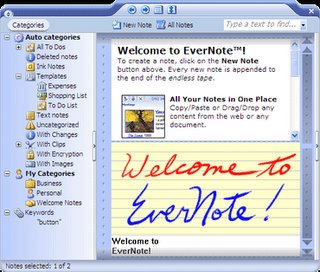
EverNote is cool. I downloaded it in January thinking it might be cool or useful, but pretty sure it was more my inner geek taking over than anything else that prompted me to try it out. Well, I was wrong.

Remember when you got your very first microwave (my family was a very late adopter, so I really do remember my family’s first microwave)? Remember how you thought it might be useful on rare occasions? Remember how within a matter of days you couldn’t even remember life without one? Well, that’s what this has been for me. I now have it open on my computer at all times. I plan all my classes on it. I write my follow-up notes on what went well and what went poorly in my classes on it. I keep track of what I’ve tried and what I’ve found when working on really hard reference questions. And (as many CIL-ers know) I take copious notes at conferences and meetings into it. (People think I’m being “cool” or “hip,” but the reality is that I just can’t remember things I hear at meetings, so I have to take notes.)

I love EverNote. It lets me assign multiple categories to notes (which is much better than putting notes into folders), and I get to make up my own categories. It also lets me keyword search all my notes. It also comes with a “web clipper” that you can click and it’ll import selected parts or all of the web page you’re viewing at the moment into a new note. There are, however, a few things it doesn’t do that it absolutely should do.

  • It doesn’t work on a Mac, so I can’t use it at our reference desk.
  • It isn’t web based, so I can’t access it from all of the many computers I use all day.
  • It doesn’t sync, so you actually have to export from, say, your desktop computer to a flash disk and import into the database living on your laptop. To move back, you have to do all this in reverse. This requires that you remember to update your database on whichever computer you’re using at the moment before taking new notes so that you guard against overwriting old notes that you’ve edited.

But these lacks will (hopefully) be remedied in future upgrades. There’s a highly active user forum, and the developers spend a lot of time participating in the forum. Oh, and did I mention that it’s FREE.

Comments closed