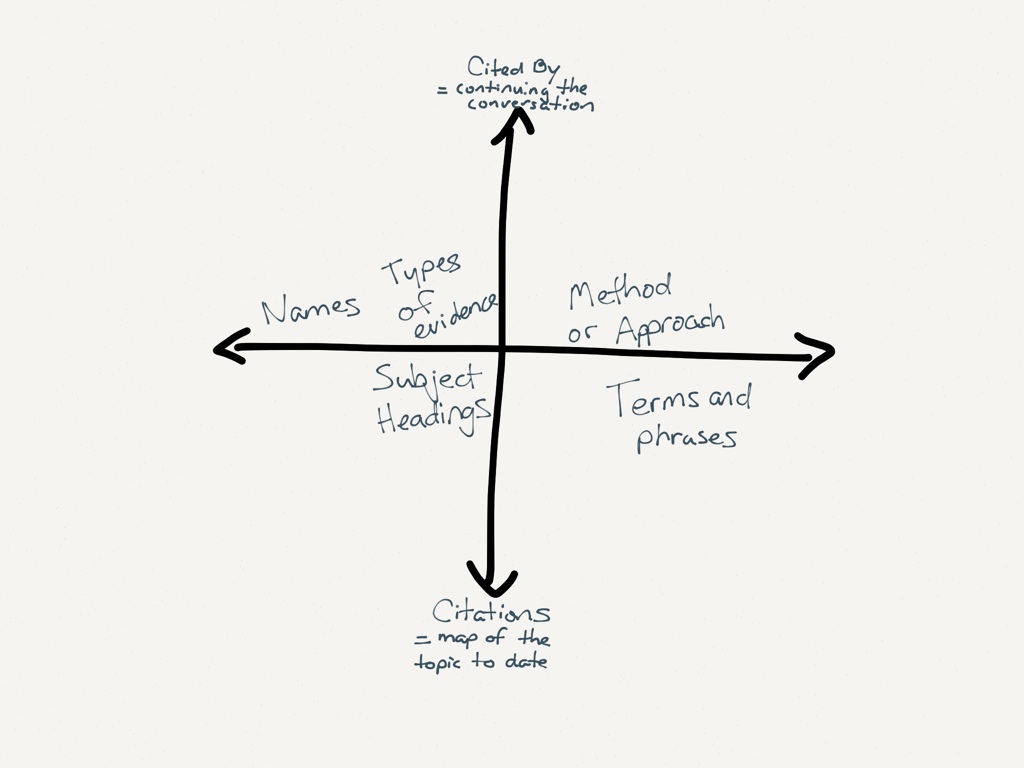
I don’t know why I hadn’t thought of it in these terms, before, but this morning just before a lightning-speed class I suddenly realized that if you have a good article in hand, you can look in four “directions” for more articles like it. (I use “article” because that’s what I was working with this morning, but it works for anything with citations, I guess.)
You can move backward by mining it’s bibliography. You can move forward by using Web of Knowledge to do a cited reference search. And you can move side to side (sort of) by reading it with an eye both for content and for vocabulary that you can use when constructing future searches.
Brilliant, Iris! This is one of those things that I think scholars know how to do, but which we have no idea whatsoever how to articulate. Oh, also, I’m signing with my new blog, which I’ve had no time to update recently. C’est la vie and all that.
And into my aggregator goes your blog… swoosh. :-)
Yes, it was kind of weird to finally come up with names for things I’d been doing every day of my life for years. I’m not sure it’s the perfect way to explain things, but it sure beats not explaining it at all and just expecting students to remember several unrelated strategies. I worry that they’ll think we just try all those strategies as a kind of shot in the dark. There is method to the madness!
Great term! It’s memorable and explains the concepts. I’m using it with my students.
I was just using the “forwards-backwards” terminology with a class of students this morning, and they seemed to grasp on pretty well to it. I hadn’t thought of the “sideways” approach though! (Oh and by the way, I used a version of your “subversive handout” with a class a few days ago. They liked that I could help them with “Advanced Google-fu” as I put it… )
Oooh! I like “Advanced Google-fu.” I’ll be stealing that one… :)
I love this model! I’m trying to think how the forward and backward directions might work for articles that don’t have bibliographies and/or that aren’t indexed in Web of Knowledge. Say you’ve got a New York Times article; maybe you could use search for the article title in Google Scholar to see who’s cited it. In lieu of moving backward by mining a bibliography, one could look in that Times article for any expert or book/article/report mentioned in the text.
Yes, I think that’s a great way of expanding this beyond the typical academic article. It’s often also surprisingly difficult to follow up on the studies mentioned in newspaper pieces, so if you go that route you’ll probably hear students expressing their deep desire for full citations for the first time in their lives. :-)
“Professor Francoeur, where’s the DOI in this Times article?”